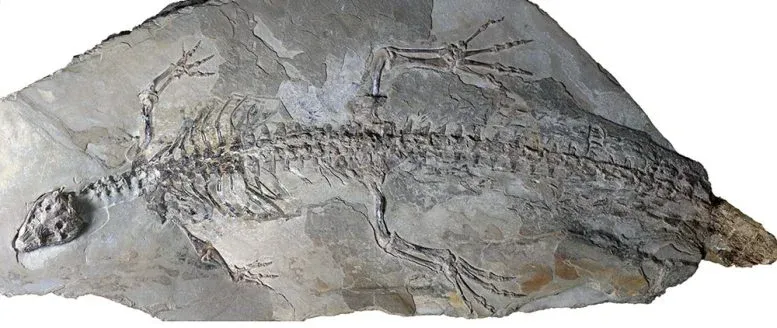
A 125-million-year-old crocodile fossil is revealing new secrets. Researchers used ultraviolet (UV) light to study Montsecosuchus depereti. This technique showed incredibly detailed skin, sensory structures, and chest cartilage.
The tiny crocodylomorph fossil was found in northeastern Spain over a century ago. Now, it offers a rare look at how this ancient animal lived.
The new study appeared in the Zoological Journal of the Linnean Society. It gives the first detailed description of the fossil's soft tissues. The specimen was found at the Pedrera de Meià site in Catalonia. It helps us understand how early crocodylomorphs looked and how features of modern crocodiles evolved.
We're a new kind of news feed.
Regular news is designed to drain you. We're a non-profit built to restore you. Every story we publish is scored for impact, progress, and hope.
Start Your News DetoxAbout 125 million years ago, this small crocodile died in a lake. Its body settled into fine sediments. These sediments later formed the limestone deposits of Pedrera de Meià. These special conditions allowed the fossil to preserve more than just bones.
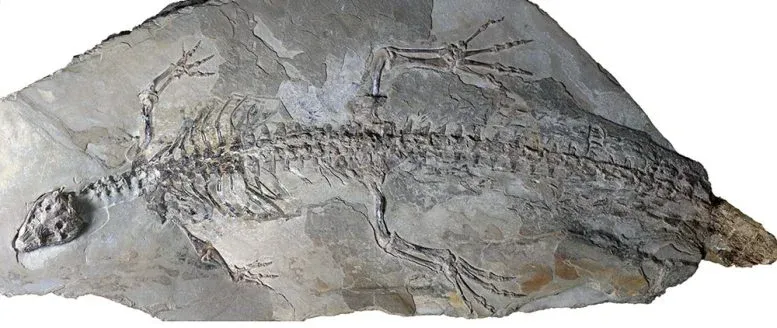
The fossil, called MGB-512, is about 20 inches long. It is kept at the Museum of Natural Sciences of Barcelona. Even though it was found over 100 years ago, new details about its soft tissues are just now being discovered.
UV Light Reveals Hidden Details
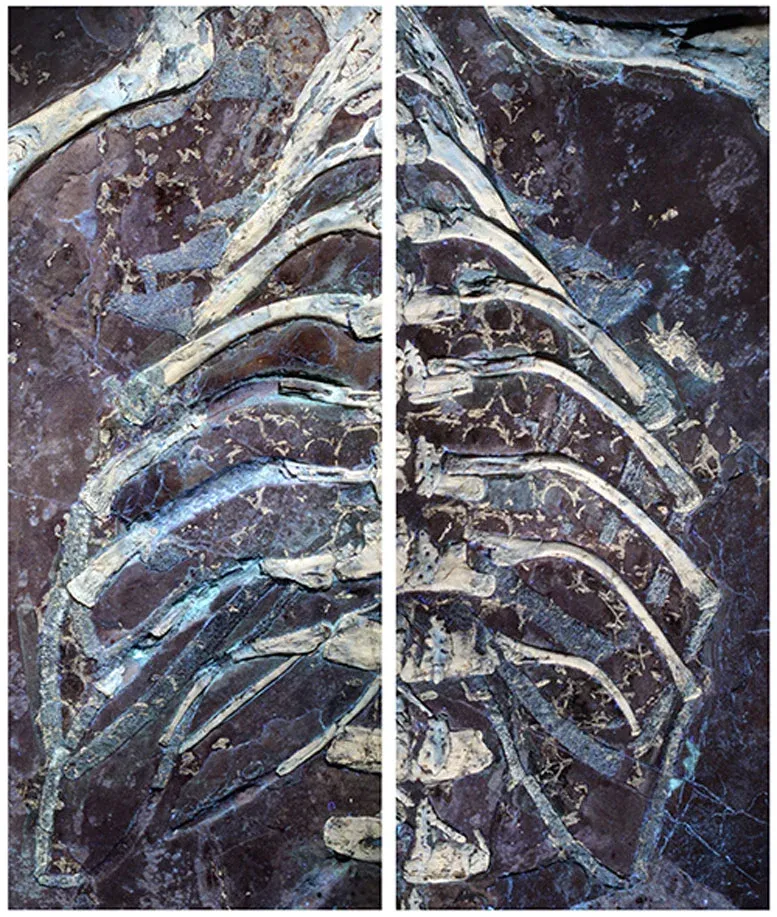
Paleontologists Oscar Castillo and Jesús Serrano were building a fossil database. They noticed strange structures on the Montsecosuchus depereti fossil under UV light. UV light makes fossilized soft tissues glow differently than the surrounding rock. This reveals features invisible in normal light.
Oscar Castillo-Visa, the study's lead author, explained that UV light shows details completely hidden otherwise.
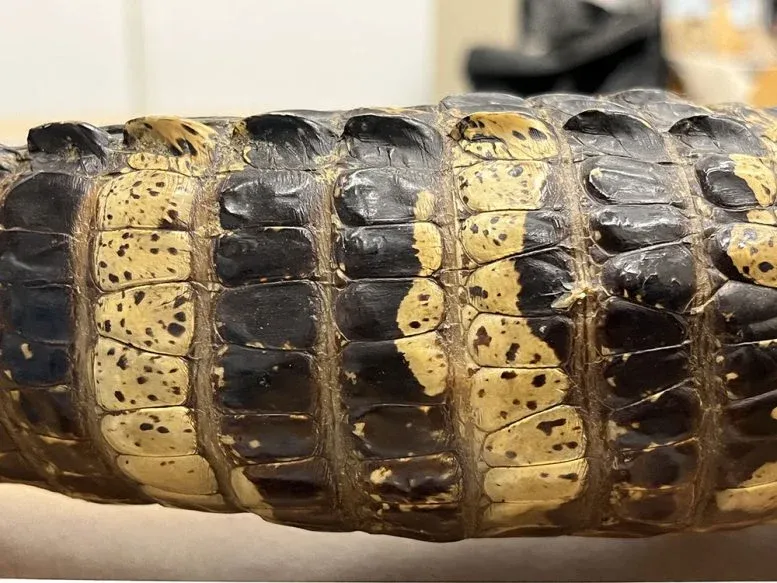
The team found several types of soft tissue, including preserved skin scales. This is the first detailed description of its skin. The scales varied in size and shape across the body. The animal also lacked the tall tail fin seen in modern crocodiles.
Researchers also found signs of sensory organs in some scales. These were mainly around the neck, limbs, and sides of the body and tail. In living crocodiles, these organs detect touch, water pressure changes, temperature, and chemical signals. Their limited presence in Montsecosuchus suggests these sensory structures first appeared in specific areas. Then, they spread across the whole body in later crocodile ancestors.
Ancient Crocodile Skin and Breathing
UV imaging also showed cartilage in the chest. This means Montsecosuchus had a well-developed breathing system, similar to modern crocodiles. This discovery suggests some early crocodylomorphs already had complex chest anatomy early in their evolution.
Castillo-Visa noted that these features show the animal was well-adapted to a semi-aquatic life, even though it was primitive.
One surprising discovery was evidence of tail coloration. UV light showed alternating light and dark bands on the tail scales. Researchers believe this was the animal's original color pattern. These markings might have helped with camouflage by breaking up the animal's shape. If confirmed, Montsecosuchus would be the oldest known crocodylomorph with preserved coloration.
Albert G. Sellés, a co-author, said they can't be sure of the exact tail color. However, it likely wasn't very different from current species, which also have different color patterns.
Oldest Preserved Crocodylomorph Coloration
These findings give new insights into the early evolution of crocodile skin, breathing, and external features. They also show how important the Catalan fossil record is for understanding how vertebrates evolved.
Pedrera de Meià is a Konservat-Lagerstätte. This is a rare type of fossil site where soft tissues, not just bones, are incredibly well-preserved. Over 8,000 fossil specimens have been found there. This site is crucial for studying Early Cretaceous fish, amphibians, reptiles, and plants.
Visitors can see many of these fossils at the Montsec de Meià Interpretation Center in Vilanova de Meià. More than 100 exceptionally preserved specimens are on display. The Orígens Geopark also has a website with many of the site's important fossils.
The fossils include spiders, flies, wasps, beetles, insect larvae, crustaceans, fish, amphibians, and plants. One plant, Montsechia, is known as the world's earliest flowering plant. The interpretation center is part of the "Dinosaurs of the Pyrenees" project. This project connects museums and visitor centers that show the rich fossil history of the Catalan Pyrenees.
Deep Dive & References
Soft tissue preservation in the Barremian Montsecosuchus depereti (Neosuchia: Atoposauridae) - Zoological Journal of the Linnean Society, 2026