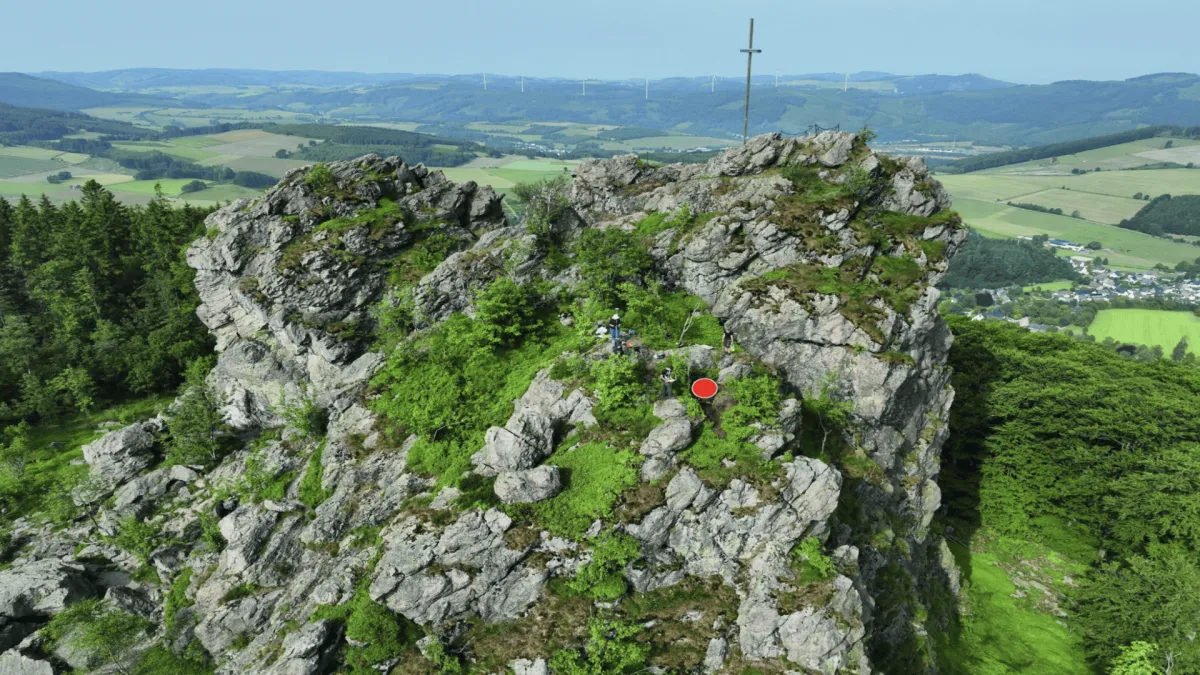
A rocky hilltop in Germany's Sauerland region has drawn people for nearly 2,000 years—but not for the reasons archaeologists assumed. Bruchhauser Steine, a dramatic fortified settlement perched above the forests, was long thought to be a practical defensive position. Its exposed location, punishing weather, and distance from major trade routes made little sense as a home. New evidence suggests something stranger and more compelling: it was a sacred destination where Iron Age communities traveled to perform elaborate rituals.
The breakthrough came in 2025 when local historian Matthias Dickhaus spotted two iron axes positioned at right angles on the rock surface. Excavation revealed socketed axes buried beneath, but the real discovery lay deeper—a quartz pit deliberately carved into the stone and sealed with soil. Inside, archaeologists found quartz fragments, a flat stone slab, and a Pochstein, a rounded stone tool used to crush materials. The arrangement painted a picture of intentional ceremony, not accidental settlement debris.
What makes this ritual sequence remarkable is the choice of material. Quartz could have been mined easily at the base of the rock, yet Iron Age people deliberately sourced it from the elevated summit. In Iron Age belief systems, quartz held spiritual weight—it appeared in ceremonial pottery and was linked to the "Otherworld," the Celtic realm of gods and spirits. Dr. Manuel Zeiler from LWL Archaeology describes what likely happened: "People mined quartz, crushed it, and finally, the 'wound in the mountain' had to be sealed again. The laying of two axes on the ground solemnly concluded the ritual."
We're a new kind of news feed.
Regular news is designed to drain you. We're a non-profit built to restore you. Every story we publish is scored for impact, progress, and hope.
Start Your News DetoxThis wasn't a one-off ceremony. Earlier discoveries—an arm ring and a deliberately damaged spearhead found in 2013—suggested the site had long held religious significance. The pattern emerging is of a place that drew people from across a region, a gathering point where the everyday world met the sacred. Iron Age communities didn't build settlements in unfavorable locations for no reason. They built them because the location itself mattered.
The Brücke-Hausen Steine Foundation is now sharing these findings through a new museum display, integrating the archaeological story with the site's geology and natural history. For hikers who visit today, the mountaintop remains dramatic and exposed—exactly as it was when ancient people climbed it to speak with the gods.