Scientists just settled a decades-old debate about how flowering plants came to dominate Earth's ecosystems. The answer: they didn't need a genetic shortcut.
Flowering plants are everywhere — in your garden, your grocery store, your coffee cup. They're the most diverse group of seed plants on the planet. But how they got here has puzzled evolutionary biologists for years. The leading theory suggested that at some point in their early history, flowering plants underwent whole-genome duplication — essentially copying their entire genetic blueprint. This kind of genetic doubling has happened in many plant lineages and is thought to fuel rapid evolution and adaptation.
The problem: finding proof. Ancient duplications leave traces in modern genomes, but those traces fade over millions of years as genes are lost, shuffled around, and mutate. It's like trying to read a photocopy of a photocopy of a photocopy. Researchers have argued for decades about whether flowering plants actually experienced this duplication event, or whether the genetic signals were just too degraded to read clearly.
We're a new kind of news feed.
Regular news is designed to drain you. We're a non-profit built to restore you. Every story we publish is scored for impact, progress, and hope.
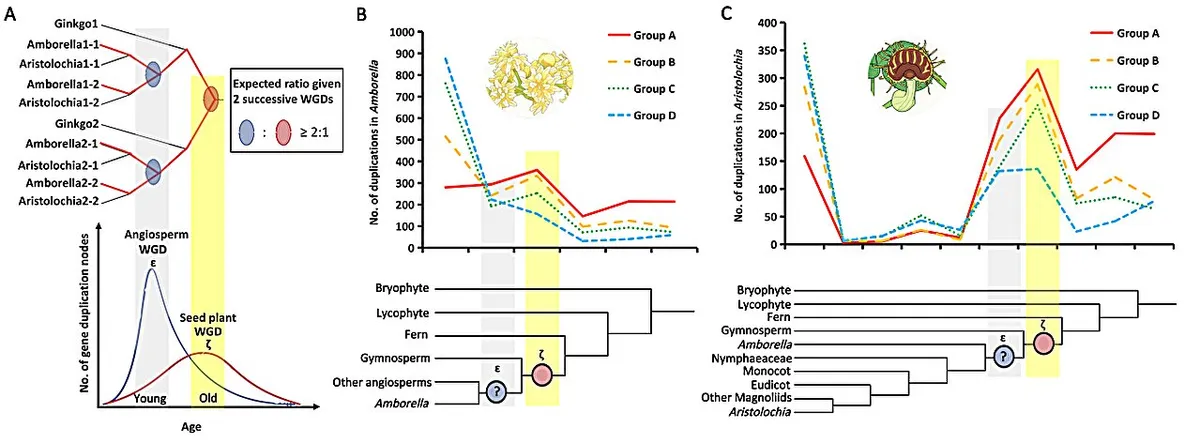
Start Your News DetoxNow, a team from China's Wuhan Botanical Garden and Ghent University in Belgium has found a way to cut through the noise. Instead of looking for any duplicate genes, they focused on a very specific type: genes that are exquisitely sensitive to dosage — meaning the cell breaks if you have too many or too few copies. These are genes that encode the core machinery of protein complexes and regulatory networks. When a whole genome duplicates, these dosage-sensitive genes get preferentially kept because having the right balance matters for survival.
The researchers compared these sensitive genes across flowering plants with different evolutionary histories, then used three independent analytical methods to test whether ancient duplications actually occurred. What they found was striking: there's clear evidence for one major duplication event in the ancestral seed plant — a genetic event that happened before flowering plants even existed. But the signal for a duplication specific to flowering plants themselves was essentially absent. The genes that should have been retained if such a duplication happened simply weren't there in the patterns the researchers would expect.
"This suggests flowering plants didn't need that genetic shortcut," said the research team. Instead, the diversity and adaptability of angiosperms appears to have come from other sources — from how existing genes were regulated differently, how they were shuffled into new arrangements, and how they were co-opted for new functions.
The finding doesn't just settle an old argument. It changes how scientists think about innovation in evolution. Genetic duplication isn't the only way — and may not even be the primary way — that life generates the variation it needs to thrive. Sometimes, doing more with what you already have turns out to be the better strategy.