A team at MIT just synthesized antibiotics that didn't exist before — and machines helped design them from scratch.
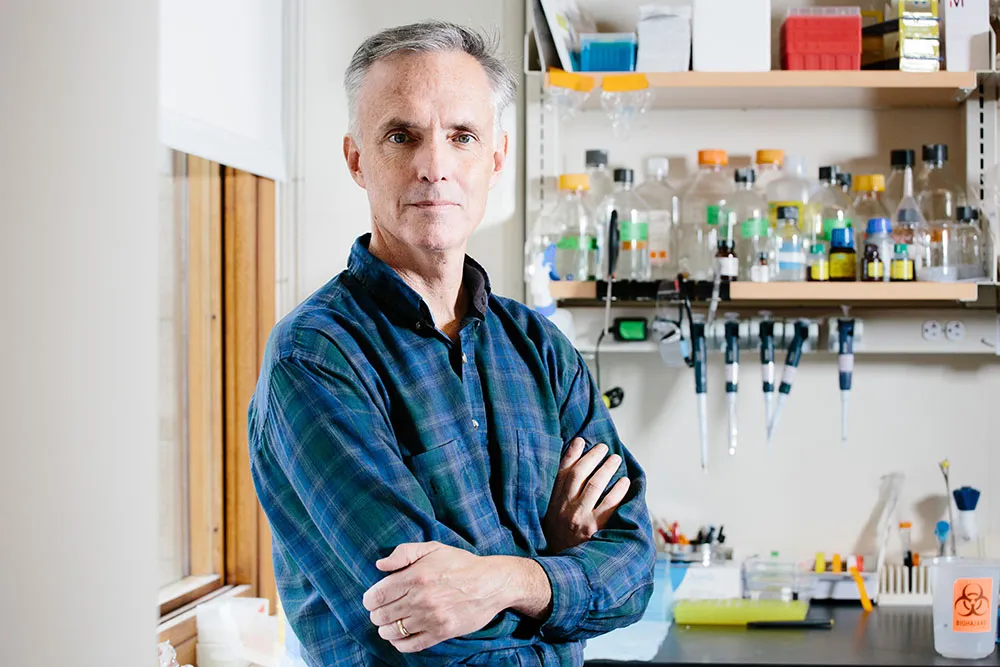
In a 2025 study published in Cell, James Collins' lab used generative AI to explore millions of possible molecular combinations, then narrowed them down to 24 candidates worth making in the lab. Seven of those worked. Two were especially promising: one effective against drug-resistant gonorrhea, another against MRSA. Both showed no toxicity and low resistance rates.
This isn't theoretical. These molecules are now moving toward clinical development.
We're a new kind of news feed.
Regular news is designed to drain you. We're a non-profit built to restore you. Every story we publish is scored for impact, progress, and hope.
Start Your News DetoxHow the collaboration actually works
The breakthrough sits at the intersection of three things: computational power, experimental biology, and institutional commitment. Collins works across MIT's Jameel Clinic for Machine Learning in Health alongside Regina Barzilay and Tommi Jaakkola, combining expertise in AI and systems microbiology. Separately, his team partners with Donald Ingber at the Wyss Institute, who has developed organs-on-chips — lab-grown tissue models that let researchers test how drugs behave in human-like environments before animal trials.
The workflow is straightforward in principle but historically slow in practice: AI generates candidates, computers filter them, chemists synthesize the most promising ones, biologists test them. What's changed is speed. By automating the generation and filtering steps, the team compresses years of traditional screening into weeks.
This matters because antibiotic resistance kills roughly 1.3 million people annually and is projected to cause 10 million deaths per year by 2050 if the current trajectory holds. The global pipeline for new antibiotics has been anemic — most pharmaceutical companies stopped antibiotic research decades ago because the economics don't work. A drug you take for two weeks generates less revenue than a chronic medication.
AI-accelerated discovery changes the math. It makes it cheaper and faster to find candidates, which makes it economically viable for smaller teams and nonprofit models.
From lab to patients
Collins co-founded Phare Bio, a nonprofit using AI to discover antibiotics. The organization recently received a grant from ARPA-H (the Advanced Research Projects Agency for Health) to design 15 new antibiotics and develop them as pre-clinical candidates. This is the bridge between "we made something that works in a dish" and "this could actually treat patients."
The next phase involves making sure these AI-designed molecules have the right properties — stability, absorbability, distribution — to work as actual medicines. That's where the organs-on-chips come in, and where the real-world constraints of drug development take over. But the computational heavy lifting is done.
What Collins and his collaborators are building isn't just a faster way to find antibiotics. It's a template: combine generative AI with high-throughput biology, partner across institutions, and create a pipeline that can respond to emerging threats in months instead of years. Antibiotic resistance won't wait for traditional timelines. This approach doesn't have to either.