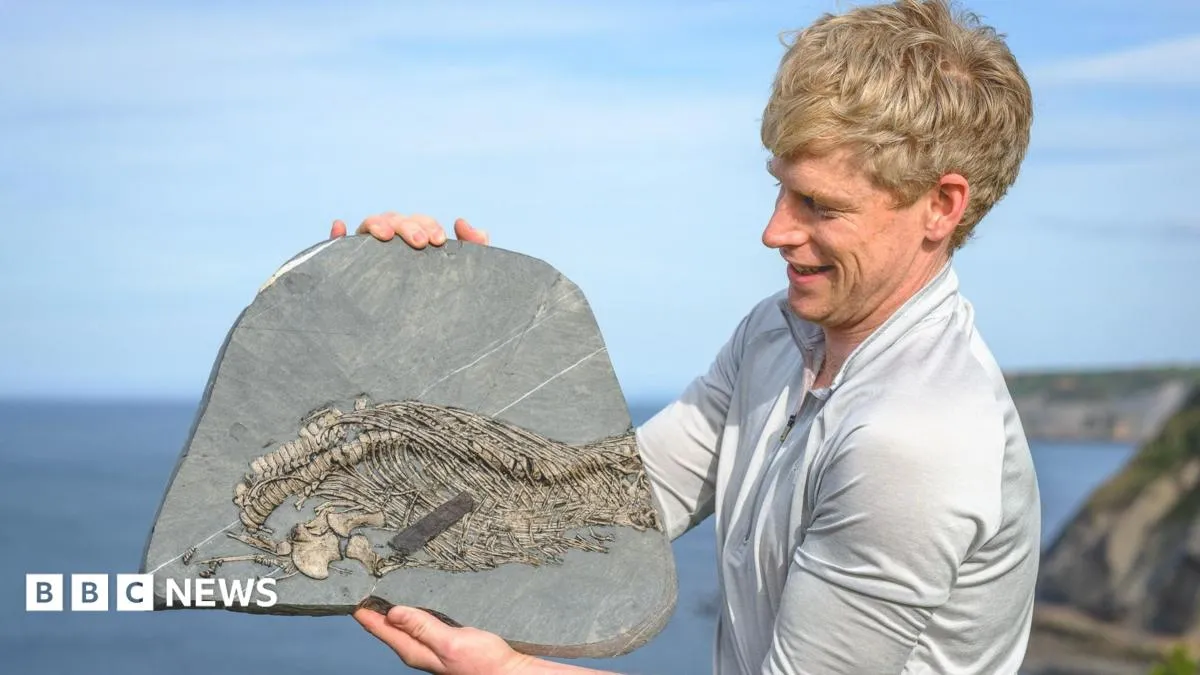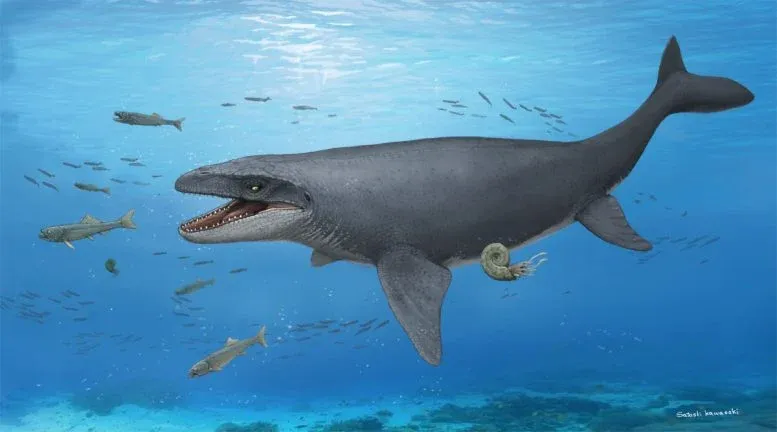
Imagine a museum rock, sitting pretty for three decades, minding its own business. Then, some curious paleontologists decide to give it a closer look. What do they find? Four bones that don't match any known mosasaur. Because apparently, that's where we are now: discovering new species hiding in plain sight, just waiting for their moment.
This isn't just any old rock. It's been chilling at the Natural History Museum, Kishiwada City, since the early 90s, when it was dug up in Sobura, Kaizuka City. The team from Okayama University of Science, Tokyo City University, and the museum itself recently gave it the glow-up it deserved.
Among the newly unearthed treasures was a premaxilla – that's the bone right at the very front of the upper jaw. Not only is it a crucial piece of the puzzle, but it's also the first time a mosasaur premaxilla has ever been found in Japan. Let that satisfying, specific detail sink in.
We're a new kind of news feed.
Regular news is designed to drain you. We're a non-profit built to restore you. Every story we publish is scored for impact, progress, and hope.
Start Your News DetoxThe Jawbone That Changed Everything
When this fossil was first collected, the paleontological world simply didn't have enough mosasaur specimens to compare it to. It was like trying to solve a puzzle with half the pieces missing and no picture on the box. Fast forward a few decades, and the global mosasaur research game has seriously leveled up. More fossils, more anatomical data, and suddenly, that mysterious bone clicked into place as a premaxilla.
But wait, there's more. They also found a basisphenoid bone, which lives near the braincase. This one's got some short, horn-shaped bits on the sides and a distinct lack of a groove on its underside. These features? Completely different from its known mosasaur cousins. Which, if you think about it, is both impressive and slightly terrifying. It’s the kind of subtle difference that makes a paleontologist do a double-take.
While the official naming ceremony is still pending, these unusual traits strongly suggest we're looking at a brand-new, previously unnamed species. It's a testament to the fact that sometimes, the biggest discoveries aren't out in the field, but patiently waiting in a museum storage room. So, next time you're in a museum, maybe give that unassuming rock a second glance. You never know what's lurking inside.
The findings were presented at the 177th Annual Meeting of the Paleontological Society of Japan, proving that even old rocks can still make headlines.