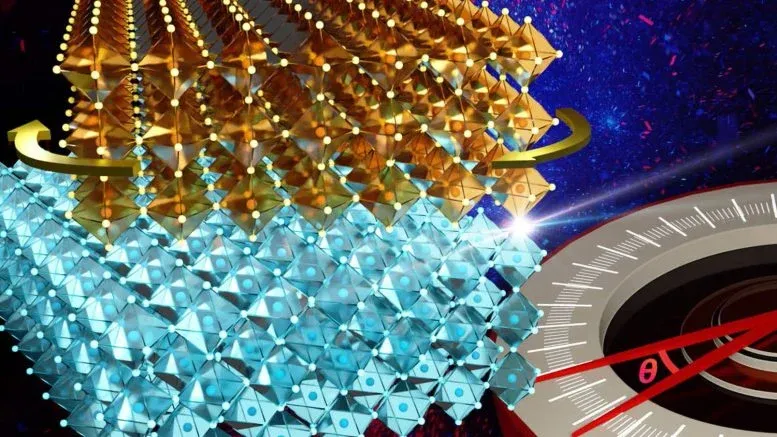
Scientists can now twist large oxide crystals to create new materials. These materials could have powerful electronic properties.
A carefully chosen twist can change how a material behaves. Researchers found a way to apply this to large sheets of crystalline oxides. This could lead to electronic materials with precisely designed structures and properties.
This method allows scientists to control the angle between two stacked oxide layers. It also creates strong chemical bonds where the layers meet. Unlike many older twistronic materials, these new structures can be made large enough for practical devices.
We're a new kind of news feed.
Regular news is designed to drain you. We're a non-profit built to restore you. Every story we publish is scored for impact, progress, and hope.
Start Your News DetoxTwistronics uses a simple but powerful idea. When two thin crystal layers are rotated, their atomic patterns no longer line up perfectly. This mismatch can change how electrons move through the material. It can also create behaviors not found in either layer alone.
Building Twisted Oxide Materials
Most twistronics research has focused on two-dimensional (2D) materials. These are held together by weak van der Waals forces. These weak connections make the layers easy to stack and rotate. However, oxide crystals are different because their atoms form much stronger chemical bonds.
Ruijuan Xu, a professor at North Carolina State University, explained this difference. She said twistronics usually uses 2D materials with weak bonds. Her team's work shows it's possible to use oxide layers with strong chemical bonds. They can still precisely control the twist angle between these layers.
Xu added that the strong bonding between oxide layers suggests new phenomena to explore. They can control many material features, like phase structure. This offers new ways to design materials and devices for specific uses.
To build these structures, researchers made thin crystal membranes of sodium niobate (NaNbO3). This is a complex oxide used as a model material. They put visible markers around each membrane using photolithography. This is a common patterning method in electronics.
One membrane was lifted and placed onto another. By watching the markers, the team could rotate the top layer to the correct angle.
The stacked membranes were then heated. This annealing process was specific to sodium niobate. This treatment allowed strong chemical bonds to form between the layers. The alignment was kept under control.
Xu noted that scale matters for devices. These crystal membranes can be made over large areas and moved to different supports. This method offers a practical way to create twist-engineered oxide electronics.
Strong Bonds Reshape the Atomic Lattice
Researchers used synchrotron X-ray diffraction to study the interface where the two crystals joined. Their measurements showed the connection was not just a flat boundary.
Instead, strong bonding forces reshaped the material. The atomic lattice gradually rotated near the interface. This allowed the crystals to adjust to their different orientations. The team also found changes in the material's phase structure. This suggests twisting affects more than just the layers' geometry.
Xu explained that the bonds between the two layers are so strong they distort the material's atomic structure. This creates a gradual rotation of the atomic lattice at the interface. They also found changes to the material's phase structure. How this affects material properties is still being explored.
The study focused on NaNbO3. However, researchers believe this assembly method could work with other complex oxide membranes. This could greatly expand the materials available for twistronics. It would also allow scientists to study interfaces held together by strong chemical bonds.
Xu concluded that their work shows a technique for creating large-area oxide twistronic materials. These materials have controlled twist angles and strong chemical bonds between layers. She believes it's an exciting time for oxide twistronics, with new chances to engineer complex oxide functions through twisting.
Deep Dive & References
Deterministic Fabrication of Large-Area, High-Crystallinity Oxide Moiré Superlattices - ACS Nano, 2026