Thailand's dugongs, those charming, chubby marine mammals, have been having a rough go of it lately. Their main food source — vast underwater meadows of seagrass — has been vanishing faster than a free sample at Costco. And when the seagrass goes, so do the dugongs, along with vital nurseries for shrimp, crabs, and fish that local fishing communities rely on.
Past attempts to replant these crucial underwater gardens often ended in heartbreak. Young seagrass shoots would wash away, get buried, or become a quick snack for hungry critters before they even had a chance to root. It was like trying to plant a garden in a hurricane.
Enter a rather ingenious solution from a collaboration between Murdoch University and Walailak University: 3D-printed bioplastic pods. Because apparently, that's where we are now, and it's actually pretty brilliant.
We're a new kind of news feed.
Regular news is designed to drain you. We're a non-profit built to restore you. Every story we publish is scored for impact, progress, and hope.
Start Your News DetoxTiny Homes for Tiny Plants
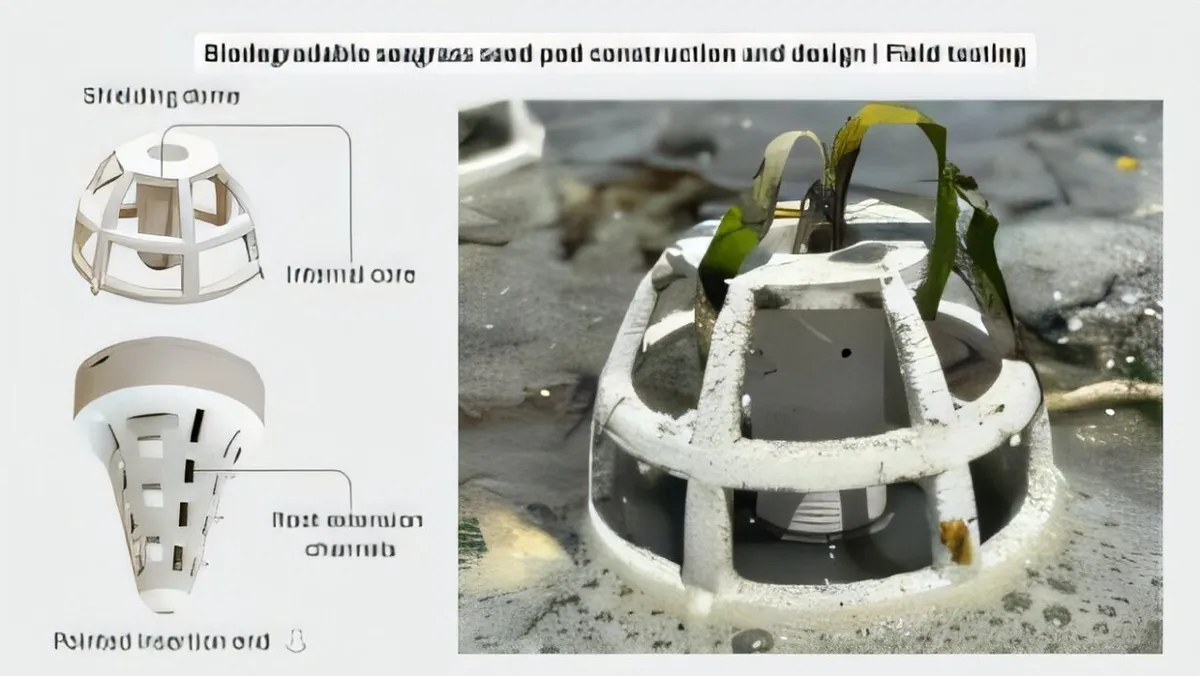
Imagine a tiny, biodegradable, protective dome with an anchor. That's essentially what these prototype pods are. They're inserted into the seabed, each cradling a delicate seagrass shoot. The dome has slots, allowing roots to grow out while shielding the plant from the ocean's rough-and-tumble life — waves, shifting sediment, and the ever-present threat of becoming a crab's appetizer.
Professor Andrew Macrae, from Murdoch University's Bioplastics Innovation Hub, explains that the pods are designed to give these vulnerable young plants a fighting chance to establish themselves. It's like sending them to marine boot camp with a tiny, temporary force field.
The real kicker? These pods are made from a bioplastic called polyhydroxyalkanoate (PHA). This isn't your average plastic that hangs around for centuries. PHA is engineered to completely break down once the seagrass plant has firmly rooted itself and can fend for itself. It's a temporary support system that leaves no trace.
Dr. Alexandra Gulizia notes the bioplastic is actually created through bacterial fermentation using local microbial strains. Which, if you think about it, is both impressive and slightly terrifying in the best possible way. They can even tweak the material's properties to make sure the pods are tough enough for the ocean but still fully biodegradable.
Researchers recently surveyed the seagrass meadows near Koh Lidi, within Thailand's Mu Ko Phetra National Park, where these trials will eventually take place. If these high-tech, temporary homes work, this simple yet sophisticated approach could offer a scalable, eco-friendly way to bring back seagrass ecosystems across Southeast Asia and beyond. And maybe, just maybe, give the dugongs a reason to stick around.