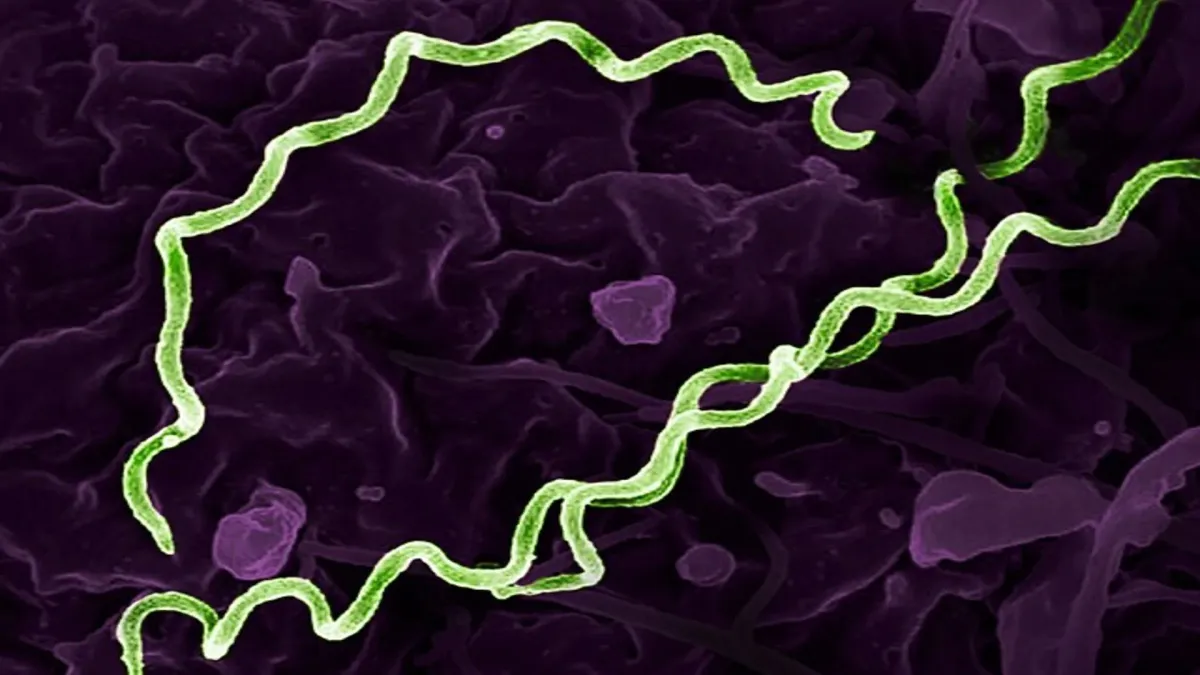
A skeleton buried in Colombia thousands of years ago is rewriting what we thought we knew about syphilis. Researchers analyzing the 5,550-year-old remains of a middle-aged hunter-gatherer found genetic traces of Treponema pallidum — the bacterium that causes syphilis — pushing back the earliest known evidence by 3,000 years.
For centuries, the standard story held that European explorers introduced syphilis to the Americas in the late 1400s. This discovery suggests something more complex was happening. Populations in the region had already been living with treponemal infections — a family of diseases including syphilis, yaws, and bejel — long before any contact with the Old World.
The find came almost by accident. Researchers from UC Santa Cruz and the University of Lausanne were studying the skeleton's DNA to trace human migration patterns when they detected bacterial DNA in the tibia bone. To fully reconstruct what they'd found, they generated 1.5 billion genetic fragments — an unusually large dataset that allowed them to piece together the complete genome of this ancient strain.
We're a new kind of news feed.
Regular news is designed to drain you. We're a non-profit built to restore you. Every story we publish is scored for impact, progress, and hope.
Start Your News DetoxWhat makes this version of T. pallidum particularly striking is that it doesn't match any modern form of the bacteria. This ancient variant represents a branch that diverged from the evolutionary tree at some point we don't yet understand, then apparently disappeared. It's like finding a cousin in your family tree you never knew existed — and who lived thousands of years ago.
Why this matters now
Syphilis isn't a historical problem. Cases have been climbing for the past two decades globally, and understanding how the bacteria has evolved over millennia could help shape better treatment strategies. By studying how T. pallidum has changed — and adapted to human populations — across thousands of years, scientists gain insight into how it might continue to evolve.
This is where paleogenomics, the study of ancient DNA, shows its real power. It's not just about satisfying historical curiosity. Ancient genomes act like a deep archive of how pathogens behave over timescales we can't observe in real time. The longer view changes what we can predict.
The next step is comparing this Colombian strain to other ancient and modern versions of the bacteria to map out the full evolutionary story — one that clearly began in the Americas, not Europe, and took paths we're only now beginning to trace.