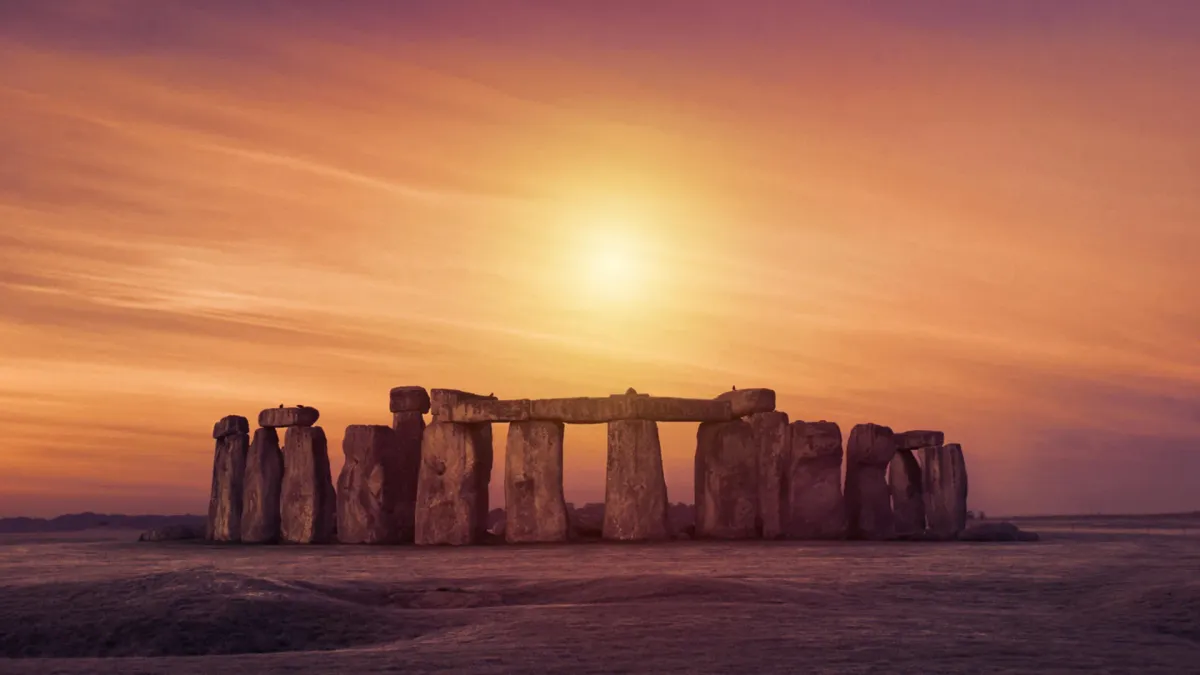
For over a hundred years, archaeologists have debated how Stonehenge's bluestones arrived at Salisbury Plain. A glacier? Human effort? Now scientists have an answer—and it comes from examining crystals smaller than a grain of sand.
Researchers at Curtin University in Australia used advanced mineral analysis to test the glacier theory. If ancient ice sheets had dragged the stones from Scotland or Wales all the way to southern England, they would have left a distinctive mineral fingerprint in the surrounding river sediments. The team examined over 500 zircon crystals—some of the hardest minerals on Earth—from sands near Stonehenge. They found no trace of that glacial signature. "We looked at the river sands near Stonehenge for some of those grains the glaciers might have carried and we did not find any," said Dr. Anthony Clarke, the study's lead author. "That makes the alternative explanation—that humans moved the stones—far more plausible."
What This Actually Tells Us
This doesn't solve how the stones moved. Theories abound: people could have sailed them down coastal rivers, rolled them across land on logs, or used methods we haven't yet imagined. But the research narrows the field dramatically. Ice is now largely ruled out. What remains is the remarkable fact that Neolithic builders, working without wheels or animals suited to the task, deliberately sourced and transported massive stones across hundreds of kilometers.
We're a new kind of news feed.
Regular news is designed to drain you. We're a non-profit built to restore you. Every story we publish is scored for impact, progress, and hope.
Start Your News DetoxThe finding builds on a 2024 discovery from the same team that traced Stonehenge's central Altar Stone—a six-tonne block—directly to Scotland. Together, these results paint a picture of intentional, ambitious engineering. The stones weren't random geological debris scattered by nature. They were chosen, moved, and placed with purpose.
What's particularly striking is how modern geochemical techniques can reach back across millennia to answer questions that have puzzled researchers for generations. By analyzing minerals invisible to the naked eye, scientists tested a century-old theory without ever touching the monument itself.
The mystery of exactly how the stones traveled remains open—and may never be fully solved. But we now know with far greater confidence who moved them, and that alone reshapes our understanding of Neolithic ambition and capability.