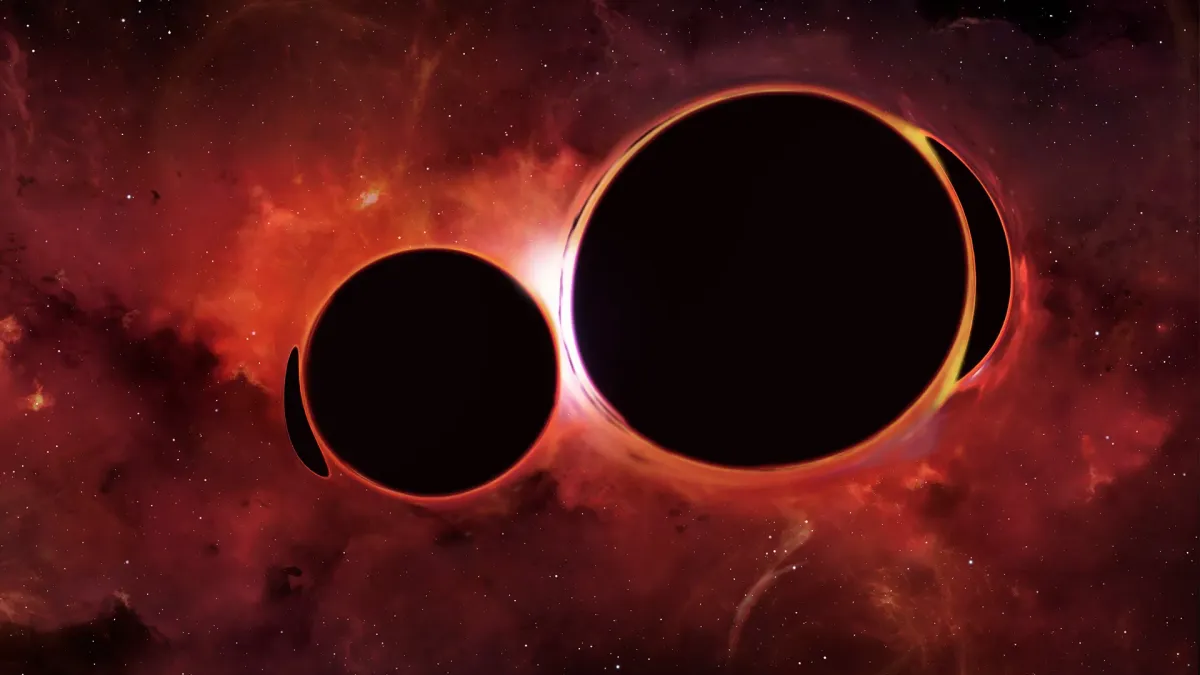
In November 2024, scientists detected a powerful event far across the universe. Gravitational-wave detectors picked up the merger of two black holes. Normally, these events are invisible to telescopes. They only create tiny ripples in spacetime. But this time, something different happened.
Seconds after the gravitational wave signal reached Earth, space telescopes saw a burst of gamma rays from the same area. This event, called S241125n, suggests that black hole collisions might sometimes produce light. If true, this would change what we know about black hole mergers. Scientists usually think these mergers happen in empty space, where there's not much material to create light.
Gravitational Waves and Gamma-Ray Bursts
The event was first noticed by the LIGO–Virgo–KAGRA network. These observatories detect ripples in spacetime. These ripples happen when two black holes spiral into each other and merge.
We're a new kind of news feed.
Regular news is designed to drain you. We're a non-profit built to restore you. Every story we publish is scored for impact, progress, and hope.
Start Your News DetoxThe signal showed the event was extremely far away, about 4.2 billion light-years from Earth. The black holes involved were also very large. Together, they weighed more than 100 times the mass of our Sun. This makes it one of the most massive stellar-mass black hole mergers ever seen. Most mergers observed before involved black holes only a few tens of times the Sun's mass.
About 11 seconds after the gravitational waves arrived, NASA’s Swift satellite detected a short gamma-ray burst. This is a quick, intense flash of high-energy radiation. It came from the same part of the sky. Soon after, China’s Einstein Probe satellite found a possible X-ray afterglow from the same region. This led to a big question.
Could the Black Hole Collision Have Produced the Burst?
Gamma-ray bursts that last less than two seconds are usually linked to neutron star mergers, not black holes. However, this burst had some unusual features.
The radiation at the start had a "softer" photon spectrum. This means the photons carried slightly lower energies than typical short gamma-ray bursts. Also, the afterglow radiation seemed "harder" than usual. This suggests the process behind this burst might be different from other gamma-ray bursts.
Researchers did a statistical analysis to see if the gravitational waves and gamma-ray burst were connected. Their calculations suggest the chance of this happening randomly is very low. It's like one random event every 30 years of observations. They used careful assumptions, so the real chance might be even lower. Still, more evidence is needed to confirm the link.
A Possible Explanation: Inside an Active Galactic Nucleus
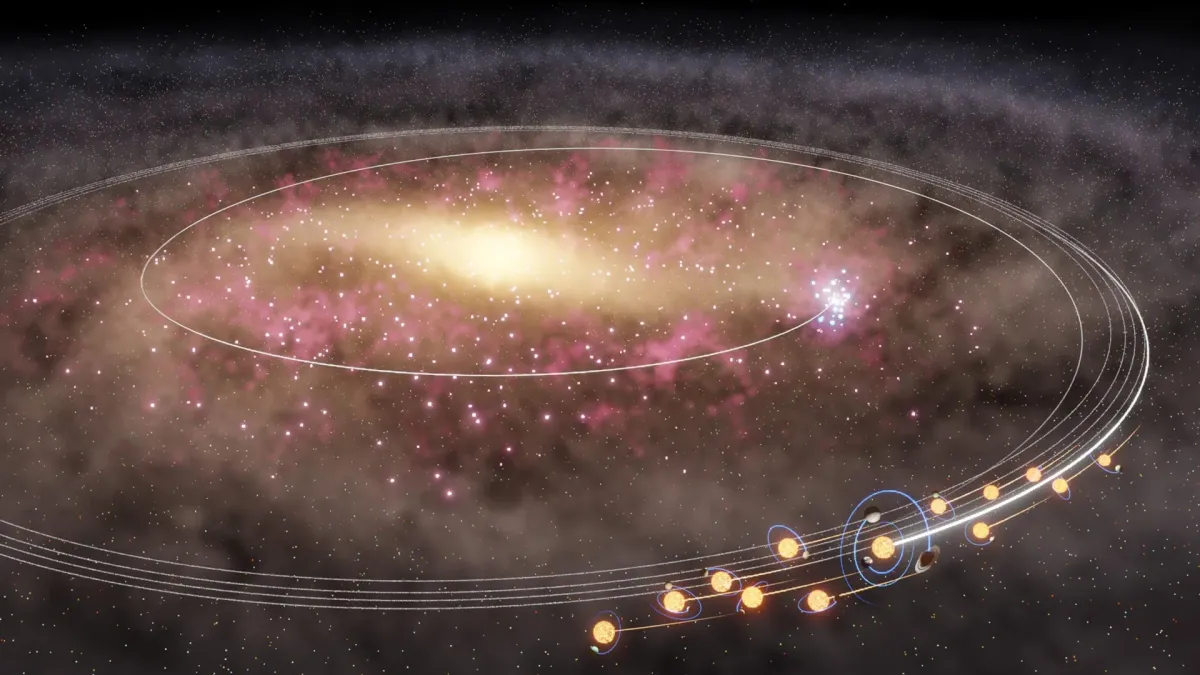
To explain how a black hole merger could create light, researchers suggest the event happened in a very active place. This would be in the disk of gas and dust around a supermassive black hole in an active galactic nucleus (AGN).
In the centers of active galaxies, huge amounts of matter swirl around a central supermassive black hole. This forms a dense, spinning disk. These disks can contain smaller black holes that orbit within the gas. Over time, some of these might form pairs and merge.
If the two black holes in S241125n merged inside such a disk, it would be very different from a merger in empty space. After the merger, the new black hole would likely get a "kick." This kick comes from uneven gravitational waves. It could send the black hole speeding through the surrounding gas.
As it moves through this dense material, the black hole could start swallowing gas very quickly. This could be much faster than the normal Eddington accretion limit. Such a fast inflow of matter can create powerful jets. These are narrow streams of particles and radiation launched from near the black hole's poles at almost the speed of light.
In this scenario, the jet would first be buried inside the thick AGN disk. As it pushes out, it creates strong shock waves through the gas. It also traps a lot of energy within the disk. Eventually, when the jet breaks through the disk's surface, the stored energy can suddenly escape. This sudden release of radiation, called a shock breakout, could produce a gamma-ray burst.
Because the radiation interacts with dense material before escaping, it would appear softer and more "thermalized." This matches the unusual properties seen by the Swift satellite.
What This Discovery Could Mean
If future observations confirm this link, it would expand multi-messenger astronomy. This field studies cosmic events by combining different types of signals. Until now, binary black hole mergers were only detectable through gravitational waves. Seeing light from them would give important clues about where these collisions happen.
This finding could also help scientists understand how very massive stellar-mass black holes form. If mergers happen inside active galactic disks, repeated collisions could build larger black holes over time.
For now, the evidence is suggestive, not definite. Researchers say more observations of the host galaxy are needed to test their explanation.
A gamma-ray burst from a binary black hole merger in an active galactic nucleus disk - The Astrophysical Journal, 2024