For years, astronomers have been scratching their heads over a cosmic conundrum: where do all those high-energy neutrinos come from? These ghostly particles zip across the universe, carrying clues about some of the most extreme events out there. The prevailing theory? Supermassive black holes, naturally. But a recent discovery just threw a cosmic wrench in that idea.
Enter "Shadow Blaster." That's the nickname scientists gave to a hidden, star-forming galaxy that's apparently been busy spitting out these elusive particles. And it's not a black hole doing the work. It's intense star formation.
The Case of the Missing Neutrino Source
Neutrinos are notoriously difficult to detect. They barely interact with anything, which is why observatories like the IceCube Neutrino Observatory at the South Pole have to bury detectors deep in ice. When one of these high-energy particles finally does register, it's a big deal. So when IceCube picked up an event dubbed IC 210922A, an international team got to work.
We're a new kind of news feed.
Regular news is designed to drain you. We're a non-profit built to restore you. Every story we publish is scored for impact, progress, and hope.
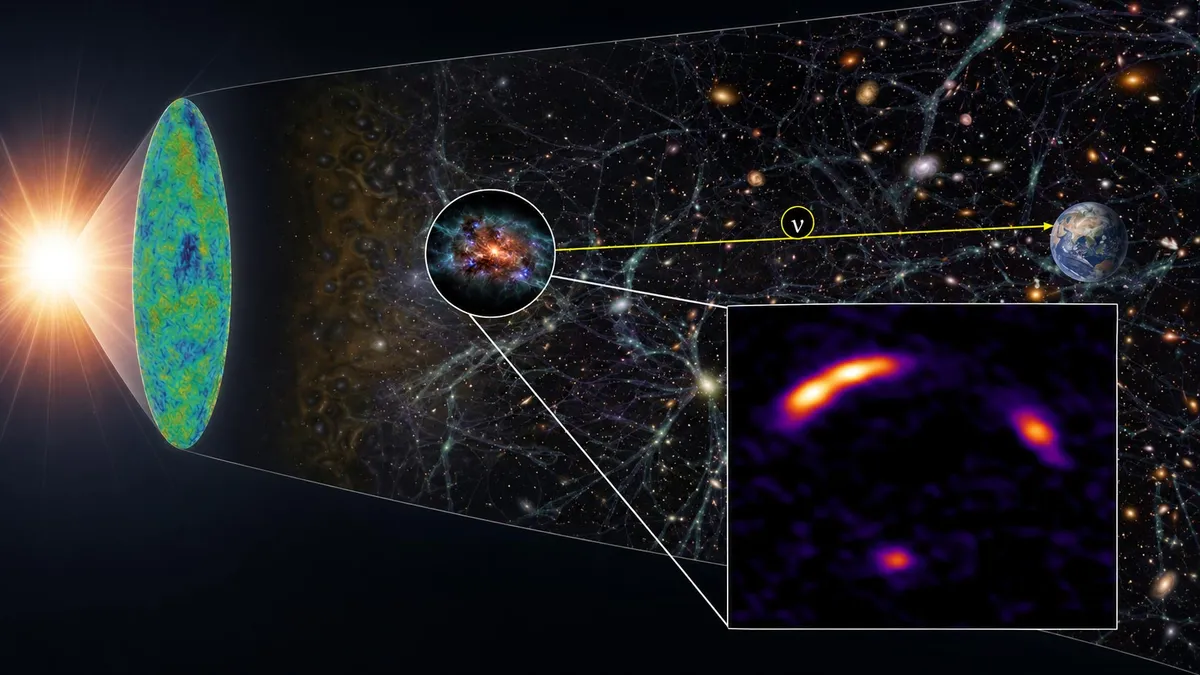
Start Your News DetoxUsing the Atacama Large Millimeter/submillimeter Array (ALMA) and other telescopes, they traced the signal back 11 billion light-years to a very bright, distant galaxy: JCMT0402−0424. The initial assumption, as always, was a supermassive black hole. But here's where things got weird. JCMT0402−0424 showed none of the tell-tale emissions that usually scream "monster black hole at work."
Turns out, this galaxy is also heavily shrouded in dust, making it practically invisible in visible light. But it glows like a supernova in submillimeter wavelengths. Hence, its very cool nickname: Shadow Blaster.
A Cosmic Magnifying Glass
Studying something 11 billion light-years away is no easy feat, especially when it's trying to hide. But the universe, ever helpful, provided a natural assist. Another galaxy, perfectly positioned between Earth and Shadow Blaster, acted as a gravitational lens. Its gravity bent and magnified the radio waves coming from the distant galaxy, essentially creating a massive, natural telescope for ALMA. This cosmic magnification allowed researchers to peer deep inside Shadow Blaster. And what they found was no black hole party. Instead, the data pointed to incredibly intense star formation, heating up the gas and dust within the galaxy. They discovered a dense "compact core" at its center, packing huge amounts of gas and dust into a region only about 1,500 light-years across. These ridiculously dense conditions, it turns out, are perfect for cranking out neutrinos.
So, instead of just supermassive black holes, it seems rapidly star-forming, dusty galaxies might be responsible for a significant portion — potentially up to 20% — of the high-energy neutrinos zipping through the cosmos. Let that satisfying number sink in. It's a bit like finding out your car's engine isn't just powered by gasoline, but also by a secret, highly efficient, dust-fueled reactor. Which, if you think about it, is both impressive and slightly terrifying.