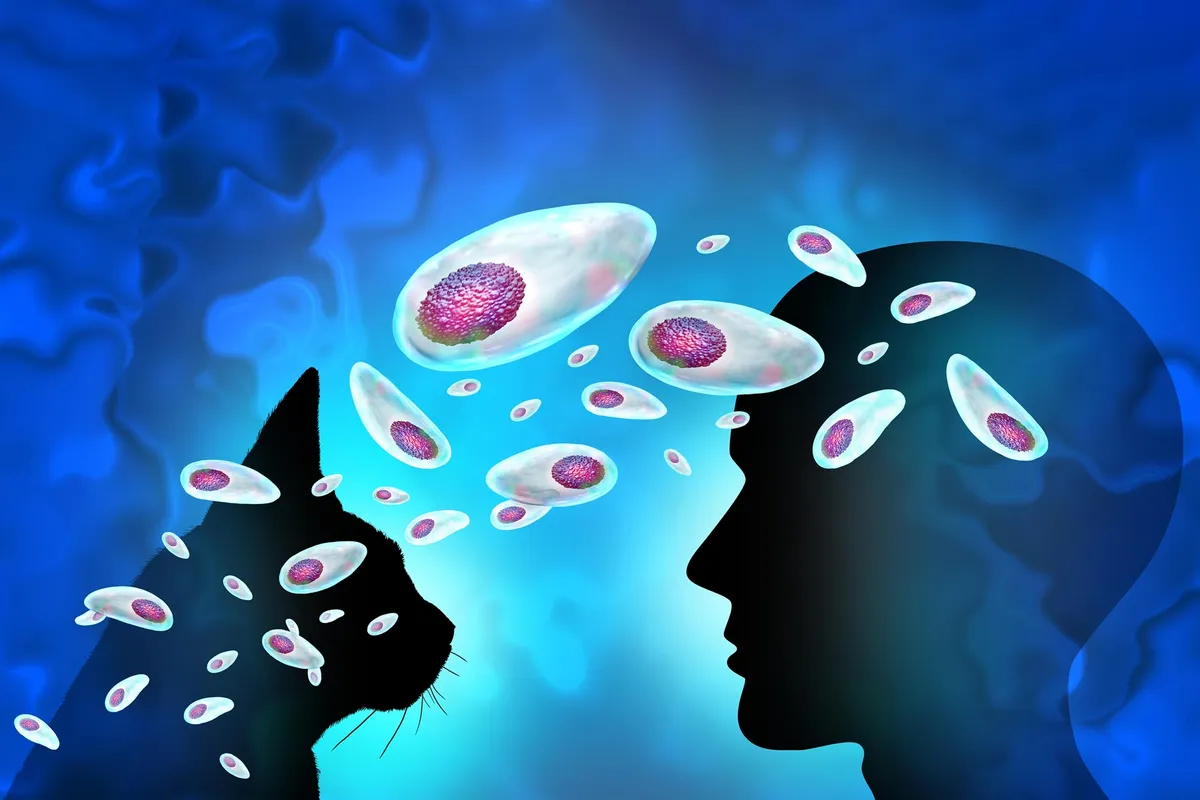
A parasite living in the brains of roughly 2 billion people worldwide has been quietly operating a far more complex system than anyone realized — and that discovery could finally unlock how to treat it.
Toxoplasma gondii, the culprit, infects about one-third of humanity. Most of the time you'd never know it's there. You pick it up from undercooked meat or cat litter, it slips past your immune system, and settles into cysts in your brain or muscles where it can stay dormant for life. But UC Riverside researchers just discovered that inside each microscopic cyst, the parasite isn't simply sleeping — it's running an organized operation with multiple specialized units, each designed for a different job.
"We found the cyst is not just a quiet hiding place — it's an active hub with different parasite types geared toward survival, spread, or reactivation," says Emma Wilson, the study's lead author, published in Nature Communications.
We're a new kind of news feed.
Regular news is designed to drain you. We're a non-profit built to restore you. Every story we publish is scored for impact, progress, and hope.
Start Your News DetoxFor decades, scientists thought each cyst contained one uniform type of parasite that stayed put until something woke it up. Using advanced single-cell analysis — essentially reading the biological blueprint of individual parasites — Wilson's team found the reality is messier and more strategic. Each cyst holds at least five distinct subtypes of parasites, all classified as bradyzoites but each with different functions. Some are optimized for staying hidden. Others are primed to reactivate and cause damage.
Why this matters for treatment
Here's the frustrating part: current drugs can kill the fast-moving form of the parasite that causes acute illness, but nothing touches the cysts. They're armored against every therapy we've thrown at them. For people with weakened immune systems — or babies infected in the womb, where the risks are most severe — that's a serious problem. The parasite can reactivate and cause toxoplasmic encephalitis (brain damage) or retinal toxoplasmosis (vision loss).
The reason we've struggled to develop better treatments is partly practical. Cysts are buried deep in brain tissue, grow slowly, and don't cooperate in lab cultures. Most research has focused on the fast-growing form instead, leaving the dormant cyst largely a mystery. Wilson's team worked around this by using mice — a natural host for the parasite — whose brains can harbor thousands of cysts. They extracted the cysts, broke them open, and sequenced the genetic material of individual parasites inside.
What they found reframes the entire problem. "By identifying different parasite subtypes inside cysts, our study pinpoints which ones are most likely to reactivate and cause damage," Wilson explains. "This helps explain why past drug development efforts have struggled and suggests new, more precise targets for future therapies."
In other words: we've been trying to hit a moving target without understanding the target's structure. Now we know which parts of the parasite's operation are most vulnerable.
The parasite's global footprint is staggering — one-third of humanity carries it — yet it's received far less research attention than many rarer diseases, partly because most infected people have no symptoms. Congenital toxoplasmosis, when infection occurs during pregnancy, remains a genuine concern in countries without routine screening. But for the vast majority of carriers, the parasite simply coexists, held in check by a functioning immune system.
Wilson's hope is that this new understanding shifts where the scientific focus lands. "It reframes the cyst as the central control point of the parasite's life cycle. It shows us where to aim new treatments. If we want to really treat toxoplasmosis, the cyst is the place to focus." The next step is turning that knowledge into drugs — work that's already underway, now with a much clearer map of what to target.