For the first time, scientists have precisely located a rogue planet — a world wandering the galaxy with no star to call home. The discovery matters because it cracks open a mystery that's been frustrating astronomers for years: how do you measure something you can barely see.
Most planets orbit stars. But growing evidence suggests the galaxy is scattered with free-floating worlds that don't. These rogue planets give off almost no light of their own, which makes them nearly impossible to spot directly. The standard detection method, called microlensing, works like this: when a rogue planet drifts in front of a distant star, its gravity bends and magnifies the star's light, creating a brief, telltale brightening. The problem is that microlensing usually can't tell you how far away the planet actually is — and without distance, you can't calculate its mass or confirm what you're looking at.
A Measurement from Two Vantage Points
The breakthrough came from a simple but powerful idea: observe the same microlensing event from multiple locations at once. Subo Dong's team combined data from ground-based surveys on Earth with simultaneous observations from the Gaia space telescope, orbiting high above the planet. The tiny differences in when the light signal reached these two vantage points — separated by millions of kilometers — allowed the researchers to calculate what's called microlensing parallax. It's the same principle that lets you judge distance by looking at something with each eye closed in turn, except applied to starlight across the solar system.
We're a new kind of news feed.
Regular news is designed to drain you. We're a non-profit built to restore you. Every story we publish is scored for impact, progress, and hope.
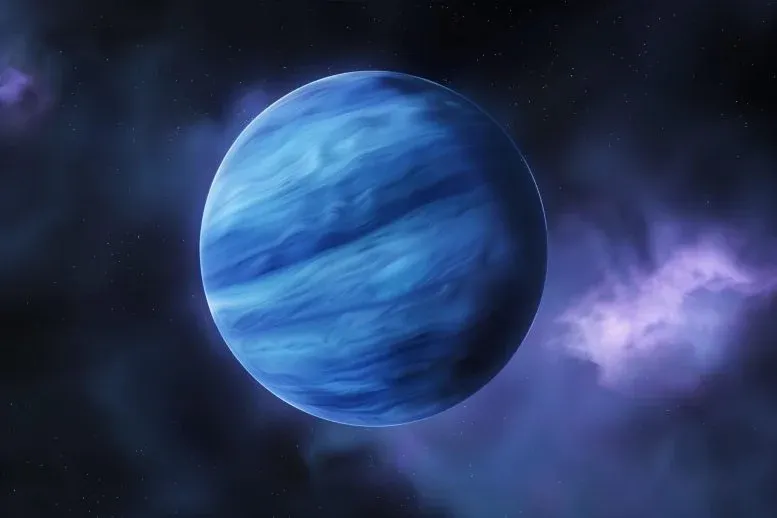
Start Your News DetoxOnce they had that measurement, the team could run detailed models of the lensing event and finally pin down what they were seeing: a planet roughly 22 percent the mass of Jupiter — so about Saturn-sized — located around 3,000 parsecs from the center of the Milky Way. That's roughly 10,000 light-years from our galactic core, drifting through the dark.
The discovery tells us something important about how these lonely worlds form. A Saturn-sized object almost certainly didn't condense from a cloud of gas and dust on its own the way brown dwarfs do. Instead, it almost certainly began as part of a normal planetary system orbiting a star, then got ejected into the void by gravitational chaos — a close encounter with another planet, or an unstable stellar companion that destabilized the whole system. Billions of years later, it's still traveling.
This single detection is just the beginning. The technique now works. As microlensing surveys continue and space telescopes keep watching, astronomers expect to find many more rogue planets and measure their properties with precision. For the first time, we're starting to map the invisible wanderers.