In modern cosmology, big science often leads the way. This includes large observatories, complex instruments, and international teams. But even in advanced fields, smaller, more agile approaches can still make progress. This is true for the search for dark matter.
A group of undergraduate students from the University of Hamburg showed this. They built a detector to look for axions, which are a strong candidate for dark matter. Their experiment set new limits on what we know about axions.
Building a Small-Scale Experiment
The students published their findings in the Journal of Cosmology and Astroparticle Physics. Their paper is titled "A New Limit for Axion Dark Matter with SPACE." They achieved their results with limited resources. This shows that small experiments can still contribute to major physics challenges.
We're a new kind of news feed.
Regular news is designed to drain you. We're a non-profit built to restore you. Every story we publish is scored for impact, progress, and hope.
Start Your News DetoxNabil Salama, one of the authors, explained their work. He is now studying for his M.Sc. in Physics at the University of Hamburg. He said their team was part of the MADMAX dark matter experiment group. MADMAX is a much larger and more complex experiment. The students benefited from MADMAX's knowledge and support.
Salama also thanked the University of Hamburg and the Quantum Universe Cluster of Excellence. They provided key equipment, like a magnet, and support from researchers.
Agit Akgümüs, the first author, is studying Mathematical Physics at the University of Hamburg. He noted that dark matter, or axions, are expected to be everywhere in our galaxy. This means experiments can be done almost anywhere.
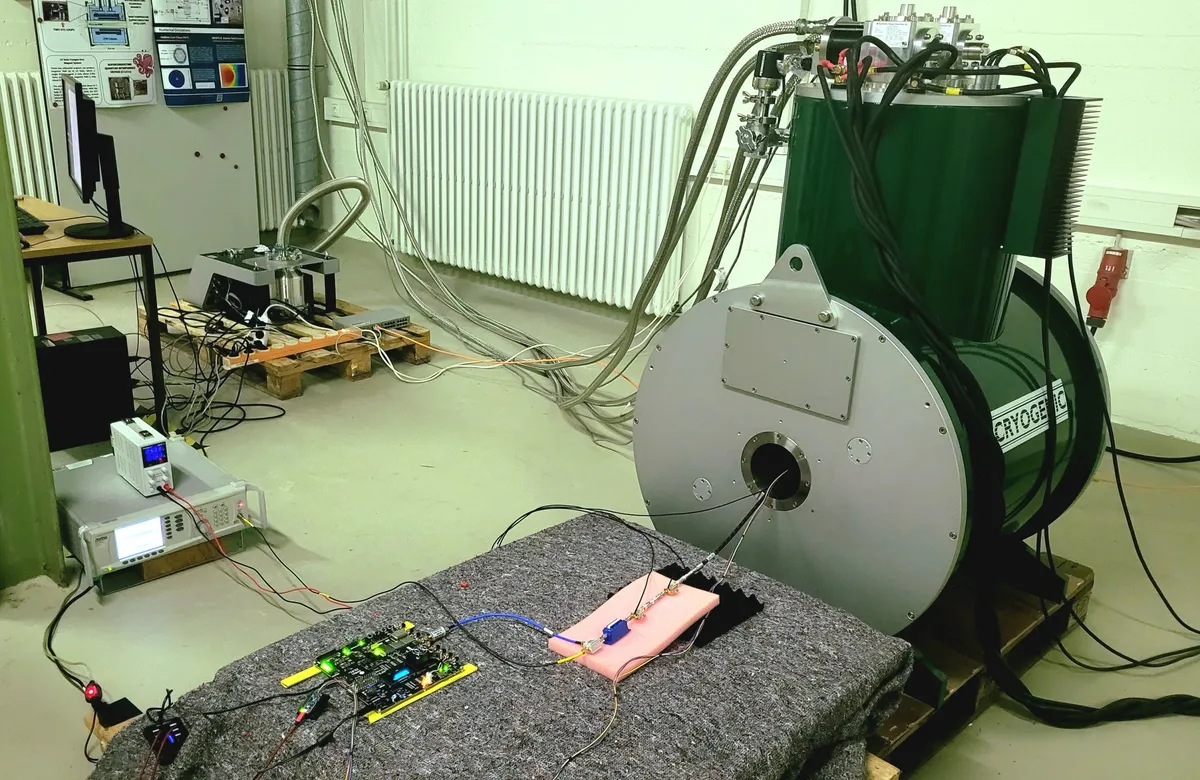
The students built their experimental setup. It included a resonant cavity made of highly conductive materials. They also added the necessary electronics, cables, and measurement tools. Salama described it as the simplest version of a cavity detector for dark matter.
They did not start completely from scratch. They used existing university infrastructure and equipment from other research groups. After building it, they tested, calibrated, and operated the experiment to collect data.
Salama explained that they simplified complex experiments to their core parts. This resulted in a less sensitive setup, limited to a small search area. However, it still produced new scientific data.
Setting New Limits
Akgümüs noted that searching for axions means exploring many possible parameters. Their experiment covered only a small region with limited sensitivity. But it still helped narrow down the possibilities. Finding the particle will require much larger experiments or many different ones.
The team did not find any signal from axions. This is not a failure. It is a meaningful scientific result. It means they can rule out axions with certain properties in the mass range they explored. This is especially true for axions that interact strongly with photons.
This study helps narrow the search area for future experiments. Salama believes their experiment proves that things can be done on a smaller scale. Akgümüs added that their results are more limited than larger experiments. Performance usually depends on resources and complexity.
However, they showed that these setups can be made much smaller. Even student-led projects can produce real scientific data.
During the review process, a referee made an interesting comment. Salama recalled that the referee said experiments like theirs could become standard teaching tools. This would happen once axions are discovered and their properties, especially their mass, are known.
Salama said they were told their setup could one day be a common student lab experiment. He feels they may have shown this future is already possible.
Deep Dive & References
A new Limit for Axion Dark Matter with SPACE - Journal of Cosmology and Astroparticle Physics, 2026