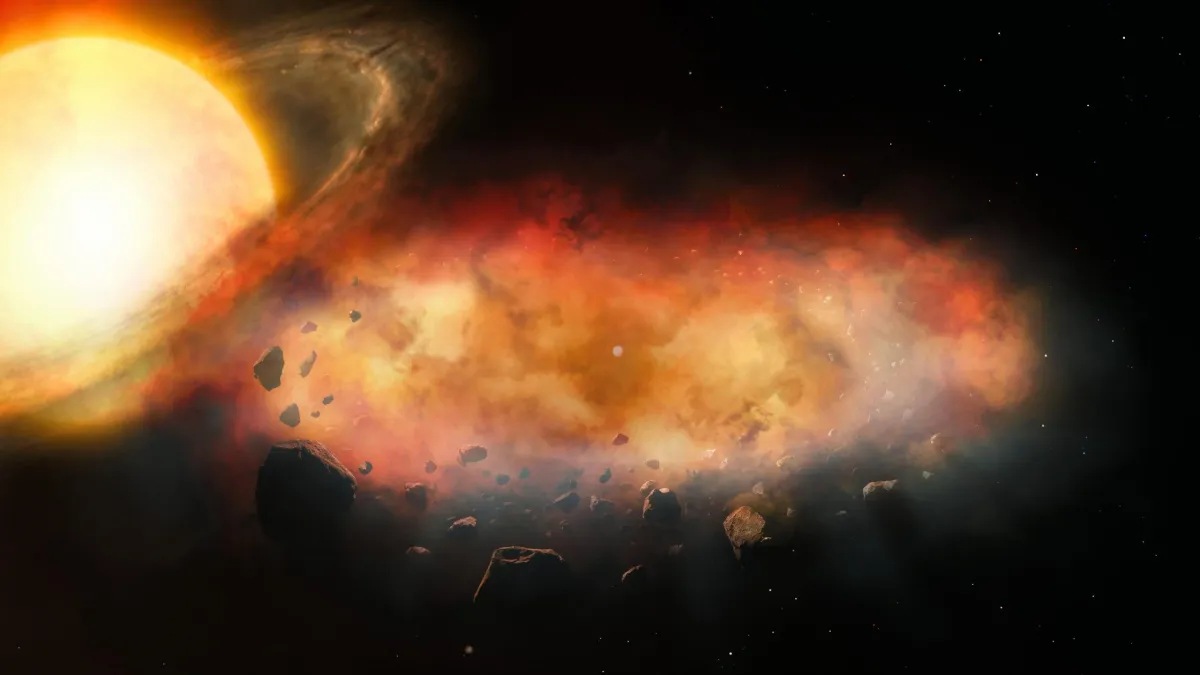
A Sun-like star simply disappeared from view for nine months. Not because it exploded or collapsed, but because an enormous cloud of vaporized metals drifted in front of it, blocking its light entirely. When astronomers using Chile's Gemini South telescope finally pieced together what happened, they realized they were watching something rarely glimpsed: the violent aftermath of a cosmic collision unfolding in real time.
The cloud wasn't just any dust storm. Using the Gemini High-resolution Optical SpecTrograph (GHOST), researchers detected iron, calcium, and other metals swirling through it — and more importantly, they measured exactly how those metals were moving in three dimensions. This was a first. No one had ever tracked the internal motion of gas in a disk orbiting a hidden companion object before.
That companion is the real puzzle. It's invisible, but it's heavy enough to hold this massive cloud in orbit through pure gravity. Based on the data, it weighs at least several times what Jupiter does. It could be a planet, a brown dwarf, or a small star — astronomers aren't sure yet. But whatever it is, it's orbiting far out in the outer reaches of this star system, in the kind of remote region where such objects shouldn't exist according to older models of how planetary systems form.
We're a new kind of news feed.
Regular news is designed to drain you. We're a non-profit built to restore you. Every story we publish is scored for impact, progress, and hope.
Start Your News Detox"The sensitivity of GHOST allowed us to not only detect the gas in this cloud, but to actually measure how it is moving," says Nadia Zakamska, the Johns Hopkins astrophysicist leading the study. "That's something we've never been able to do before in a system like this."
What makes this discovery significant isn't just the novelty of the observation. It's what it reveals about planetary systems that have been around for billions of years. These systems aren't static. Even when they're old and supposedly settled, catastrophic collisions can still happen. A smaller body — perhaps an asteroid or a comet — likely smashed into the disk orbiting this hidden companion, vaporizing on impact and creating the massive cloud that eventually drifted across our line of sight.
The event is a reminder that the Universe operates on timescales and distances so vast that we're always catching only fragments of much larger stories. A nine-month blackout that seemed sudden to us might be a brief moment in a system's billion-year history. Yet with better instruments and sharper eyes, we're learning to read those fragments, to understand the ongoing drama happening in distant star systems, and to piece together how worlds form, collide, and transform across the cosmos.