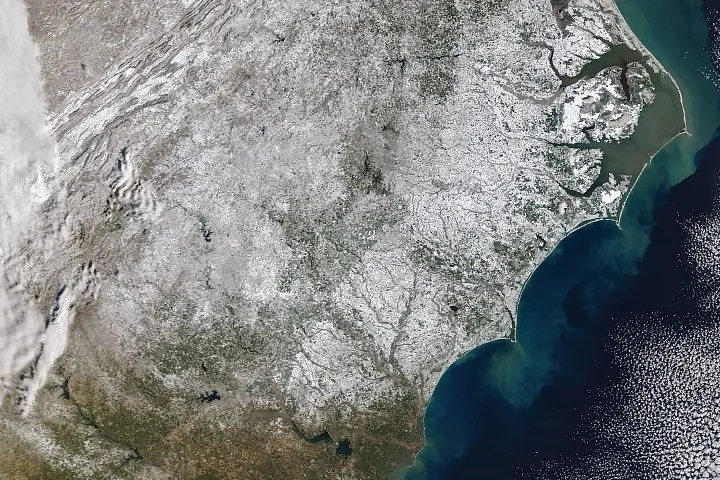
In late January 2026, a winter storm swept across North Carolina from the Appalachian Mountains to the Atlantic Coast, delivering measurable snow to every single county in the state—a milestone not reached since the early 2010s.
The storm arrived when Arctic air lingering from earlier in the week collided with a low-pressure system tracking near the coast. The result was a nearly continuous white blanket captured by NASA's Terra satellite on February 2, stretching from mountain towns to beachfront communities.
A Rare Statewide Event
Snowfall totals varied dramatically across the state's geography. The western mountains saw the heaviest accumulation, with some areas exceeding a foot. Charlotte, in the Piedmont region, received nearly 12 inches—its largest snowfall since 2004. Greenville, slightly inland from the coast, recorded 14 inches, the most since March 1980. Even Raleigh, typically spared heavy snow, saw 2.8 inches, while coastal areas like Carteret County reported more than a foot.
We're a new kind of news feed.
Regular news is designed to drain you. We're a non-profit built to restore you. Every story we publish is scored for impact, progress, and hope.
Start Your News DetoxWhat made this event genuinely rare wasn't just the snow itself, but its statewide reach. For all 100 North Carolina counties to record measurable snow requires a specific meteorological alignment: cold air from the north meeting moisture from a storm system at just the right moment. This combination had eluded the state for over a decade.
The Ground-Level Reality
From space, the satellite image looked serene. On the ground, it was a different story. Dangerous road conditions caused multiple collisions, with more than 100 vehicles piling up on I-85 north of Charlotte. The Outer Banks faced coastal overwash, with Highway 12 flooded by standing water and sand. Several homes along Hatteras Island collapsed into the sea as high winds and waves battered the shoreline.
The storm's beauty masked its disruption—a reminder that even rare and remarkable weather events come with real consequences for the people living through them. What North Carolina's climate office called "a statewide snowstorm for the ages" also meant closed roads, stranded drivers, and coastal erosion that will take months to assess.