Sixty-six million years ago, an asteroid the size of a city slammed into Earth near what is now Mexico's Yucatan Peninsula. The impact and the years of darkness that followed wiped out nearly everything—including all non-avian dinosaurs. For a long time, scientists thought recovery took tens of thousands of years. New research suggests life actually bounced back far faster than anyone realized.
A study published in Geology in January found that new marine species emerged between 3,500 and 11,000 years after the Chicxulub impact. That's not just faster than the old estimate of 30,000 years—it's a completely different scale. "It's ridiculously fast," says Chris Lowery, a paleoceanographer at the University of Texas at Austin.
How a Speck of Space Dust Rewrote History
The breakthrough came from a clever recalibration. Scientists had always measured the timeline using the K-Pg boundary, a global geological layer packed with iridium and other asteroid debris. But they'd made an assumption: that sediments accumulated at the same rate before and after the impact. That assumption was wrong.
We're a new kind of news feed.
Regular news is designed to drain you. We're a non-profit built to restore you. Every story we publish is scored for impact, progress, and hope.
Start Your News DetoxThe mass die-off changed everything about how Earth's surface worked. Erosion patterns shifted. Sedimentation rates changed. The old measurements couldn't account for that shift.
So Lowery's team turned to helium-3, a rare isotope that rains down from space at a constant, measurable rate. It's like having a cosmic clock embedded in the rock layers. By measuring how much helium-3 accumulated alongside the fossils, they could recalibrate exactly how fast sediments actually built up at six different K-Pg boundary sites across Europe, North Africa, and the Gulf of Mexico.
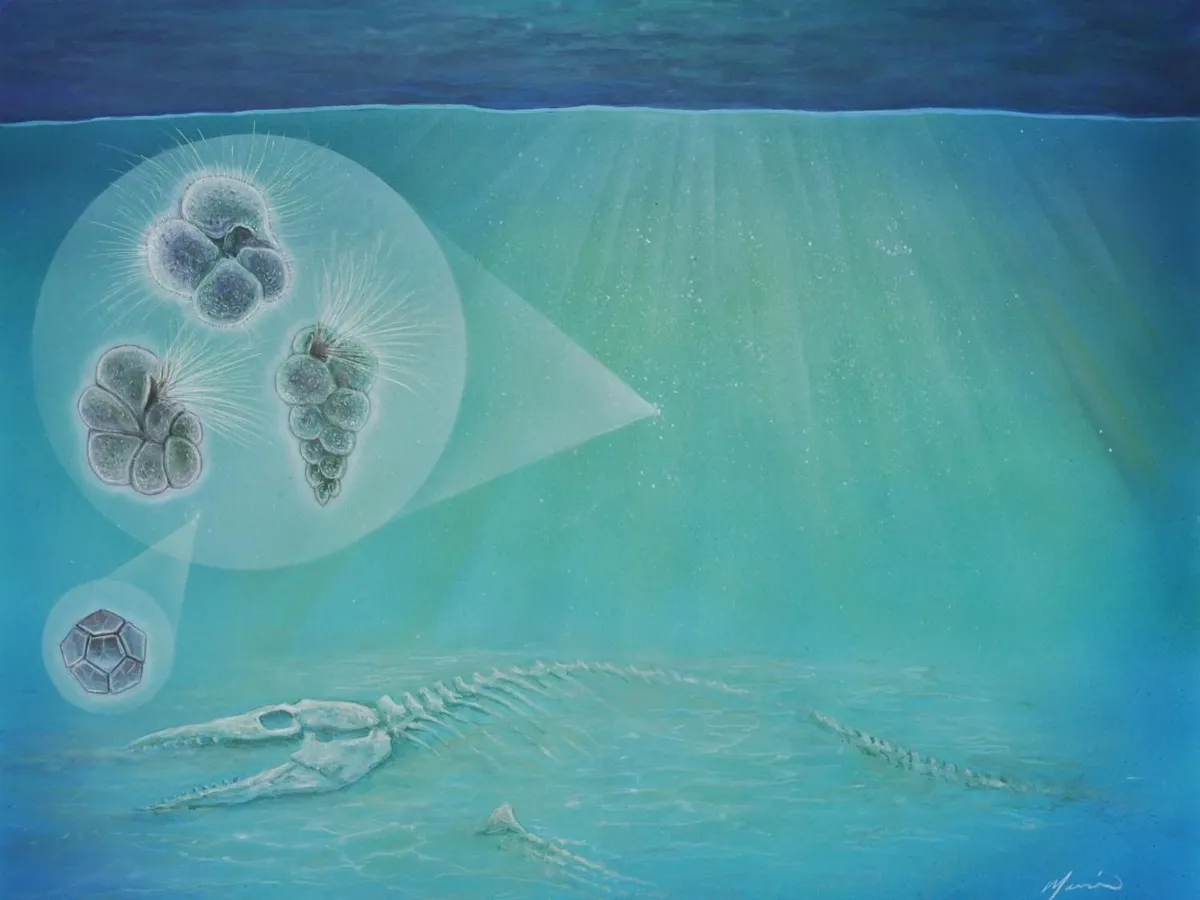
The result was striking. A new species of tiny marine plankton called Parvularugoglobigerina eugubina first appeared in the fossil record between 3,500 and 11,000 years after the asteroid hit. Other plankton species may have shown up even sooner, within just a couple of thousand years.
To put that in perspective: the last ice age lasted about 10,000 years. Life recovered from an extinction event that killed 75 percent of all species on the planet in roughly that same timeframe.
What makes this even more remarkable is that these early plankton weren't starting from scratch. "They had to be consuming something else," notes Timothy Bralower, a paleobiologist at Pennsylvania State University and study co-author. The ocean ecosystem was already beginning to rebuild itself. New species were finding food sources, carving out niches, adapting to a transformed world.
The research hints at something worth holding onto. Evolution and ecosystems can respond far more rapidly to extreme change than we might expect. Vicente Gilabert Pérez, a micropaleontologist at the University of the Basque Country in Spain, puts it plainly: "Evolutionary processes can, under certain circumstances, respond very rapidly to environmental change, especially under extreme conditions."
Bralower sees the deeper implication. "For us, this gives hope that we can build up the blocks of life from damage we're causing to habitats today." It's not a free pass—the Chicxulub impact was still catastrophic, and recovery took millennia. But it's a reminder that life, given even a fraction of a chance, finds a way forward.