Imagine a world where your device doesn't just see you, but sniffs out trouble. Scientists have just laid the groundwork for an "artificial olfactory system" — basically, an electronic nose powered by AI. And it's poised to distinguish tens of thousands of odors, making your dog's sniffing skills look… well, still pretty good, but now it has competition.
This isn't just about making your smart home smell a little fresher. We're talking about a tech that could sniff out bad food, detect dangerous gas leaks, monitor pollution, and even diagnose diseases. Because apparently, that's where we are now: your phone might soon be able to tell if you're sick just by taking a whiff.
The secret sauce? Materials called Metal-Organic Frameworks, or MOFs. Think of them as microscopic sponges with incredibly tiny, customizable pores. Researchers, led by Hyuk-Jun Kwon from the Daegu Gyeongbuk Institute of Science and Technology, realized these MOFs could effectively absorb odor molecules, even at room temperature and with minimal power. Which, if you think about it, is both impressive and slightly terrifying.
We're a new kind of news feed.
Regular news is designed to drain you. We're a non-profit built to restore you. Every story we publish is scored for impact, progress, and hope.
Start Your News DetoxSmelling Like Humans, But Smarter
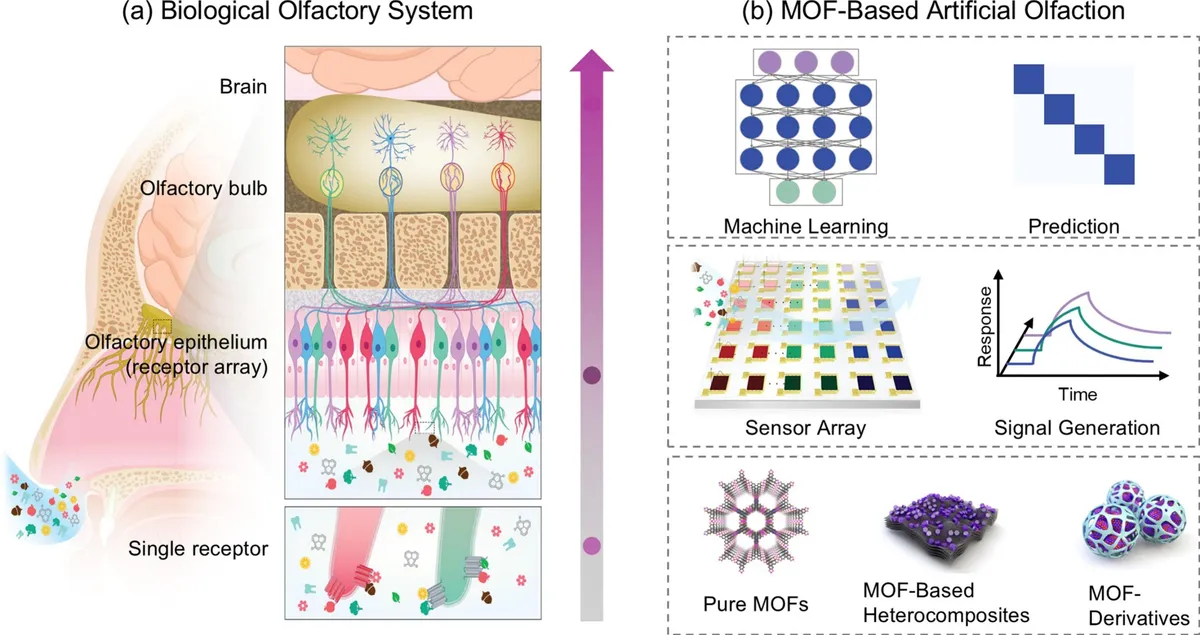
Here’s where it gets really clever. Humans can distinguish countless smells with only a handful of receptors. How? Because each odor activates a combination of receptors, creating a unique pattern. It's like a secret code for every scent.
The team applied this same "combinatorial coding" idea to their MOF sensors. By using many different MOFs, each reacting slightly differently to various odors, they can create a complex signal pattern. Then, they throw AI at it. Machine learning and deep learning algorithms take these intricate MOF signals and classify them, essentially teaching the e-nose to understand what it's smelling.
Kwon noted that MOFs offer a vast library of materials that can be designed to react differently to various odors, much like our own smell receptors. This isn't just a cool gadget; it's a bridge between material science and AI-powered odor recognition, paving the way for smart electronic noses tailored for specific tasks. ## The Future Smells… Interesting
The potential applications are vast and, frankly, a bit mind-bending. Beyond food safety and pollution, these MOF-based e-noses could show up in healthcare for early disease diagnosis, in smart farming, and even in self-driving cars and robots. Imagine a car that sniffs out a gas leak before you even see it, or a robot that detects a spoiled crop just by hovering nearby.
So, the next time you take a deep breath, consider this: an AI-powered nose might soon be doing the same, only with far more precision and a much more impressive resume. Your doctor might just ask you to breathe on your phone. Because, why not?