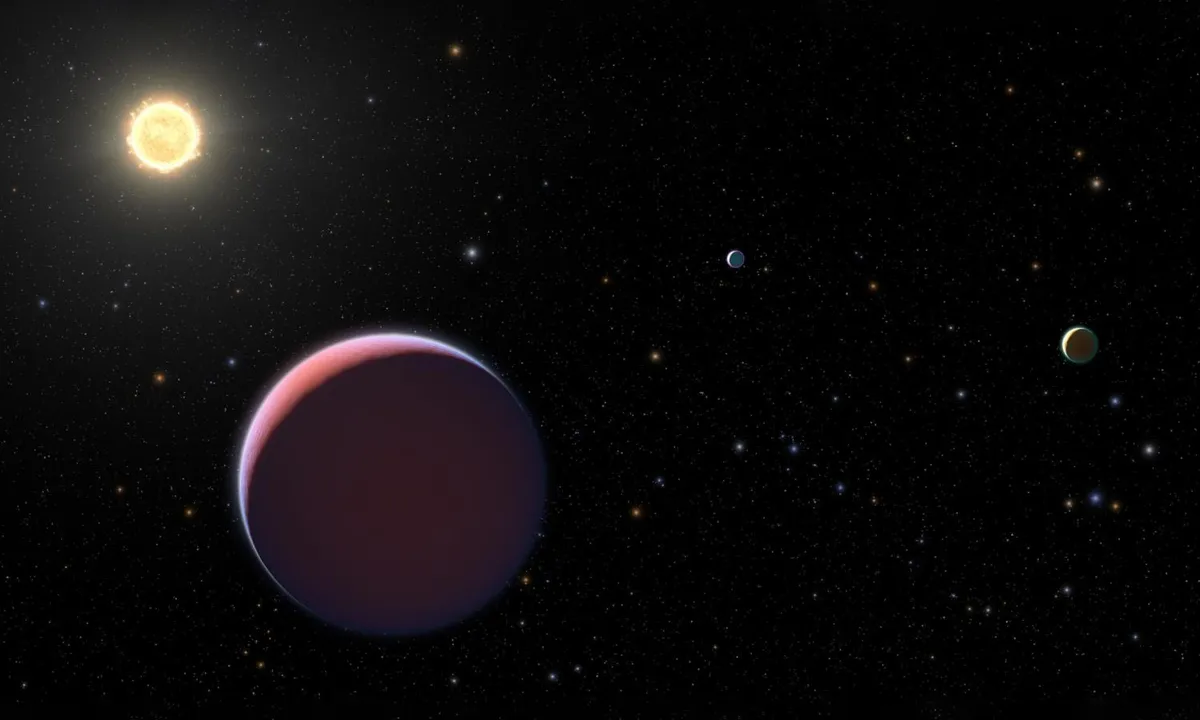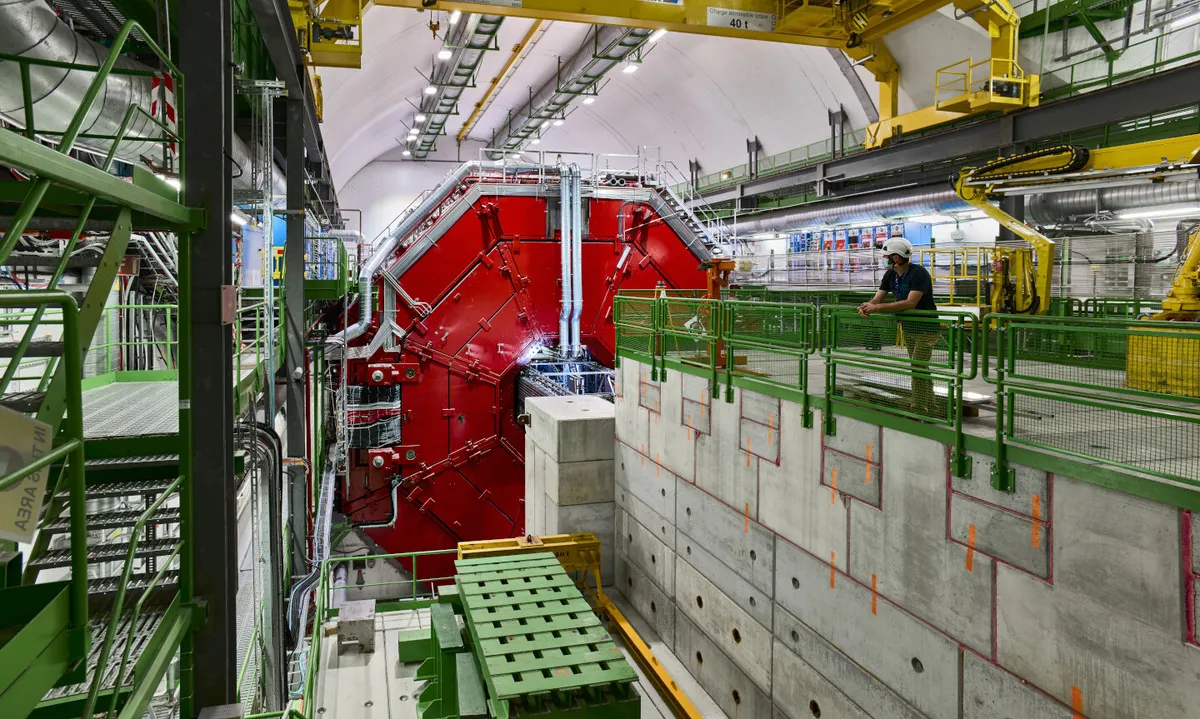
Imagine the universe just after the Big Bang. It was a super-hot, super-dense soup of fundamental particles called quark-gluon plasma (QGP). Now, scientists at CERN's Large Hadron Collider (LHC) think they've spotted signs of this ancient soup forming in collisions much smaller than they ever thought possible.
For years, physicists believed you needed massive particle smash-ups, like lead atoms crashing together, to create the extreme conditions for QGP. But the ALICE Collaboration just found something wild: a similar pattern in collisions involving just protons, or a proton and a lead atom. That's like finding a mini-ocean in a teacup.
The "Flow" of the Quark Soup
Here's the cool part: when particles collide and form this QGP, the new particles don't just spray out randomly. They show a preferred direction, like water flowing in a river. Scientists call this "anisotropic flow." And get this: particles made of three quarks (baryons) show a much stronger flow than particles made of two quarks (mesons).
We're a new kind of news feed.
Regular news is designed to drain you. We're a non-profit built to restore you. Every story we publish is scored for impact, progress, and hope.
Start Your News DetoxThis difference is a big deal. It suggests that inside the QGP, quarks are actually combining to form these new particles. Since baryons have an extra quark, they pick up more of this directional flow. It's a key signature of the quark-gluon plasma.
The ALICE team carefully measured this flow in proton-proton and proton-lead collisions. They saw the exact same pattern as in the big lead-lead collisions: baryons flowing much stronger than mesons. This is the first time anyone has seen such clear evidence of this quark-level flow across so many particle types in these smaller systems.
David Dobrigkeit Chinellato, a lead physicist for ALICE, says these results strongly support the idea that a tiny, expanding system of quarks exists even in these "small" collision events. It's like the early universe in miniature, popping into existence for a fleeting moment.
They even compared their findings to computer simulations. Models that included the idea of quarks flowing and then combining perfectly matched what they observed. Models that didn't? They completely missed the mark.
This isn't just a particle physics win; it's a step closer to understanding the very first moments of our universe. What happens in these tiny collisions helps us peek back in time to the Big Bang itself. And the ALICE team isn't stopping there. New data from oxygen collisions in 2025 will help fill in more pieces of this cosmic puzzle, bridging the gap between the tiny and the massive.
It turns out, some of the biggest secrets are hidden in the smallest crashes.