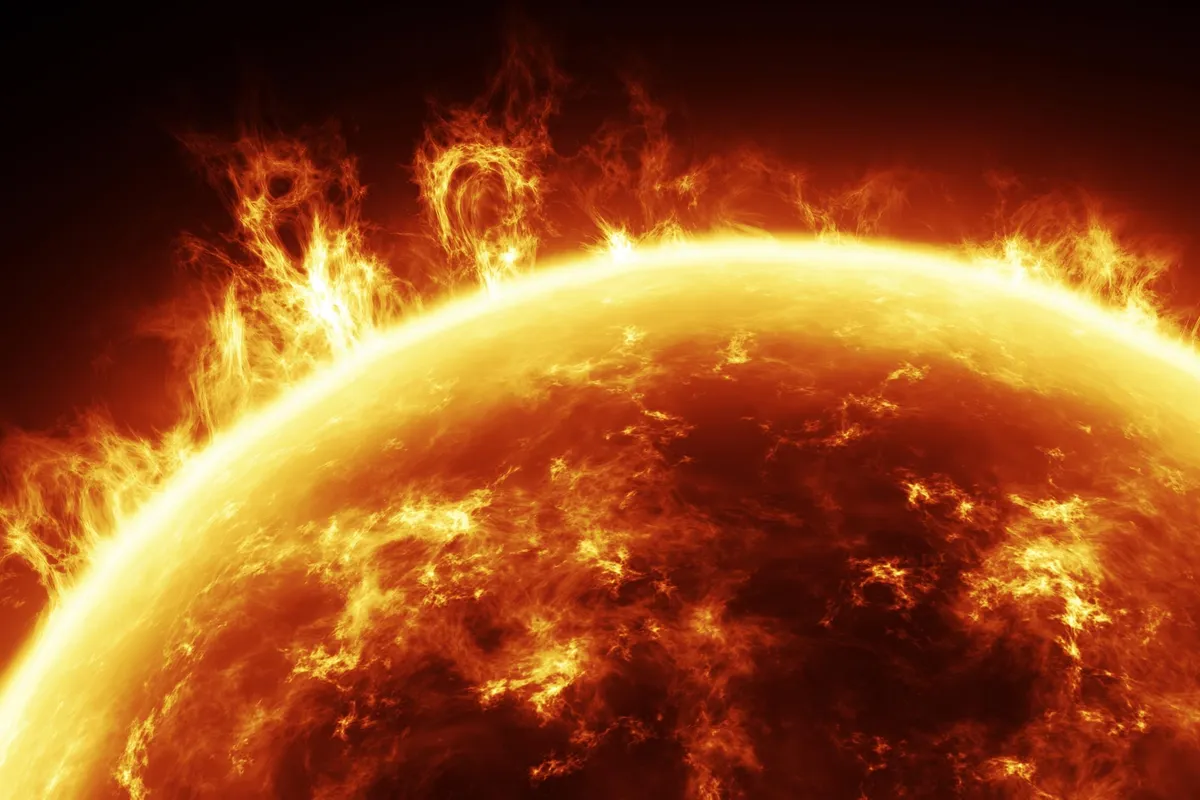
Get this: scientists just found the Sun's hidden magnetic engine. It's not on the surface where we see all the action, but a whopping 124,000 miles down. That's like stacking 16 Earths end-to-end and digging all the way to the last one.
This deep, secret spot is where the Sun actually organizes its magnetic field. Every 11 years, the Sun's magnetic field completely flips. This is why we see sunspots — those dark, cool patches — pop up and then drift across its surface. They're basically giant magnetic storms.
For decades, we've watched these sunspot patterns, but the real control room for all that magnetic drama stayed hidden. Now, researchers at the New Jersey Institute of Technology (NJIT) have finally peered inside.
We're a new kind of news feed.
Regular news is designed to drain you. We're a non-profit built to restore you. Every story we publish is scored for impact, progress, and hope.
Start Your News DetoxThey used nearly 30 years of data from satellites and ground telescopes. These instruments listen to "sound waves" bouncing around inside the Sun, a bit like how we use ultrasound to see inside a body. By tracking these waves, they could map what's happening deep below the fiery surface.
What they found was a "butterfly pattern" of plasma flows, way down in a layer called the tachocline. This pattern perfectly matched the sunspot activity we see on the surface years later. It's like seeing the blueprint for a storm before it even hits.
Why This Matters
This tachocline layer is a narrow region where the Sun's rotation changes sharply. Imagine a massive cosmic blender where different sections spin at different speeds. This creates powerful currents that generate magnetic fields.
Knowing exactly where this "dynamo" operates is a pretty big deal. It means we can start to predict solar activity much better. Things like solar flares and coronal mass ejections — basically, huge burps of energy from the Sun — can mess with our satellites, communications, and even power grids here on Earth.
Right now, most predictions only look at what's happening near the Sun's surface. But these new findings show we need to look much deeper to really get ahead of space weather. It’s like trying to predict a hurricane by only looking at the clouds, instead of the ocean currents driving it.
This discovery also helps us understand other stars. Many stars have magnetic cycles similar to our Sun's, but we can't get close enough to study them in detail. Our Sun is basically a cosmic lab, and what we learn here can help unlock secrets across the galaxy.
Scientists hope to keep listening to the Sun's rumblings. With more data, they'll be able to track these deep magnetic patterns across many solar cycles, giving us an even better heads-up on what our star is cooking up next.