On April 1, 2026, the Artemis II mission launched on a nearly 10-day trip around the Moon. This was the first time NASA's Orion spacecraft carried a crew. NASA astronauts Reid Wiseman, Victor Glover, and Christina Koch, along with CSA (Canadian Space Agency) astronaut Jeremy Hansen, splashed down in the Pacific Ocean near San Diego on April 10.
The crew traveled 252,756 miles from Earth at their farthest point. This set a new record for how far humans have journeyed into space. They also saw the lunar surface in a new way. The Artemis program aims to send astronauts on more complex missions to the Moon for science and to prepare for future human missions to Mars.
Preparing for the Journey
To get ready for lunar exploration, the Artemis II crew trained in Iceland's volcanic areas. They practiced navigation and field geology skills in tough conditions, working as a team. The astronauts collected rock samples using tools like hammers and chisels. They also gave feedback to instructors to improve future Artemis training sites.
We're a new kind of news feed.
Regular news is designed to drain you. We're a non-profit built to restore you. Every story we publish is scored for impact, progress, and hope.
Start Your News DetoxThe crew also trained extensively in NASA’s Orion Crew Survival System (OCSS). This bright orange spacesuit is worn inside the Orion spacecraft during launch and re-entry. Each suit is custom-fitted and includes systems for air, water, food, and waste. In an emergency, it can keep an astronaut alive for up to six days. The crew practiced suit operations in simulated weightlessness and pressurized environments to ensure they would perform well in deep space.
During the mission, the crew shared their personal and professional thoughts about the Moon. These reflections were shaped by years of training.
Launch and Mission to the Moon
NASA’s SLS (Space Launch System) rocket, carrying the Orion spacecraft and its crew, launched on April 1, 2026. It lifted off from Launch Complex 39B at NASA’s Kennedy Space Center in Florida.
Cameras on the SLS rocket, called the Flight Imaging Launch Monitoring Real-time System (FILMRS), captured views of the launch. These cameras are designed to withstand the harsh conditions of the rocket's avionics.
Flight Day Highlights
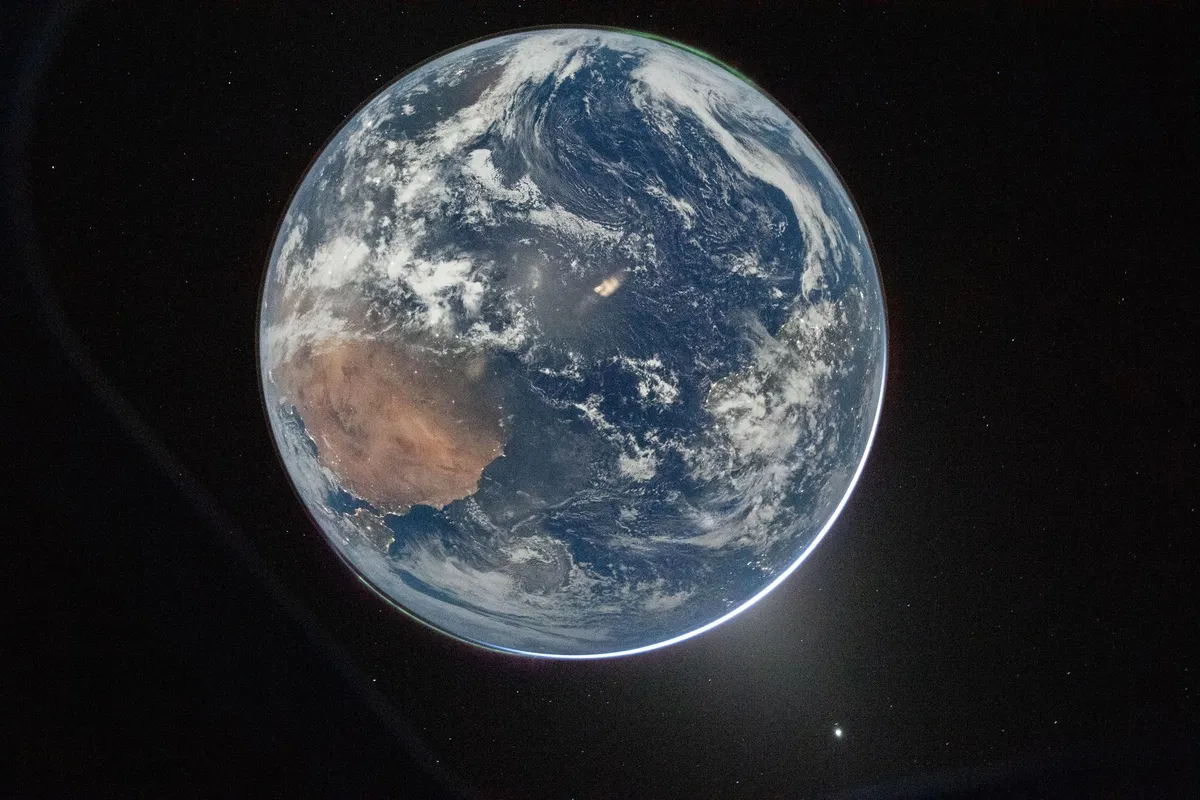
On Flight Day 1, the Orion spacecraft's optical navigation sensor captured a black and white image of Earth. The crew was already traveling farther than humans had in over 50 years.
On Flight Day 2, an astronaut took a picture of Earth from an Orion window after the translunar injection burn.
Flight Day 3 offered a view of a crescent Earth from the Orion spacecraft.
On Flight Day 4, Mission Specialist Christina Koch took a selfie through an Orion window. She used a camera on a solar array wing. Koch held "Rise," the zero-gravity indicator chosen from over 2,600 designs. "Rise" was inspired by the Apollo 8 Earthrise photo.
Flight Day 5 provided a view of the Moon's nearside. Parts of the far side were also visible, including the Orientale basin. Dark areas were ancient lava flows, and Tycho crater, a younger crater, was seen with white rays.
On Flight Day 6, the crew captured an "Earthset" as they went around the Moon's far side. This echoed the iconic Apollo 8 Earthrise photo. The Moon and Earth aligned in the same frame, both partly lit by the Sun.
The Orion spacecraft photographed the Moon backlit by the Sun during a solar eclipse on April 6, 2026. Saturn and Mars were also visible in the image.
Solar array cameras took close-up images of the Orion spacecraft during an inspection.
On Flight Day 7, the crew captured a photo of the Milky Way galaxy.
The Artemis II crew took a group photo with "Rise" inside the Orion spacecraft on their way home.