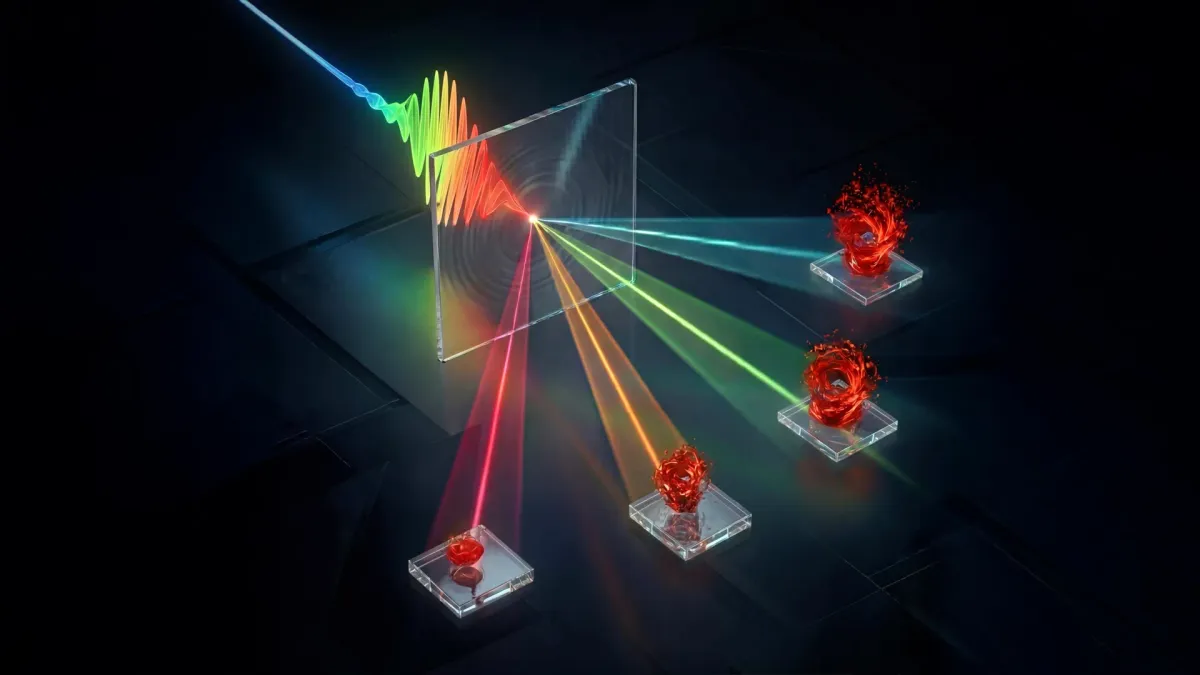
For decades, scientists have been scratching their heads over a peculiar phenomenon in ultrafast lasers: pulses of light that seem to “breathe.” They expand and contract like tiny, rapid lungs. Now, an international team has finally unveiled a single mathematical model that explains this laser respiration, merging two previously distinct theories into one elegant solution.
Ultrafast lasers are the rockstars of precision, spitting out light bursts so short they're measured in picoseconds or femtoseconds. We’re talking about the kind of speed crucial for delicate eye surgeries, peering inside the human body with advanced imaging, and zapping materials in high-tech manufacturing. Understanding their quirks isn't just academic; it’s about making them more reliable and specialized for whatever wild uses we dream up next.
The Laser's Little Secret
Inside these lasers, light pulses zip around a space called a cavity. Sometimes, they form stable waves known as solitons. Think of them as light's disciplined athletes — unlike regular light that spreads out, solitons maintain their shape. Usually, these pulses are steady, like a metronome. That’s “steady state emission.”
We're a new kind of news feed.
Regular news is designed to drain you. We're a non-profit built to restore you. Every story we publish is scored for impact, progress, and hope.
Start Your News DetoxBut then there are the "breathers." Their solitons don't just hold their shape; they morph. They expand and contract repeatedly as they travel through the cavity, like a chest taking a breath. The laser’s output is constantly changing, never quite settling down.
Before this breakthrough, scientists had two different mathematical explanations for this breathing, depending on the laser’s power level. Above a certain power threshold, the solitons would breathe quickly, completing their cycles in just a few passes. Below that threshold? The process slowed to a glacial pace, taking hundreds or even thousands of cycles to complete one “breath.”
Unifying the Breath
Dr. Sonia Boscolo from Aston University led the charge, developing a new model that brings both behaviors under one roof. The trick was to combine the rapid light changes within the cavity with the slower shifts in the laser's energy supply. Turns out, these two types of breathing aren't separate phenomena; they're just different manifestations of the same fundamental physics. Their findings were just published in Physical Review Letters.
This unified framework doesn't just explain what happens; it reveals why. The slow, below-threshold breathing is a combo of something called Q-switching and soliton shaping. The faster, above-threshold breathing is mostly due to Kerr nonlinearity and dispersion. Because apparently, that’s where we are now. And the model predicts both the fast and the slow cycles simultaneously, which was previously considered impossible.
This discovery fills a gaping hole in laser science, giving engineers a single, powerful tool to design the next generation of light-based tech. No more juggling multiple simulations. As our hunger for more reliable and powerful optical systems grows, having a single framework to predict and study complex laser behavior will be nothing short of a superpower. Because who wouldn't want a laser that knows how to take a deep breath?