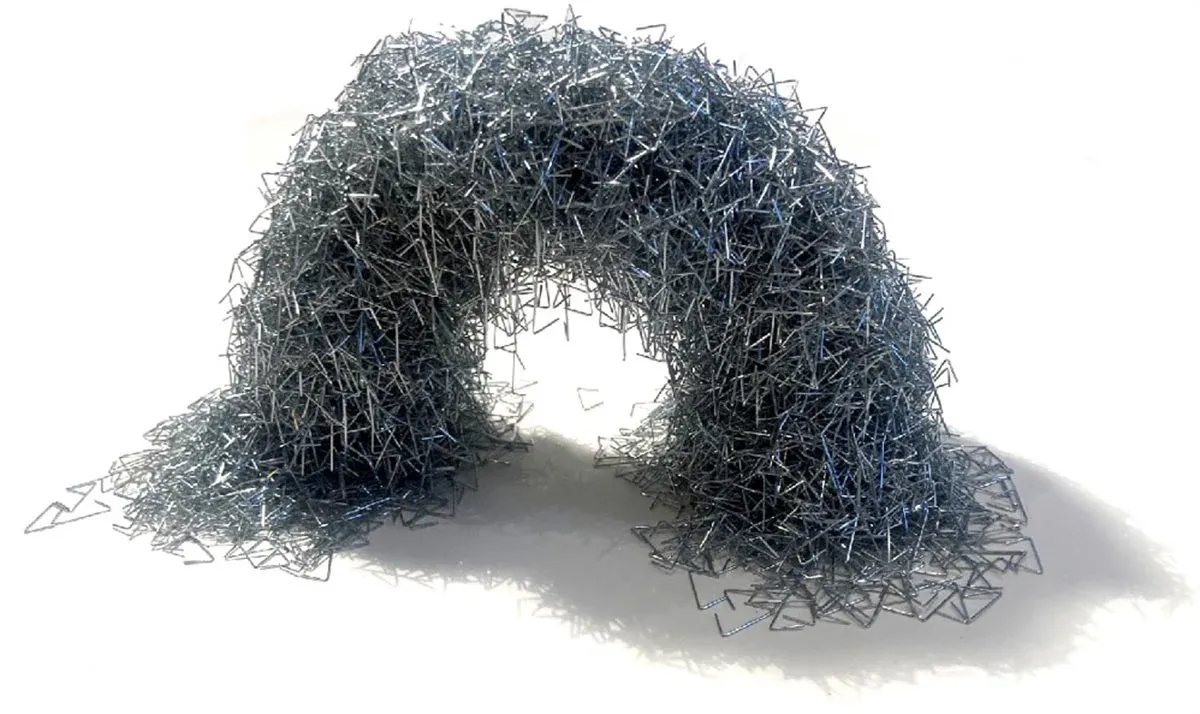
Imagine a pile of office staples. Pull on the clump, and it resists, acting like a solid brick. But give it a good shake, and suddenly, it's a loose, jumbled mess again. It's a party trick of sorts, and now, it's inspiring engineers at the University of Colorado Boulder to rethink how we build everything.
Instead of rigid blocks or chemical bonds, these folks are exploring materials made of tiny, specially shaped particles that can hook into each other and then, crucially, unhook when you want them to. Because apparently, that's where we are now: designing materials that can both hold together and fall apart on command.
Professor Francois Barthelat, who leads the Laboratory for Advanced Materials & Bioinspiration, says his team has been playing with building blocks for years. But it was only recently they started looking at these interlocking, entangled particles. He's pretty jazzed about the possibilities, and honestly, so are we.
We're a new kind of news feed.
Regular news is designed to drain you. We're a non-profit built to restore you. Every story we publish is scored for impact, progress, and hope.
Start Your News DetoxNature's Surprisingly Tangled Wisdom
The secret sauce, according to a new study in the Journal of Applied Physics, is something called "entanglement." Think of it as particles getting all intertwined and forming connections. It's not a new concept for Mother Nature; birds' nests are basically just woven sticks, and even our bones rely on rigid minerals and soft proteins playing nice.
The trick, of course, is getting engineered materials to do the same. Barthelat's team found that the whole thing hinges on the shape of the particles. PhD student Youhan Sohn pointed out that smooth sand grains can't interlock. But change the shape of that sand grain? Suddenly, it's a whole new ballgame.
After figuring out this crucial detail, the researchers used Monte Carlo simulations (which sounds like a fancy casino game but is actually a computational method) to predict how different shapes would interact. Their goal: find the geometry that would create the most entanglement. Then, they did actual pickup tests to see if their theories held water. Or, you know, staples.
The Staple Solution and the T-1000 Dream
The experiments pointed to a surprisingly simple hero: a "two-legged" particle, shaped exactly like a staple. This unassuming design showed the strongest tendency to interlock, which is both elegant and slightly ironic.
Even better, this staple-like design offered a rare combo: high tensile strength (how much it resists being pulled apart) and toughness (how much energy it can absorb before breaking). As PhD student Saeed Pezeshki put it, their entangled granular material shows both high strength and toughness at the same time. Which, if you think about it, is both impressive and slightly terrifying.
But here's the kicker: the material can also assemble and break apart fast. By using different vibrations, the researchers could control how tightly the particles linked up. Gentle vibrations made them strong; stronger vibrations made them disengage. Barthelat described it as a material that's not quite liquid, not quite solid. It's just... strange.
So, what's this mean for the future? Well, for starters, sustainability. Imagine buildings or bridges that could be disassembled and reused instead of demolished. Or swarm robotics, where tiny robots could entangle, perform a task, and then disentangle when they're done. Because apparently, robots need to be able to hug now.
Barthelat even compared it to the T-1000 from Terminator 2, the liquid metal assassin who could slide under a door and reform. While scaling up is still a challenge, the idea of shape-shifting materials that can be anything they want to be, when they want to be it, is definitely gaining traction. For now, they're experimenting with even spikier particles. Because sometimes, the future just needs more burrs.