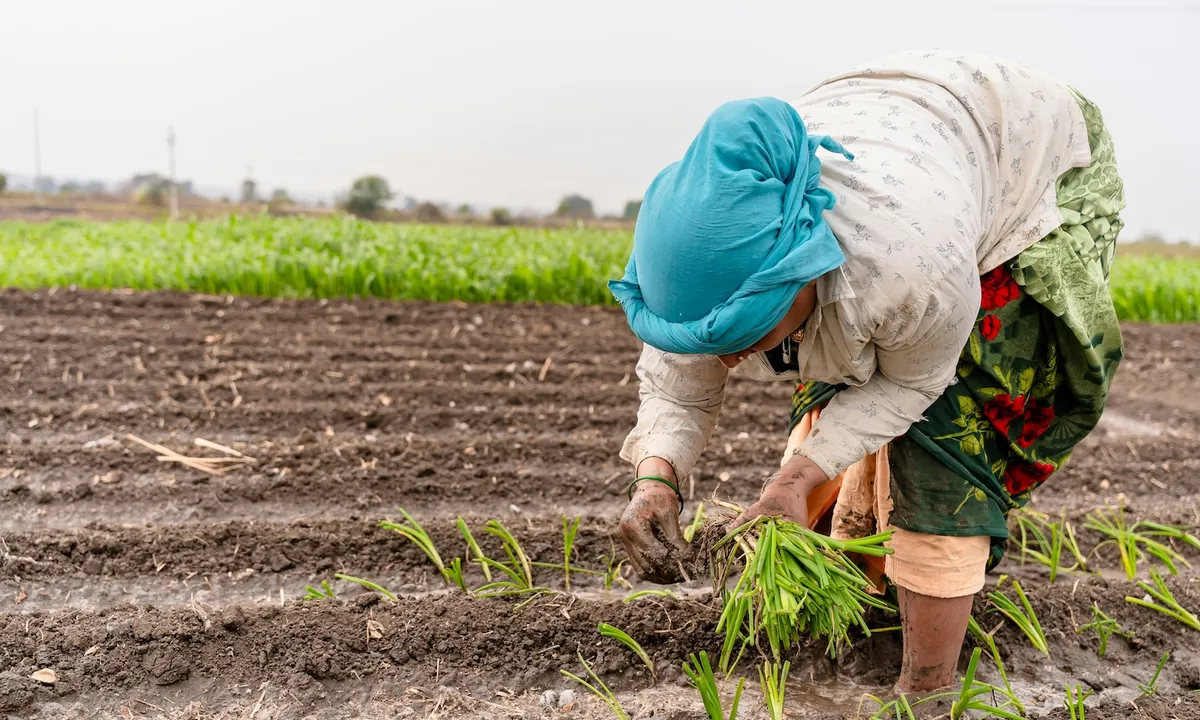
When unseasonal rains hit twice in a month, a woman farmer in rural India doesn't just lose a crop—she loses the income she needs to keep her family fed and housed. That's becoming the new normal, and it's reshaping who works the land.
More than half of the 3.8 million women organized by SEWA (Self-Employed Women's Association) across India work in agriculture or as farm laborers. As rural men migrate to cities for steadier work, women are inheriting farms without inheriting the resources or protections men once had. Gender discrimination keeps many from owning land outright or accessing credit. Climate stress—now hitting multiple times a month instead of once a season—turns precarity into crisis.
SEWA, which has spent over 50 years organizing India's informal workers, has pivoted to climate resilience as an urgent survival issue. The organization's response reveals something important about adaptation: it doesn't require waiting for governments or corporations to act. It requires meeting people where they are.
We're a new kind of news feed.
Regular news is designed to drain you. We're a non-profit built to restore you. Every story we publish is scored for impact, progress, and hope.
Start Your News DetoxInsurance That Pays Before the Damage Spreads
Parametric climate insurance sounds technical, but it's elegant in practice. Instead of waiting for crop assessments after disaster strikes—a process that can take months and leave families destitute—the insurance triggers automatically when measurable thresholds are crossed: temperature spikes above a certain point, rainfall exceeds a predetermined level, a cyclone hits a tracked zone. The payout arrives fast, before debt spirals or eviction notices land.
The uptake suggests it's working. In 2022, 20,000 SEWA members enrolled. By 2025, roughly 250,000 had joined. That's not a trivial expansion, and it's happening in a context where most rural women have no safety net at all.
But insurance alone doesn't build long-term resilience. SEWA has layered in two other initiatives. A "climate school" teaches women about what's driving the crisis and what they can do about it—knowledge that shifts from passive victim to informed actor. More intriguingly, SEWA is training "climate entrepreneurs": women who help their communities transition to cleaner energy sources. They earn commissions by connecting households to solar-powered irrigation pumps and efficient appliances, which means they're incentivized to solve the problem, not just talk about it.
This model matters because it doesn't import solutions from outside. It builds local capacity and creates income within the community. A woman trained as a climate entrepreneur becomes a trusted neighbor who understands the technology and the local context—far more effective than a government program administered by someone from the city.
The deeper insight here is about power. SEWA's founder Reema Nanavaty frames the work simply: "We are not here to fight a government or a trader or a contractor, but how do we fight poverty and earn a life of dignity and self respect." Climate adaptation, in this framing, is inseparable from economic justice. You can't ask a woman to invest in a solar pump if she has no capital and no access to credit. You can't expect her to wait out a drought if she has no insurance. Resilience, for people living on the edge, means both climate-smart farming and the financial systems that make it possible.
As extreme weather becomes more frequent and unpredictable, the question isn't whether women farmers will adapt—they have no choice. The question is whether they'll adapt with agency and income, or in desperation. SEWA's work suggests that when you equip women with tools, knowledge, and financial security, adaptation becomes a pathway to dignity rather than a scramble for survival.