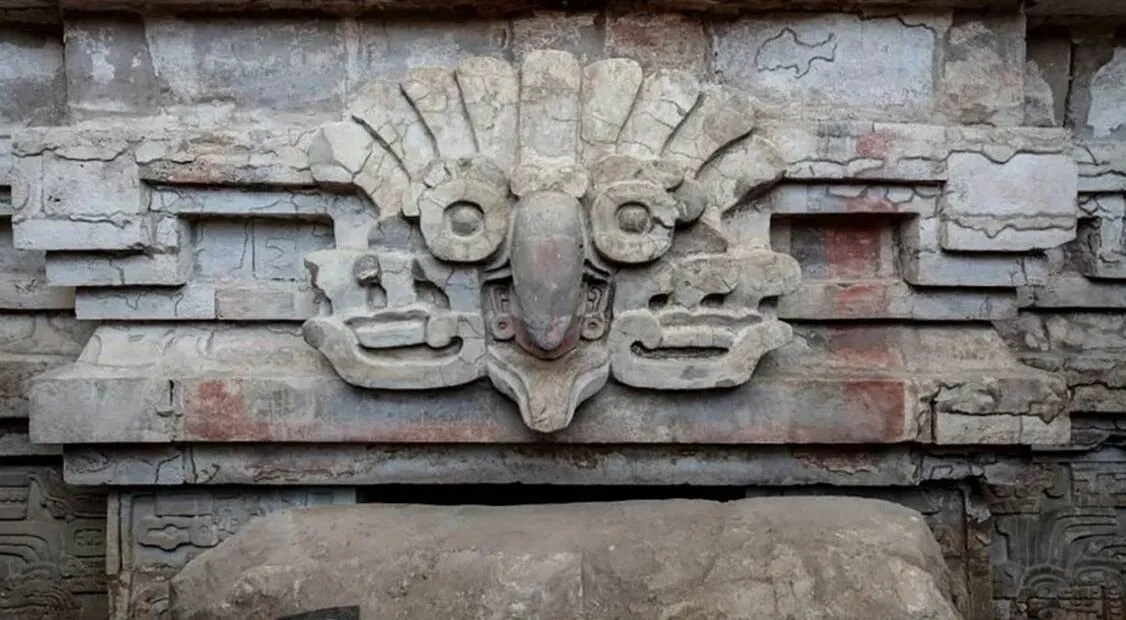
Archaeologists in Mexico have uncovered a 1,400-year-old tomb that's essentially a time capsule of Zapotec belief. The burial chamber in San Pablo Huitzo, in the state of Oaxaca, is decorated with murals so vivid—greens, whites, blues, reds—that they could have been painted last century. But what stops you in the chamber is the frieze: a massive owl head with a human face caught in its beak.
In Zapotec mythology, owls weren't cute. They symbolized night and death, and this one appears to represent the passage of the person buried here. The owl's beak likely contains the head of the deceased—a visual metaphor for transformation that speaks to how this culture understood mortality.
Mexico's National Institute of Anthropology and History called it the most significant archaeological discovery in Mexico over the past decade. That's not hyperbole. The level of preservation is extraordinary. At the tomb's entrance stand two carved human figures holding artifacts, likely guardians meant to protect the burial. Every surface tells a story about Zapotec funerary tradition and social hierarchy.
We're a new kind of news feed.
Regular news is designed to drain you. We're a non-profit built to restore you. Every story we publish is scored for impact, progress, and hope.
Start Your News DetoxWhat this reveals
The Zapotecs inhabited parts of modern-day Oaxaca starting in the 6th century BCE—they were a sophisticated civilization with complex beliefs about death and the afterlife. They clashed with the Aztecs for centuries, and their descendants remain a recognized ethnic group in Mexico today. This tomb gives researchers concrete evidence of how they structured their society, how they honored their dead, and what they believed happened after death.
President Claudia Sheinbaum noted that the discovery will illuminate Zapotec social organization and ritual practices. That matters because so much of pre-Columbian history was lost or filtered through colonial accounts. Direct evidence like this—pigment on stone, carved symbols, architectural choices—speaks in the original voice.
Conservators are now racing against time and nature. Insects, tree roots, humidity, and temperature shifts all threaten the murals. The work to stabilize and protect the tomb is ongoing, which means researchers will spend years carefully extracting knowledge from what's been preserved. The real excavation hasn't even begun.