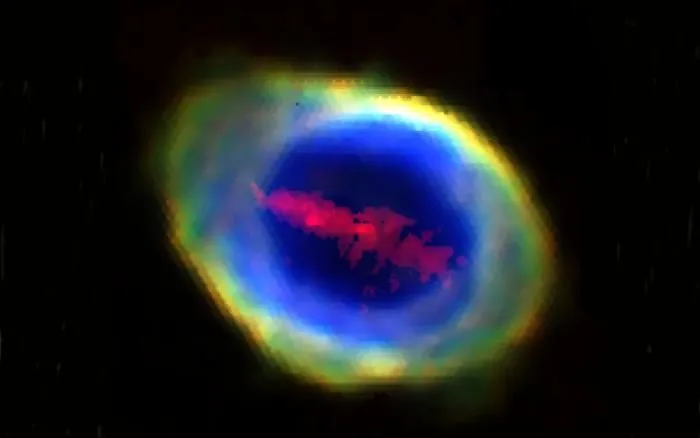
We've been studying the Ring Nebula for nearly 250 years. But it took a new telescope tool, pointed at the same familiar cloud, to reveal something that was hiding in plain sight: a massive bar of iron atoms stretching across the middle.
The Ring Nebula—also called Messier 57—sits about 2,500 light-years away in the constellation Lyra. You can see it with binoculars if you know where to look. It's the glowing remnant of a star that died a few thousand years ago, ejecting its outer layers into space in a shape that vaguely resembles a cosmic doughnut.
When Roger Wesson and his colleagues at Cardiff University pointed the WEAVE instrument (William Herschel Telescope Enhanced Area Velocity Explorer) at the nebula in 2023, they weren't looking for anything new. They were testing the tool's ability to map the chemical composition of the entire nebula at once. Instead of taking a single snapshot, WEAVE breaks visible light into different wavelengths across the whole object, creating a detailed chemical map.
We're a new kind of news feed.
Regular news is designed to drain you. We're a non-profit built to restore you. Every story we publish is scored for impact, progress, and hope.
Start Your News DetoxThat's when the iron bar "popped out as clear as anything," Wesson says. It stretches across a distance roughly 500 times the width of Pluto's orbit—a genuinely enormous structure—and sits tucked inside the nebula's innermost ring. The cumulative mass of all that iron roughly equals the mass of Mars.
What makes this discovery genuinely puzzling is that the iron doesn't behave like the rest of the nebula. The Ring Nebula contains helium, hydrogen, oxygen, nitrogen, and sulfur spread throughout. But this iron bar appears isolated, with none of those other elements mixed in. "It's weird," says Janet Drew, an astrophysicist at University College London and a co-author on the study, published in Monthly Notices of the Royal Astronomical Society.
The team has two working hypotheses. The iron bar might represent a previously unknown stage in how dying stars shed their layers—a process we thought we understood pretty well. Or it could be the vaporized remnants of a rocky planet that got caught in the stellar explosion. Neither explanation is particularly satisfying yet, which is exactly why this matters. A discovery that doesn't fit existing models is the kind that forces us to rethink how these cosmic processes actually work.
Wesson suspects this won't be a one-off oddity. If the Ring Nebula harbors a hidden iron bar, other nebulas probably do too—we've just never had the tools to see them. The next step is to keep looking, and to gather more data on this particular bar to trace its origins.