Astronomers have found the most distant dormant black hole ever. This "sleeping giant" is about 6 billion times the mass of our Sun. It offers a rare look at a huge cosmic object that is no longer actively feeding.
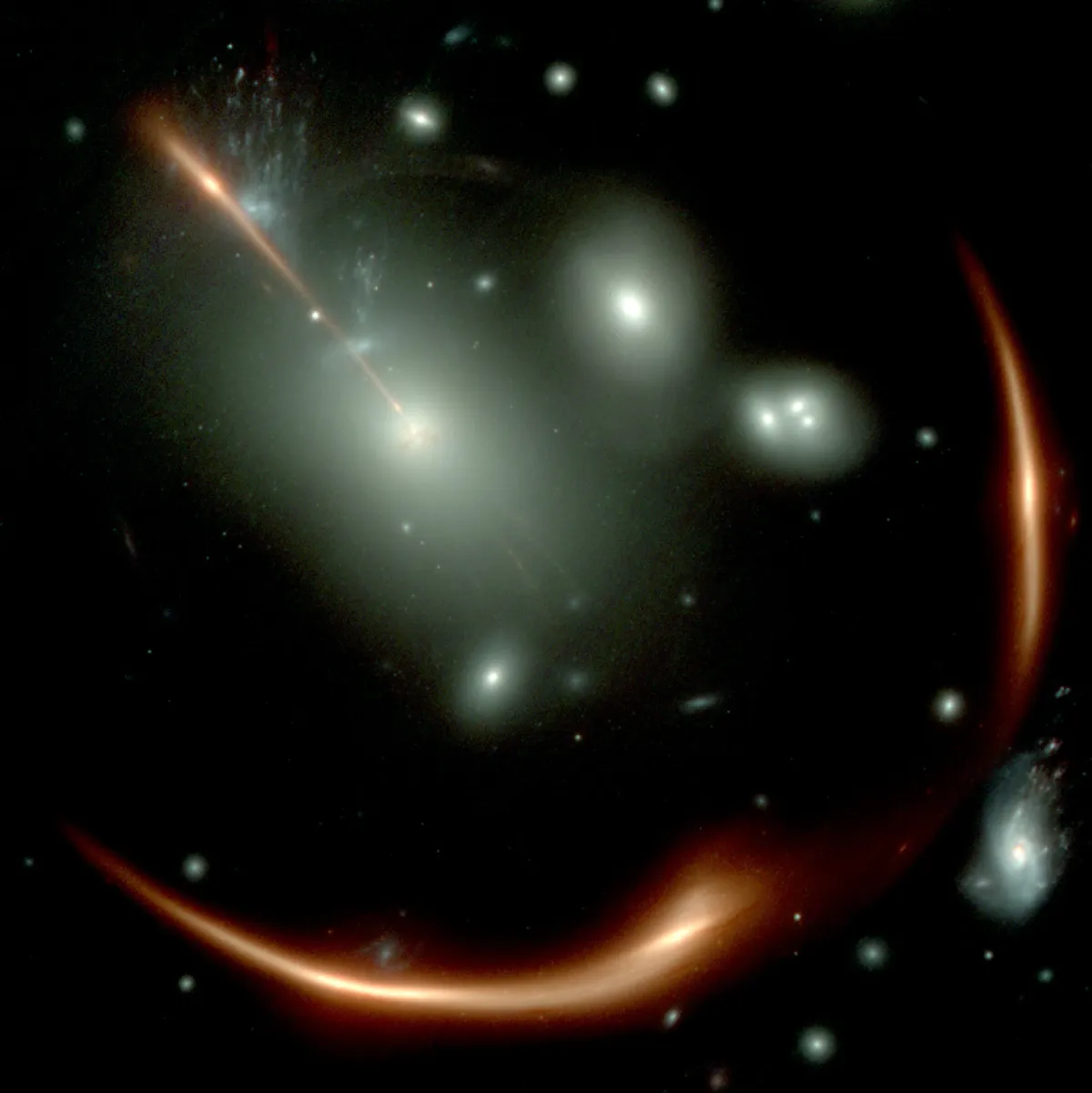
This black hole is in a galaxy called MRG-M0138, over 10 billion light-years away. This discovery breaks the previous record for a dormant black hole by 15 times.
How They Found a Quiet Giant
Black holes don't give off light themselves. But when gas falls into them, it can release a lot of radiation, making them very bright. These bright ones are called quasars or active galactic nuclei.
We're a new kind of news feed.
Regular news is designed to drain you. We're a non-profit built to restore you. Every story we publish is scored for impact, progress, and hope.
Start Your News DetoxThe black hole in MRG-M0138 is inactive, meaning no gas is falling into it right now. So, astronomers could only find it by seeing how its gravity affected nearby stars.
To figure out its mass, researchers used the James Webb Space Telescope (JWST). They watched how stars moved around the invisible black hole. This method, called stellar dynamics, has been used for closer galaxies. This is the first time it worked for such a far-off object.
Professor Richard Ellis from UCL Physics & Astronomy explained that by tracking how stars move in the galaxy's core, they could measure the black hole's mass. This shows that the technique can be used for early universe galaxies. It will help scientists understand how black holes grow and shape galaxies over time.
Magnified by Space
Normally, it would be impossible to see stars moving in such a distant galaxy. But the team used a natural cosmic trick called gravitational lensing. Another galaxy between Earth and MRG-M0138 bent and refocused the light from the distant galaxy. This made the image 30 times bigger.
This magnification allowed the team to see the galaxy's inner structure in great detail. Dr. Andrew Newman from Carnegie Science in Pasadena, California, said that combining JWST data with gravitational lensing let them look inside the black hole's "sphere of influence," where its gravity speeds up stars. He noted this is one of the best ways to weigh a black hole, and they were excited to use it for such an early time in cosmic history.
Clues to Galaxy Evolution
This discovery gives important clues about how galaxies and their central black holes grew together in the early universe. In nearby galaxies, there's a strong link between a galaxy's mass and its black hole's mass. But scientists need more data from earlier times to understand how this relationship started.
The team found that both the black hole and its host galaxy are dormant. The galaxy isn't making new stars anymore. This suggests that MRG-M0138 might have once had a bright quasar. Researchers think that as the black hole grew quickly, the energy it released either heated up or pushed out the gas needed for new stars, stopping star formation.
Scientists expect JWST and other telescopes to find many more dormant black holes from the early universe. These findings could show more about how black holes stop star formation and how dormant black holes can become active again when new material flows into them.
Deep Dive & References
A stellar dynamical mass measurement of an inactive black hole at redshift 2 - Science, 2026