Astronomers have finally found evidence of a wind blowing from Sagittarius A* (Sgr A*), the supermassive black hole at the center of our Milky Way galaxy. This discovery solves a mystery that has puzzled scientists for over 50 years. It also helps us understand how the black hole interacts with its surroundings.
For decades, theories suggested that Sgr A* must produce a wind. However, no one had been able to observe it directly until now.
Finding the Elusive Black Hole Wind
Researchers at Northwestern University used advanced observations to get the clearest view yet of the area around Sgr A*. This allowed them to spot the subtle signs of the wind.
We're a new kind of news feed.
Regular news is designed to drain you. We're a non-profit built to restore you. Every story we publish is scored for impact, progress, and hope.
Start Your News DetoxMark Gorski, who co-led the study, explained that black holes must create a wind unless they are in a perfect vacuum. Since no such vacuum exists in space, a wind was expected. The new observations finally provided a clear enough view to see its effects.
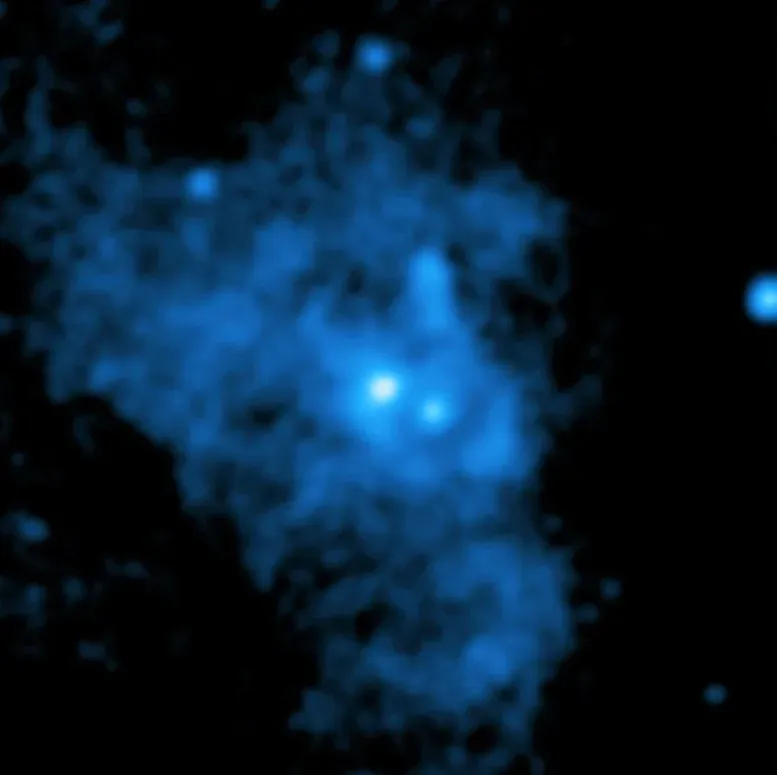
(Sgr A*), the supermassive black hole in the center of our galaxy. The white dot in the center of the image shows Sgr A*. In orange is data from the Atacama Large Millimeter/Submillimeter Array (ALMA) radio telescopes in Chile, mapping the location of cold gas composed of carbon monoxide in the image. In blue is X-ray data from NASA’s Chandra X-ray Observatory. A large cone-shaped cavity, visible as an absence of cold gas in the ALMA data, is filled by hot X-ray-emitting gas in the Chandra data. Researchers think a hot, energetic wind blowing from Sgr A* created this structure by sweeping the cold gas away or heating it up. Credit: X-ray: NASA/CXC/Northwestern Univ./M. Gorski; Radio: ESO/NAOJ/NRAO/ALMA; Image processing: NASA/CXC/SAO/K. Arcand and P. Edmonds*
Elena Murchikova, also a co-leader, noted that molecular gas very close to the black hole feeds it. She added that the wind is not very powerful and its direction likely changes over time. This suggests our black hole is not unique.
How Black Hole Winds Affect Galaxies
Black holes are known for pulling in matter, but they can also push it away. When gas spirals into an active black hole, it speeds up to nearly the speed of light. This process creates energy and pressure, which can launch some material back into space as winds or jets.
Scientists had previously found signs that Sgr A* had erupted in the past. However, evidence of a continuous wind was missing. The Northwestern team believes this is because the black hole is currently in a quiet state. It is also hard to observe because we have to look through a lot of gas and dust in our galaxy.
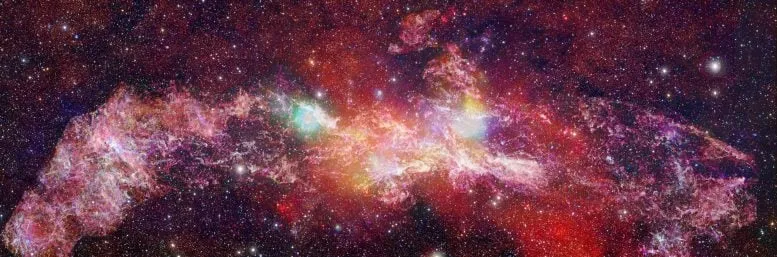 Composite image of the Milky Way center, combining radio date from ALMA and X-ray data from Chandra. Credit: ALMA(ESO/NAOJ/NRAO)/S. Longmore et al. Background: ESO/D. Minniti et al.
The team used five years of data from the Atacama Large Millimeter/Submillimeter Array (ALMA) in Chile. They created the most detailed image yet of the cold molecular gas near Sgr A*. This image showed gas within about three light-years of the black hole.
After removing the black hole's bright radio emissions, they made a map that was much clearer than previous ones. This new view revealed structures never seen before.
A Cone-Shaped Cavity Points to the Wind
The researchers found a large, cone-shaped cavity about three light-years long. This area had no cold molecular gas. They concluded that a hot wind from Sgr A* was the most likely cause. The wind either pushed the cold gas away or heated it up so it couldn't be detected.
Gorski explained that hot material from the black hole would not mix with cold material. It would either push the cold material out or heat it. If it gets too hot, the cold gas becomes invisible.
The team also considered if winds from stars could create such a large cleared-out region. They found that even all the nearby stars combined couldn't provide enough energy. The cavity's shape also pointed directly at the black hole.
To confirm their findings, the researchers compared their results with X-ray observations from NASA’s Chandra X-ray Observatory. Chandra had detected bright X-ray emissions in the same area. This X-ray data perfectly matched the gas-free cone seen in the ALMA observations.
Murchikova noted that when you find something new, the first thought is often about potential errors. However, overlaying their image with the X-ray data made everything fit together.
The team estimates the wind has been active for at least 20,000 years. The findings also suggest that Sgr A* is relatively quiet compared to many other supermassive black holes in other galaxies. This gives scientists a unique chance to study a black hole in its "quiet state," which is its most common state.
Deep Dive & References
The Discovery of an Active Wind from the Milky Way’s Central Black Hole - The Astrophysical Journal Letters, 2026