A tiny cluster of cells has a really important job: telling an embryo where to put the head, where to put the tail, and where to put, well, everything else. Scientists have known about this biological command center, called an “organizer,” for a century — but only in animals with backbones.
Now, researchers in Germany have found this ancient system goes much, much further back in animal history. Like, way back. To creatures that predate jellyfish, for crying out loud.
Scientists at Friedrich Schiller University Jena just reported in Nature that comb jellies — some of the oldest animal groups on Earth — use a strikingly similar system. This suggests the fundamental instructions for building an animal body might have appeared incredibly early in the evolution of multicellular life. Which, if you think about it, is both impressive and slightly terrifying.
We're a new kind of news feed.
Regular news is designed to drain you. We're a non-profit built to restore you. Every story we publish is scored for impact, progress, and hope.
Start Your News DetoxA Century-Old Idea, New Discoveries
This whole discovery builds on a famous experiment from 1924. Biologist Hans Spemann and his student Hilde Mangold discovered the “organizer” in amphibian embryos. They moved a bit of tissue from one embryo to another, and the second embryo grew a whole second body. Spemann snagged a Nobel Prize in 1935 for this work. Mangold, tragically, died in a fire at 25 and never saw her research’s full impact.
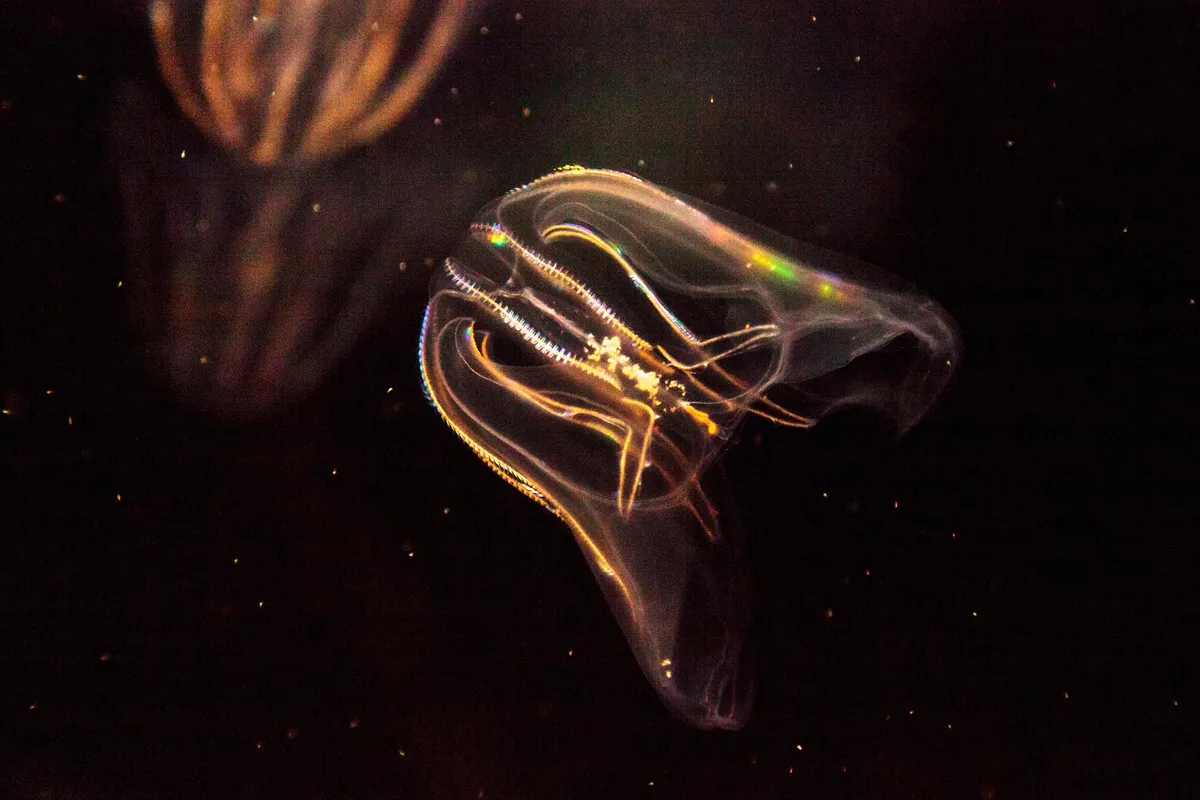
Fast forward to today, and the Jena team basically hit rewind. They repeated the experiment with comb jellies. These delicate, shimmering marine animals are often mistaken for jellyfish but are actually a separate, even older group. Think of them as the OG ocean residents.
The researchers moved tissue from one comb jelly embryo to another. And guess what? The recipient embryo grew a second body. Just like in the amphibian experiment. The transplanted cells influenced their new neighbors, proving this ancient mechanism is still kicking.
Professor Andreas Hejnol, who led the Jena team, noted that comb jellies (or Ctenophora) branched off from our own lineage about 700 million years ago. Let that satisfyingly round number sink in.
Tiny Surgery, Big Implications
This wasn't exactly a simple procedure. The comb jelly species they used can grow up to 12 centimeters long, but its embryos are only about 120 micrometers across — roughly the width of a human hair. Biologist Dr. Stanislav Kremnyov managed to transplant tissue samples a mere 20 micrometers in size. The Nature editor, apparently, quipped that the experiments must have felt like “dissecting clouds.” Which, honestly, sounds about right.
But they didn't stop there. They took the experiment a step further, moving organizer tissue not just between comb jelly embryos, but also into a sea anemone embryo. Sea anemones are from the cnidarian lineage, which split from the ctenophore lineage about 60 million years after ctenophores split from us. So, we're talking about a serious evolutionary gulf here.
Again, the transplanted tissue caused a second body axis to form. Hejnol called this “xenotransplantation” — moving tissue between such vastly different animal groups across millions of years — unprecedented. It even helped identify the organizer gene in the sea anemone for the first time.
So, it turns out this fundamental blueprint for building a body isn't just for the vertebrates among us. It’s a foundational piece of the animal kingdom, going back to some of the earliest, cloud-like creatures to ever float through the ocean.