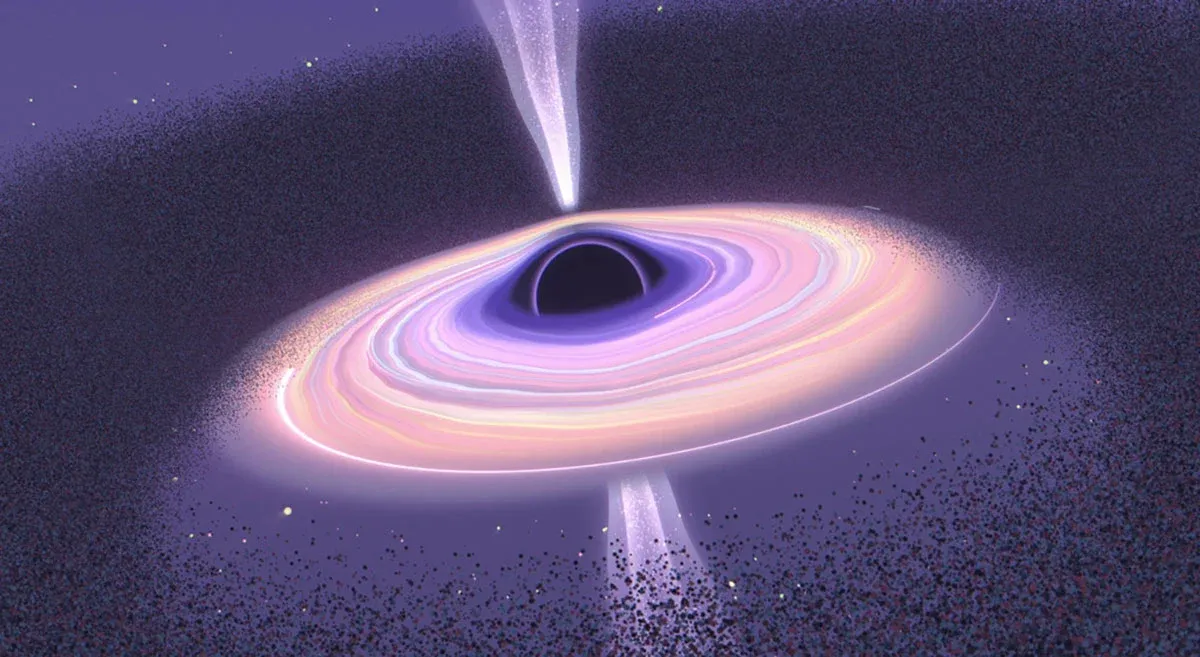
When galaxies decide to have a fender bender, their resident supermassive black holes often follow suit. They merge. And sometimes, the newly supersized black hole gets a cosmic kick in the pants, rocketing away from its galactic home base at truly astonishing speeds.
Finding these runaway giants has been a bit of a celestial scavenger hunt. Until now, perhaps. A new study suggests a rather elegant solution: look for the dust they're trailing like a disgruntled cartoon character.
The Great Escape
So, why the sudden eviction? Blame Einstein. When two black holes become one, they don't just quietly settle down; they send out gravitational waves. If the merging black holes weren't perfectly matched in mass or their spins were a bit wonky, these waves can act like a cosmic slingshot, propelling the new, bigger black hole in the opposite direction.
We're a new kind of news feed.
Regular news is designed to drain you. We're a non-profit built to restore you. Every story we publish is scored for impact, progress, and hope.
Start Your News DetoxWe're talking speeds of thousands of kilometers per second. Which, if you think about it, is both impressive and slightly terrifying for anything in its path.
Dust Bunnies of the Cosmos
This new research posits that when a supermassive black hole gets its marching orders, it doesn't leave entirely empty-handed. It drags along the inner part of its accretion disk – that swirling, superheated cloud of gas and dust that orbits very, very close to the black hole itself.
This inner material is linked to something called the Broad Line Region, where fast-moving gas emits light that can be stretched or compressed by the Doppler effect. Think of it like an ambulance siren changing pitch as it speeds toward or away from you, but with light instead of sound. The team wondered if a black hole's escape velocity could be tied to how much dust was still clinging to it.
If so, dust could be the ultimate cosmic breadcrumb trail. Instead of just looking for black holes that seem a little off-center, astronomers could now actively search for the literal baggage they carry as they blast through the void.
The Case for Dust
And it turns out, there's a small but statistically significant link between a quasar's speed (quasars are those incredibly bright galactic cores often powered by active black holes) and the amount of dust around it. To double-check, they ran the same test with Narrow Line Regions, which are supposed to be left behind during a recoil. As expected, that connection vanished, which is a satisfying bit of cosmic confirmation.
There was one head-scratcher: black holes moving towards us seemed to have more dust than those moving away. The scientists have a few theories, ranging from analysis quirks to some unknown physics still playing hide-and-seek. Because, of course, the universe always has to keep us on our toes.
This study offers a tantalizing correlation, hinting at a new way to track these behemoth cosmic expats. Future gravitational wave observatories, like ESA’s LISA mission, could provide the definitive proof. Researchers estimate that up to half of all known quasars might be the result of a recent black hole merger. If that's true, we're about to get a whole lot more data, and potentially, a definitive map to these massive, incredibly fast-moving cosmic giants. Just imagine the frequent flyer miles.