Water. It's everywhere. It's in your coffee, it's falling from the sky, and it's making your pipes burst when it freezes. But despite its ubiquity, water is a bit of an enigma. Unlike most liquids, it expands when it freezes, and generally behaves like it's trying to win an award for 'most peculiar substance.' Scientists have long suspected these quirks are tied to its hidden molecular structure, but actually seeing those changes has been like trying to spot a ghost in a hurricane.
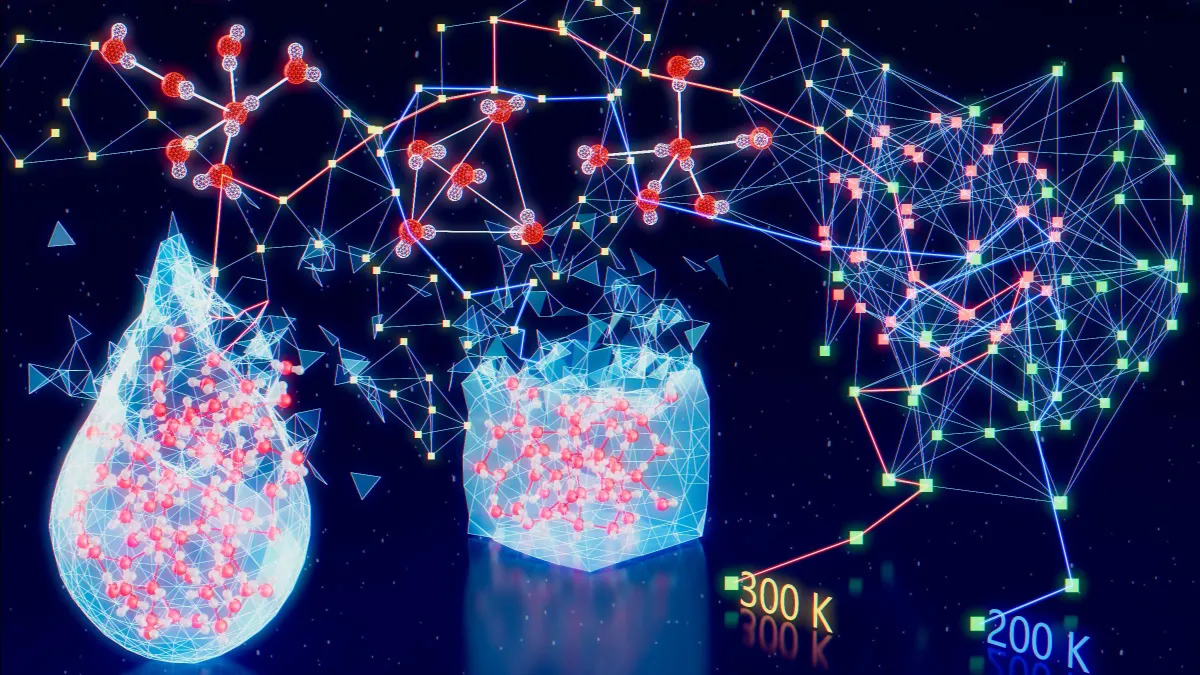
Enter AI. A team at the University of Osaka just unleashed artificial intelligence on water's deepest secrets, and the results are, well, pretty cool. Their study, published in Communications Chemistry, used an AI system to finally make sense of water's many structural personalities, especially when it's supercooled.
The Dual Life of Supercooled Water
Normally, water needs a little nudge — a speck of dust, a scratch in a glass — to form ice crystals. Without those 'nucleation sites,' it can stay stubbornly liquid even below its freezing point. This is supercooled water, and it's where water's weirdness goes into overdrive.
We're a new kind of news feed.
Regular news is designed to drain you. We're a non-profit built to restore you. Every story we publish is scored for impact, progress, and hope.
Start Your News DetoxThe leading theory is that supercooled water isn't just one thing; it's constantly flicking between two distinct liquid structures: a high-density liquid (HDL) and a low-density liquid (LDL). Think of it as a molecular Jekyll and Hyde. The LDL is a more open, spacious arrangement of water molecules, while the HDL is compact and cozy. And as the temperature rises, the compact HDL starts to dominate.
Scientists have developed a whole lexicon of ways to describe these local molecular structures, from "tetrahedral bond order" to "local density." The problem? These methods were created independently, meaning they spoke different languages, making it nearly impossible to compare them and figure out which one was actually telling the most accurate story about water's behavior.
"Past studies have shown that using machine learning to classify and understand structural data is effective," explained Kang Kim, a corresponding author on the study. So, they decided to let a neural network do the heavy lifting, essentially asking it to think like a human and figure out which descriptions actually mattered. Which, if you think about it, is both impressive and slightly terrifying.
To train their digital detective, the researchers fed it a banquet of structural data from computer simulations of supercooled water. The AI then spent countless hours doing what AIs do best: spotting patterns that would make a human's eyes glaze over.
"The network used what it learned to compare how 16 different descriptors distinguished between LDL and HDL structures at various temperatures," said Nobuyuki Matubayasi, a senior author. The result? The AI identified the most efficient descriptors, finally giving scientists a consistent way to talk about water's shape-shifting nature.
This new system promises to unlock a deeper understanding of how those tiny structural changes connect to water's macroscopic oddities. So, the next time you see ice floating (instead of sinking), you can thank AI for helping us get a little closer to understanding why. And maybe, just maybe, it'll help us design better pipes that don't burst quite so easily.