Imagine the universe as a newborn, barely 670 million years old — a cosmic blink of an eye. Now imagine finding a 30-year-old bodybuilder in its nursery. That's essentially what astronomers just did, spotting 31 of the oldest, most impossibly massive black holes ever recorded.
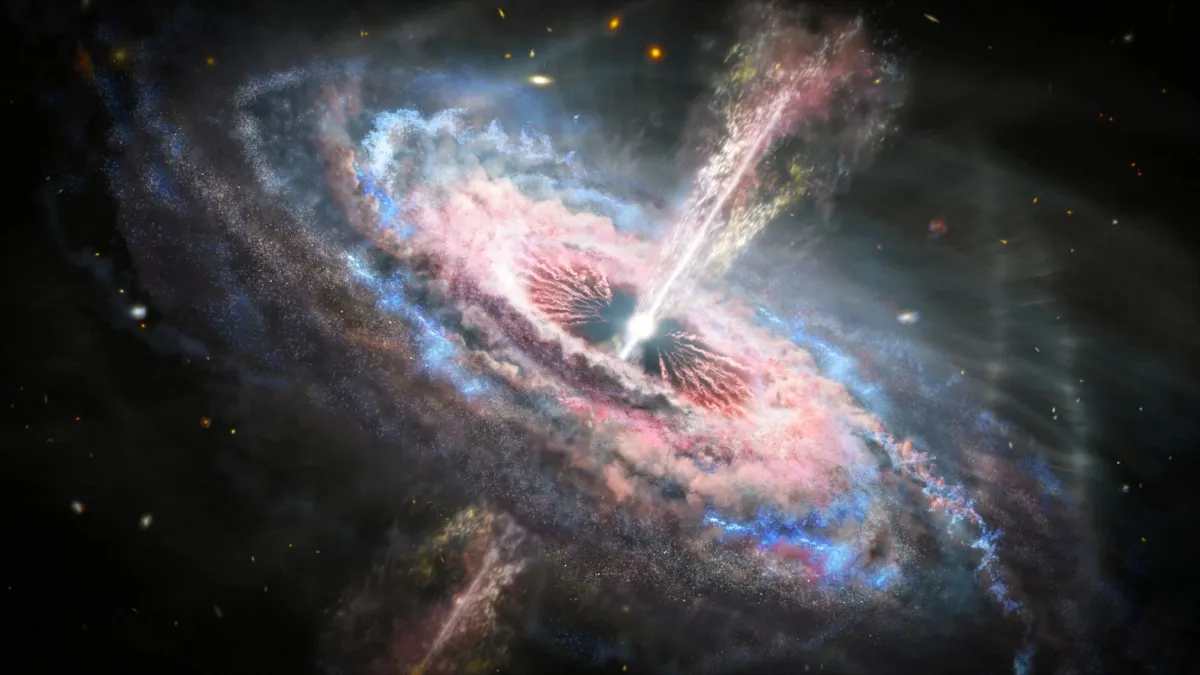
These aren't just any black holes. These are quasars, celestial powerhouses so bright they can outshine entire galaxies. They glow because supermassive black holes at their cores are devouring everything around them, pulling in gas and matter with the force of a trillion suns. And these 31 were already flexing that kind of power when the universe was only about 5% of its current age.
Which, if you're keeping score, is both impressive and slightly terrifying. It also makes scientists scratch their heads: How did these gravitational monsters get so big, so fast, after the Big Bang? Joseph Hennawi, a physics professor at UC Santa Barbara and Leiden University, co-authored the study and put it simply: "Every step further back in time makes the puzzle more confusing."
We're a new kind of news feed.
Regular news is designed to drain you. We're a non-profit built to restore you. Every story we publish is scored for impact, progress, and hope.
Start Your News DetoxThe Hunt for Ancient Light
Finding these early cosmic titans is like trying to spot a specific firefly in a hurricane, from another continent. The universe's expansion stretches their light into infrared wavelengths, which then get muddled by Earth's own atmospheric glow. Plus, from our vantage point, they can look exactly like much closer, ordinary stars.
Enter the European Space Agency's Euclid space telescope. Launched in 2023, Euclid is basically a cosmic bloodhound, orbiting above Earth's infrared haze and sniffing out faint objects across vast stretches of the sky that ground telescopes simply can't reach. It's designed to map over a third of the entire sky, and it's already proving its worth.
Using Euclid's data, researchers found these 31 ancient quasars. Before Euclid, astronomers had only found a handful of very bright early quasars, making it hard to understand what most of these objects were really like. Lead author Daming Yang, a doctoral student at Leiden, called Euclid a "game-changer." Because apparently, that's where we are now: telescopes are playing games.
The Young Universe's Oldest Giants
Among the new discoveries, 14 quasars have what scientists call a "redshift" of 7 or higher. Redshift is how astronomers measure cosmic distance and age; a redshift of 7 means the universe was a mere 750 million years old. The two oldest quasars in this group hit redshifts of 7.69 and 7.77, making them the earliest ever seen. Their light traveled for over 13 billion years to reach us, showing us the universe's first 670 million years.
This isn't just about breaking a distance record. It's about peering into the "epoch of reionization," a pivotal time when the first stars and galaxies finally cleared out the neutral hydrogen that filled space after the Big Bang. It set the stage for the universe we know today.
New technology isn't just about telescopes. Machine learning is also key, sifting through millions of cosmic sources to find the few real quasars hiding among countless lookalikes. Hennawi's group spent years building the software to do just that.
The next goal? Finding a quasar beyond a redshift of 8, revealing an object from within the universe's first 630 million years. Then, telescopes like James Webb and the Atacama Large Millimeter Array will jump in to measure their masses and study their host galaxies. Hennawi’s grand vision: to weave all this data into a "quasar chronicle of the first billion years." Let's just hope the universe keeps its diary updated.