Imagine trying to study something incredibly tiny, but every time you try to get a closer look, your tools freak out. That's been the reality for scientists trying to peek at magnetic structures in advanced materials, the kind that could power the next generation of super-efficient spintronic devices.
These devices, which store information using magnetic domains instead of electric charges, are far more energy-efficient than your current tech. But observing them under strong magnetic fields? That was the tricky bit. The powerful fields would deflect the electrons scientists used to image the materials, making everything blurry. Until now, their fancy microscopes were limited to fields about as strong as a fridge magnet – not exactly ideal for the 'harder' magnetic materials they really wanted to investigate.
The Petal-Powered Solution
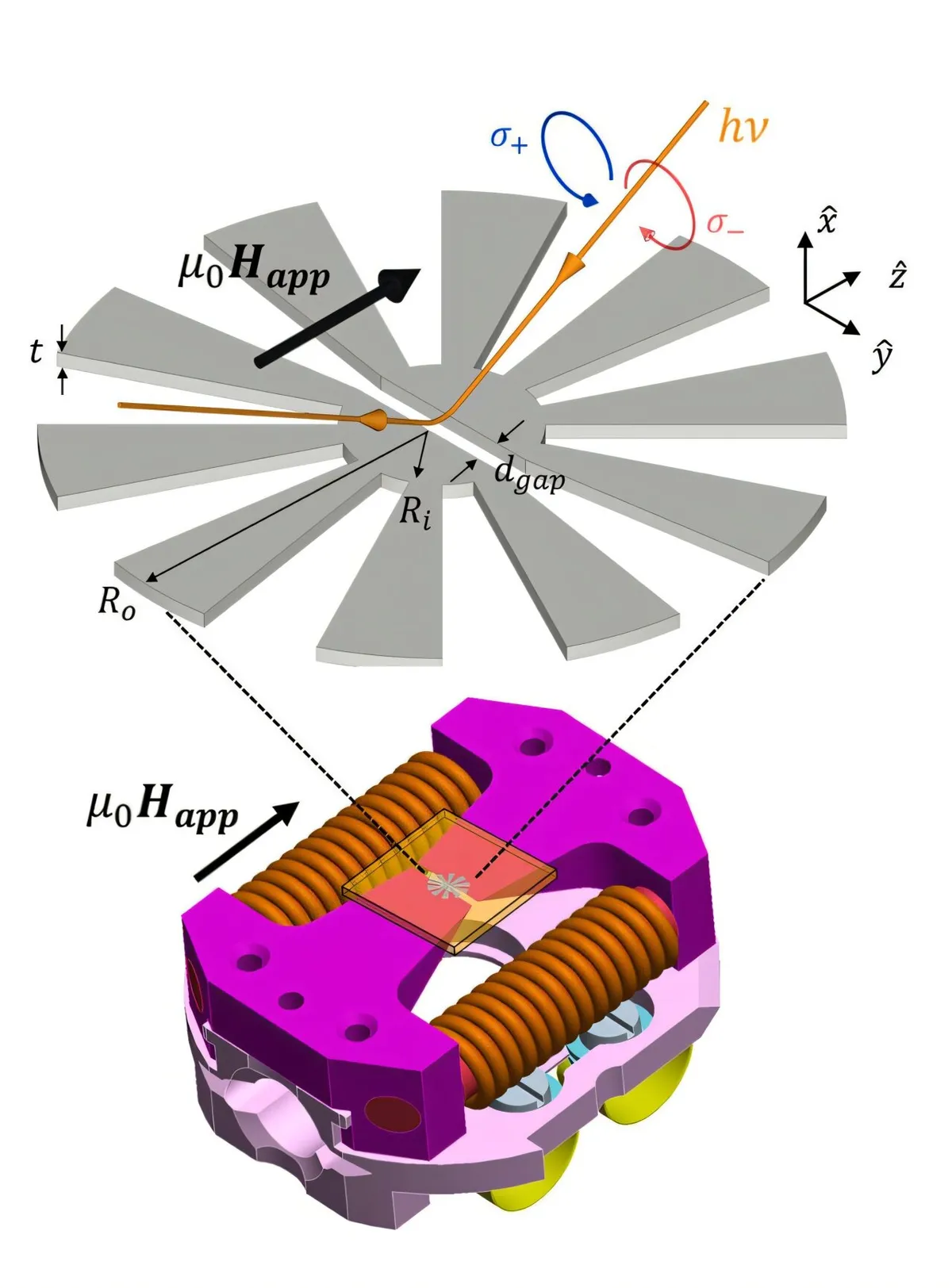
Enter Dr. Sergio Valencia and his international team. Their solution is as elegant as it is effective: tiny, flower-shaped magnetic flux concentrators (MFCs). Think of them as microscopic magnifying glasses for magnetic fields. They're crafted from magnetic materials themselves, and you simply place the sample you want to study right inside these little metallic blossoms.
We're a new kind of news feed.
Regular news is designed to drain you. We're a non-profit built to restore you. Every story we publish is scored for impact, progress, and hope.
Start Your News DetoxThe genius is in the design. Those 'petals' aren't just for show; they focus the magnetic field into a super-concentrated sweet spot where the sample sits. It's like taking a weak flashlight beam and focusing it into a laser point. Suddenly, the electrons don't get deflected because the field is so neatly contained.
This isn't just a slight improvement. The team just boosted their imaging capabilities by five times, pushing the observable magnetic field up to 150 millitesla (mT). That's a significant leap, and in theory, these MFCs could crank it up to 30 times the original limit. Because apparently, that's where we are now: designing miniature magnetic flora to unlock the secrets of quantum materials.
Ancient Magnets, New Discoveries
To prove their point, Valencia's team put these micro-flowers to the ultimate test. They didn't just grab any old lab sample; they went for two ancient magnetite specimens. One was a chain of magnetic nanoparticles – about 45 nanometers wide – created by bacteria. The other? A 60-million-year-old fossil, roughly two micrometers across. Because if you're going to push the boundaries of science, you might as well do it with a dash of prehistoric flair.
These experiments not only proved the MFCs worked but also yielded new insights. For the first time, researchers got to watch the magnetic domain structure evolve in that giant magnetofossil. Which, if you think about it, is both impressive and slightly terrifying. Imagine the stories that fossil could tell if it weren't so busy having its magnetic fields probed.
This breakthrough means scientists can now explore a whole new universe of materials, from artificial spin ice (which sounds delicious) to 2D van der Waals magnets. And it's not just for this specific microscope; other electron-based imaging techniques could also benefit from these tiny, field-boosting flowers. Suddenly, the previously unexaminable just became fair game. And all it took was a little floral arrangement.