
The Milky Way has a hidden architecture that shapes everything about it — where stars ignite, how gas swirls, which direction cosmic particles travel. But you can't see it with ordinary light. It's the galaxy's magnetic field, a vast invisible structure that's been largely unmapped until now.
Astronomers at the University of Calgary have just released the most detailed map yet of this magnetic skeleton. Using radio observations that can penetrate dust and gas that visible light can't reach, they've exposed patterns that have puzzled scientists for years — including a bizarre diagonal twist in one of the galaxy's spiral arms.
"Without a magnetic field, the galaxy would collapse in on itself due to gravity," says Dr. Jo-Anne Brown, who led the work. "We need to know what the magnetic field looks like now, so we can create accurate models that predict how it will evolve."
We're a new kind of news feed.
Regular news is designed to drain you. We're a non-profit built to restore you. Every story we publish is scored for impact, progress, and hope.
Start Your News DetoxSeeing the Invisible
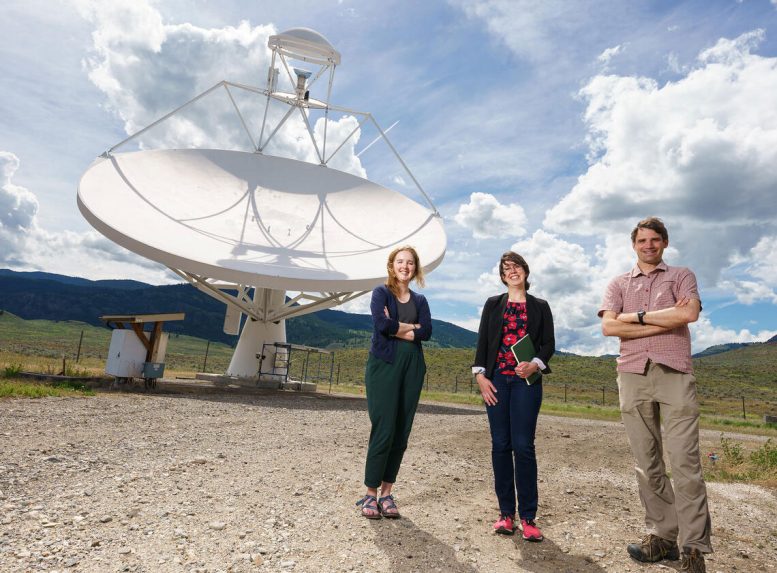
The team used a new radio telescope at the Dominion Radio Astrophysical Observatory in British Columbia to scan the northern sky at multiple frequencies simultaneously. This approach works like tuning a radio dial — different frequencies reveal different layers of the same structure, letting researchers untangle overlapping signals and see the magnetic field in three dimensions.
They tracked something called Faraday rotation: a subtle twist in the orientation of radio waves as they pass through ionized gas threaded by magnetic fields. Think of it like a straw in a glass of water appearing bent because light bends when it hits the water. Here, electrons and magnetic fields in space twist radio waves in measurable ways. By tracking how much twist occurs across the sky and at different frequencies, the astronomers could map the otherwise invisible magnetic architecture surrounding our solar system.
In January, Brown's team published their findings in two papers in The Astrophysical Journal and The Astrophysical Journal Supplement Series. But they also did something rarer: they released the complete dataset for free, giving researchers worldwide a new reference point for testing theories about how galactic magnetic fields form and evolve.
The Sagittarius Surprise
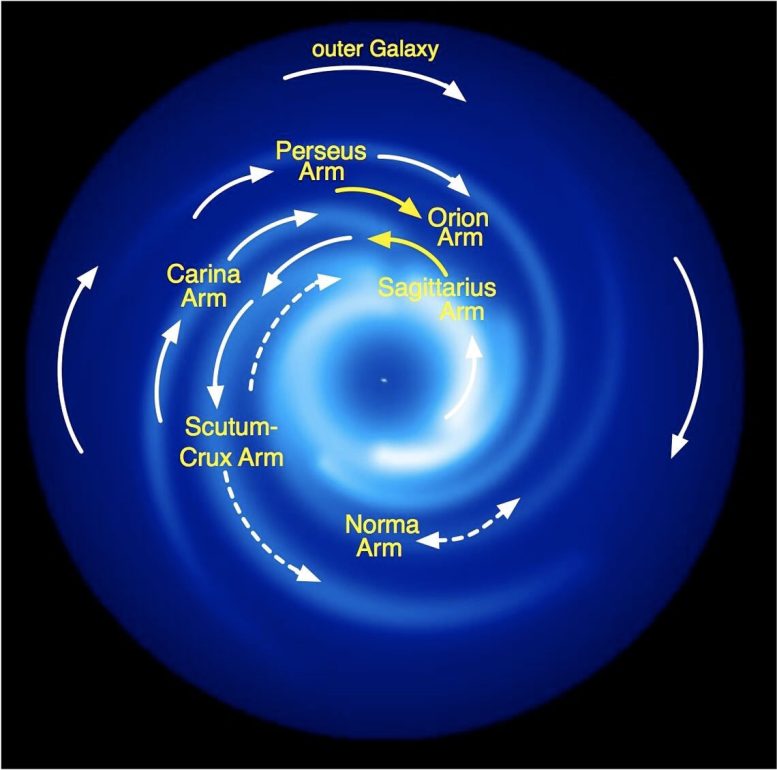
One discovery stands out. The Sagittarius Arm — a spiral region of the galaxy — has a magnetic field that reverses direction. If you looked down at the Milky Way from above, the overall field spins clockwise. But in the Sagittarius Arm, it goes counterclockwise. For years, scientists couldn't figure out how the transition happened. Then PhD candidate Rebecca Booth, working with the new data, found something unexpected: the reversal isn't gradual. It's diagonal.
"One day, Anna brought in some data, and I went, 'O.M.G., the reversal's diagonal,'" Brown recalls. Booth's follow-up work created a new three-dimensional model showing that what appears as a diagonal line from Earth is actually a tilted reversal zone in the galaxy's magnetic structure.
This map is already changing how astronomers think about the Milky Way. The next step is using similar observations at other frequencies and from the southern hemisphere to build an even more complete picture of how our galaxy's magnetic skeleton holds itself together.