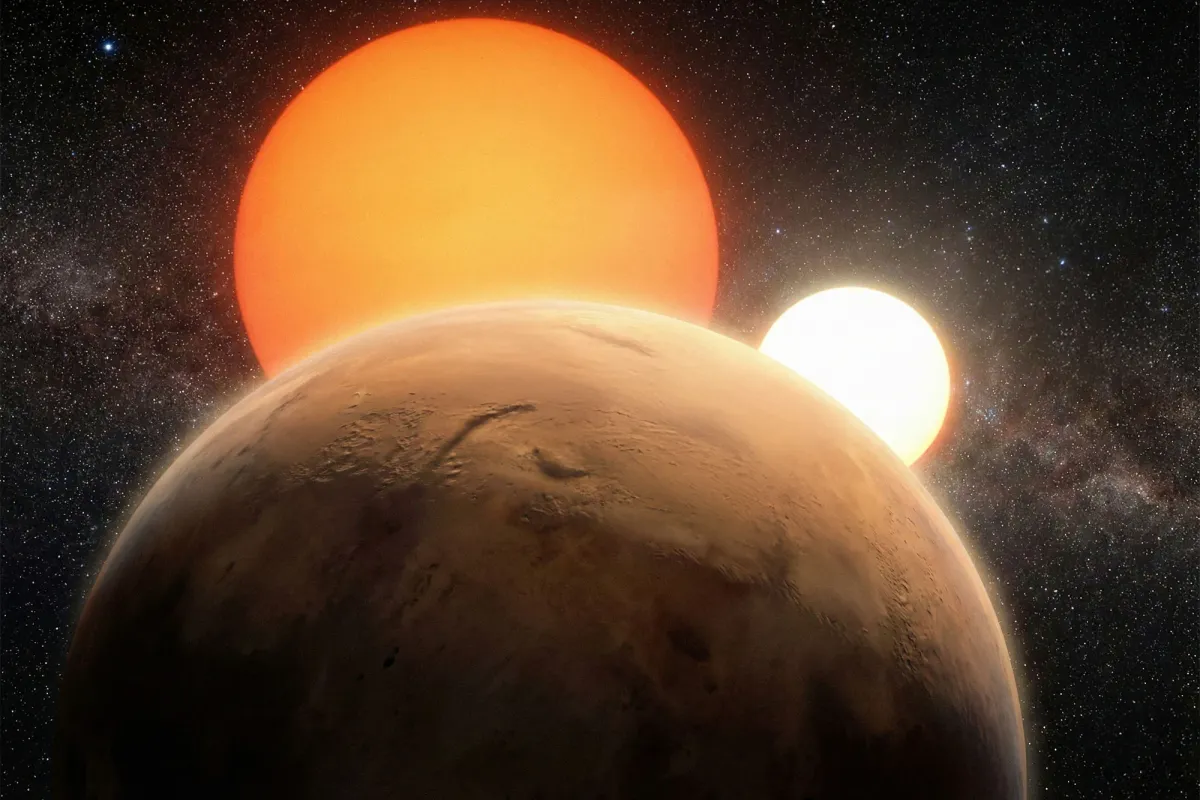
For the first time, astronomers have directly observed the violent aftermath of a collision between massive objects outside our solar system. In 2023, using the James Webb Space Telescope, researchers spotted a sprawling dust cloud around Fomalhaut, a star just 25 light-years away. The collision itself happened between two comet-like bodies, each at least 30 kilometers across — roughly twice the size of the asteroid that wiped out the dinosaurs 66 million years ago.
This wasn't a complete surprise. Astronomers had detected a similar dust cloud from Fomalhaut back in 2004, suggesting these violent events happen regularly in the system. But catching them in real time — or close to it — is extraordinarily rare. "We have witnessed what we believe to be a collisional event between two comet-like bodies in the Fomalhaut system," says Maxwell Millar-Blanchaer, an assistant professor at UC Santa Barbara. "This is a fundamental evolutionary process in young planetary systems that's difficult to see in real time."
What makes this discovery so compelling is what it reveals about planetary formation. When we look at our own solar system today, it's relatively calm. But billions of years ago, it was chaos — objects smashing together, reforming, colliding again. Fomalhaut, at roughly 430 million years old, is still in that violent adolescence. "It's like looking back in time," says Paul Kalas, an astronomer at UC Berkeley, "to that violent period of our solar system when it was less than a billion years old." Over tens of thousands of years, he notes, the dust around Fomalhaut would shimmer with these collisions "like fireworks."
We're a new kind of news feed.
Regular news is designed to drain you. We're a non-profit built to restore you. Every story we publish is scored for impact, progress, and hope.
Start Your News DetoxThe dust cloud itself doesn't reveal the colliding objects — they're too small and dark to see directly. Instead, the researchers observe light reflected off the dust particles, which scatter starlight in a distinctive way. By measuring the brightness of the 2023 event and comparing it to the 2004 observation, they could estimate the size of the bodies involved. Mark Wyatt, a theorist at the University of Cambridge, took the analysis further: based on the collision rate, he estimates there are roughly 300 million objects the size of the colliders orbiting Fomalhaut.
This discovery opens a new window into how planetary systems form and evolve. Direct observations of collisions are almost impossible to get any other way. Over the next three years, researchers plan to use both the James Webb and Hubble telescopes to track how the dust cloud evolves, watching a cosmic accident unfold in slow motion.
One cautionary note: as future telescopes become more sensitive in the hunt for exoplanets, astronomers will need to be careful. A faint point of light orbiting a star might look like a newly discovered world — until closer inspection reveals it's just dust from a distant collision.