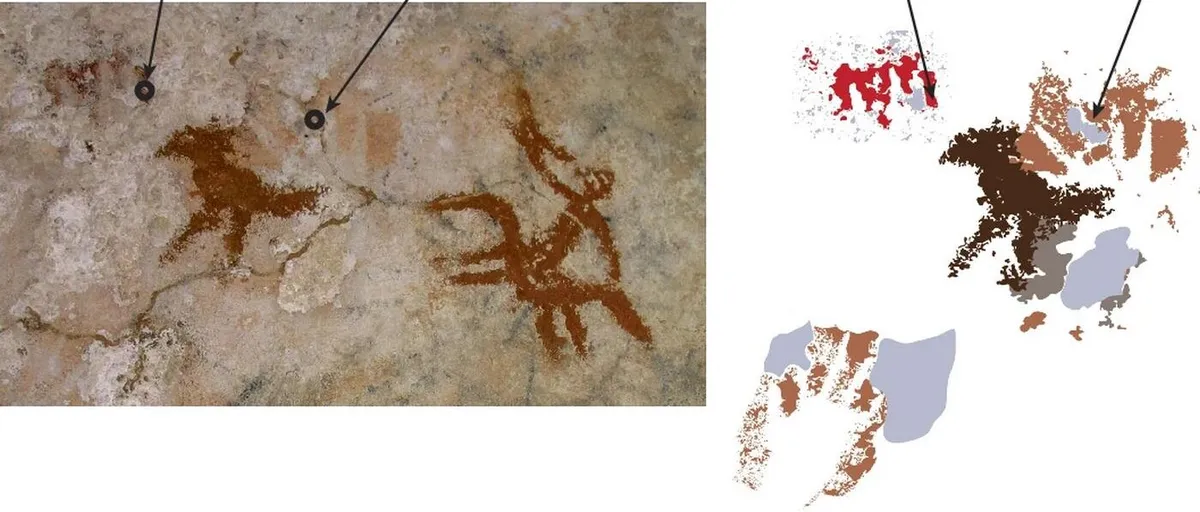
A limestone cave in Indonesia now holds the oldest known rock art on Earth. Handprints pressed into stone 67,800 years ago—older than any Neanderthal hand stencil, older than any ochre scraping in Europe—belong to people who were already crossing open ocean with purpose.
Think about that. Seventy thousand years ago, your ancestors were not huddled in one place. They were navigating water. They were moving between islands in what is now Indonesia, heading toward Australia and beyond. They left their hands on a cave wall—perhaps a signature, perhaps a ritual, perhaps simply "I was here." We will never know exactly. But we can see them.
Adhi Agus Oktaviana, a researcher at Indonesia's BRIN Research Center for Archaeometry, led the team that dated these prints using a technique called laser-ablation uranium-series analysis. It sounds technical because it is: they vaporized microscopic layers of calcite that had formed over the handprints, measuring radioactive decay to pinpoint when the hand first touched stone. The math was unambiguous. These prints are 16,600 years older than the previous record holder found on Muna Island, and 1,100 years older than the famous Neanderthal hands in Spain.
We're a new kind of news feed.
Regular news is designed to drain you. We're a non-profit built to restore you. Every story we publish is scored for impact, progress, and hope.
Start Your News DetoxWhat the Hands Tell Us
The prints themselves are strange and deliberate. The fingers are narrowed, shaped almost like claws. This wasn't accidental wear. "This art could symbolize the idea that humans and animals have a very close relationship," says Adam Brumm, an archaeologist at Griffith University's Australian Research Centre for Human Evolution. Other paintings in the same region show what researchers interpret as half-human, half-animal creatures—early evidence that our ancestors were already thinking in symbols, already blending the human and animal worlds in their imagination.
What makes this discovery matter isn't just the age. It's what it says about where humans were and what they were doing. The Wallacea region—a sunken landmass now risen above sea level—wasn't just a stepping stone to Australia. It was a habitat. People lived here, hunted here, made art here. They had crossed the sea intentionally, repeatedly, for thousands of years before these particular hands touched this particular cave wall.
The broader picture has shifted. We know now that humans reached the Sahul landmass (the ancient continent that is now Australia and Papua New Guinea) at least 65,000 years ago. But these handprints suggest the journey was longer, more deliberate, and more culturally sophisticated than we had evidence for before.
The discovery also carries an urgent practical message. These karst caves—the limestone formations that preserve this record—are vulnerable to development, mining, and neglect. Researchers are calling for these areas to be protected as part of spatial planning and resource management policy. In other words: we've just found proof that humans were here, thinking and creating, tens of thousands of years before writing existed. The least we can do is keep the caves standing.