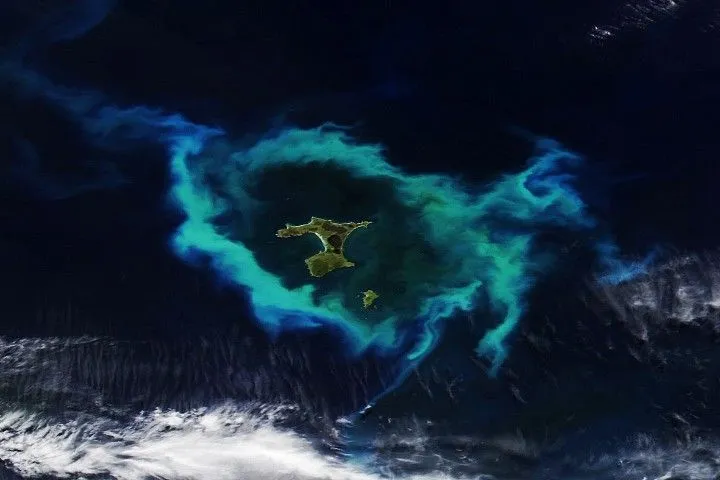
In January 2026, something striking appeared on NASA's satellite feeds: a ring of brilliant green and blue swirls wrapping around the Chatham Islands, a sparse cluster of land 500 miles east of New Zealand. The color wasn't paint or algae bloom in the traditional sense—it was a sudden explosion of phytoplankton, microscopic organisms so numerous they became visible from space.
These tiny photosynthetic creatures are the foundation of ocean life. When conditions align, their populations can spike dramatically, and the NOAA-20 satellite captured this display on January 10 using its visible-infrared imaging system. The intricate wisps and swirls visible in the image show how surface currents and ocean eddies had shuffled the organisms into delicate patterns.
Why This Spot Blooms So Reliably
The Chatham Islands sit atop the Chatham Rise, an underwater plateau that creates a natural mixing zone. Cold, nutrient-rich currents flowing up from Antarctica collide with warm, nutrient-poor water drifting down from the subtropics. This collision, combined with the plateau's shallow top separating deeper waters on either side, churns the ocean and brings nutrients to the surface. Add in the austral summer's long daylight hours, and you have a recipe for phytoplankton to thrive.
We're a new kind of news feed.
Regular news is designed to drain you. We're a non-profit built to restore you. Every story we publish is scored for impact, progress, and hope.
Start Your News DetoxThat abundance ripples through the entire ecosystem. The waters around the Chatham Islands support some of New Zealand's most productive fisheries—pāua, rock lobster, and blue cod are commercially valuable species that depend on these plankton blooms. The region is also a haven for marine mammals: five seal species, 25 species of whales and dolphins, and countless seabirds all feed on the productivity this bloom represents.
Yet there's a darker side to this abundance. The Chatham Islands are also a hotspot for whale and dolphin strandings, where hundreds of animals sometimes beach themselves at once. Scientists aren't entirely sure why—whether it's related to the blooms themselves, navigation challenges, or other factors—but the contrast is stark: the same waters that sustain such rich life also draw these animals to shore in ways that often prove fatal.
These satellite images, captured routinely by NASA and NOAA, give scientists a window into ocean health and productivity patterns that would be invisible from the surface. Each bloom tells a story about currents, nutrients, and the delicate balance that keeps ocean food webs functioning. The Chatham Rise is just one of many places where this drama plays out, but it's one of the most visually striking.