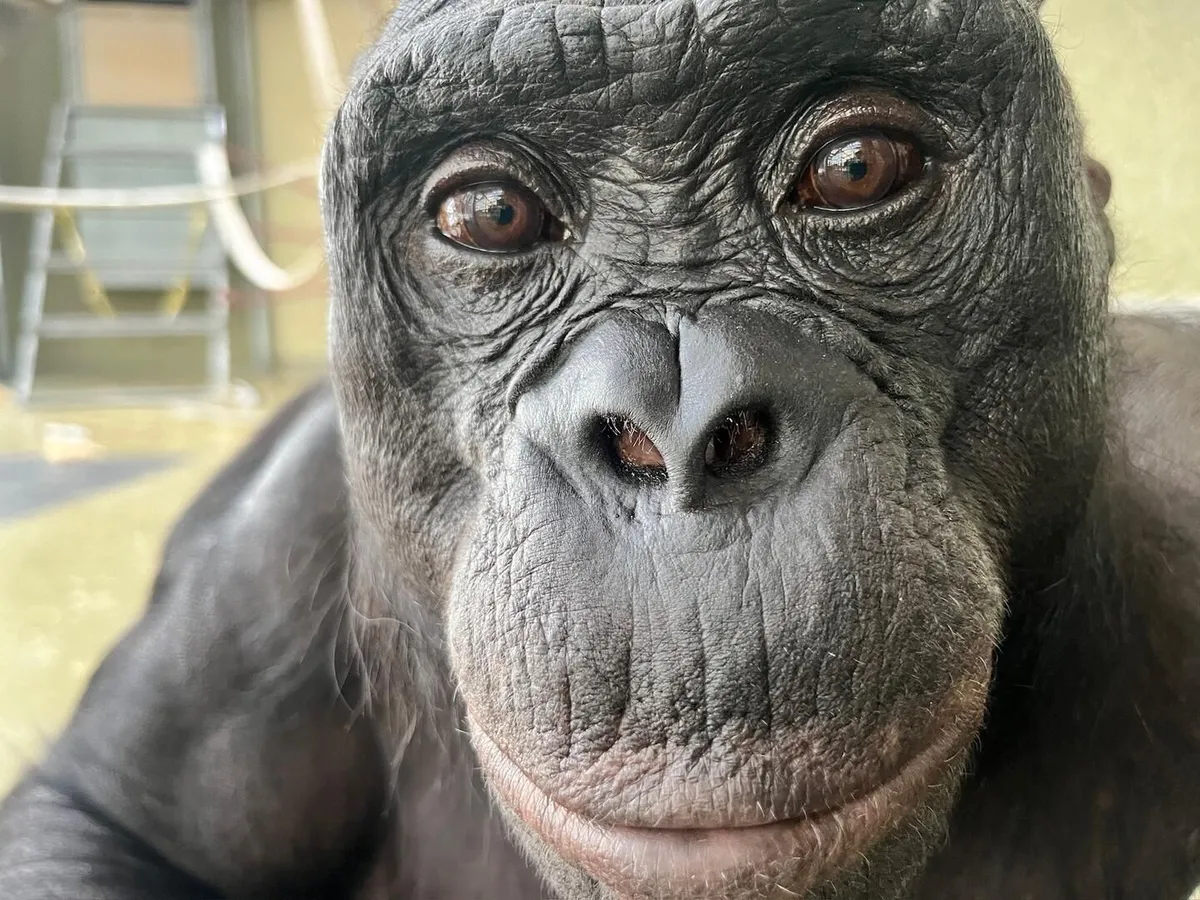
A bonobo named Kanzi could tell the difference between a real cup of juice and an imaginary one—a finding that suggests imagination might not be uniquely human after all.
When comparative psychologist Amalia Bastos first met Kanzi at Ape Initiative in Des Moines, Iowa, in 2023, the 43-year-old bonobo immediately requested a game of chase and tickle using a communication system of over 300 symbols he'd learned. As Bastos and her colleague Christopher Krupenye pretended to chase each other, Kanzi watched, seemingly delighted by the performance—understanding, somehow, that nothing real was happening.
That moment sparked an idea. If Kanzi could grasp pretend play, could he understand pretend objects too?
We're a new kind of news feed.
Regular news is designed to drain you. We're a non-profit built to restore you. Every story we publish is scored for impact, progress, and hope.
Start Your News DetoxThe Tea Party Experiment
The researchers designed a simple test. A researcher would sit across from Kanzi at a table with two empty, clear cups. They'd pretend to pour juice from an empty jug into both cups, then pretend to pour one back out. When asked which cup still held the imaginary juice, Kanzi pointed to the correct one 68 percent of the time—well above random chance.
To confirm Kanzi wasn't just guessing that real juice might be hiding somewhere, the team tried a second version: they showed him one cup with actual juice and one empty cup they pretended to fill. This time, Kanzi chose the real juice 78 percent of the time. He knew the difference. A similar experiment with real and imaginary grapes produced the same pattern.
"Kanzi is able to generate an idea of this pretend object, and at the same time, know it's not real," Bastos said in the study, published in Science in February 2025.
The implications reach back millions of years. Bonobos are among our closest living relatives—we share a common ancestor from around six to nine million years ago. If Kanzi could imagine, the ability might be far older than we thought, buried deep in the evolutionary history we share with other apes.
What This Actually Means
Not every scientist is convinced. Daniel Povinelli, a biologist at the University of Louisiana at Lafayette, suggested Kanzi might have simply noticed which cup the researchers touched less recently. Michael Tomasello at Duke University said he'd need to see Kanzi actually pretend to pour water himself before accepting the findings. These are fair pushbacks—the line between recognizing pretense and creating it is genuinely blurry.
But many primatologists weren't shocked. "I would expect most great apes will prove to do the same," says Richard Wrangham, a primatologist at Harvard. The real surprise might be that we've never properly tested for imagination in other apes before, suggesting we've systematically underestimated what's happening inside their minds.
Kanzi died in March 2025 at age 44, so researchers won't continue experiments with him. But the door is now open. Scientists are planning to test other apes—particularly those raised in the wild, without Kanzi's unusual human contact and symbol training. They're also reviewing video footage of wild apes to see if imagination shows up in their natural behavior, in moments we've simply never thought to look for.
The research invites a quiet reconsideration: what else have we missed about the mental lives of the creatures closest to us.