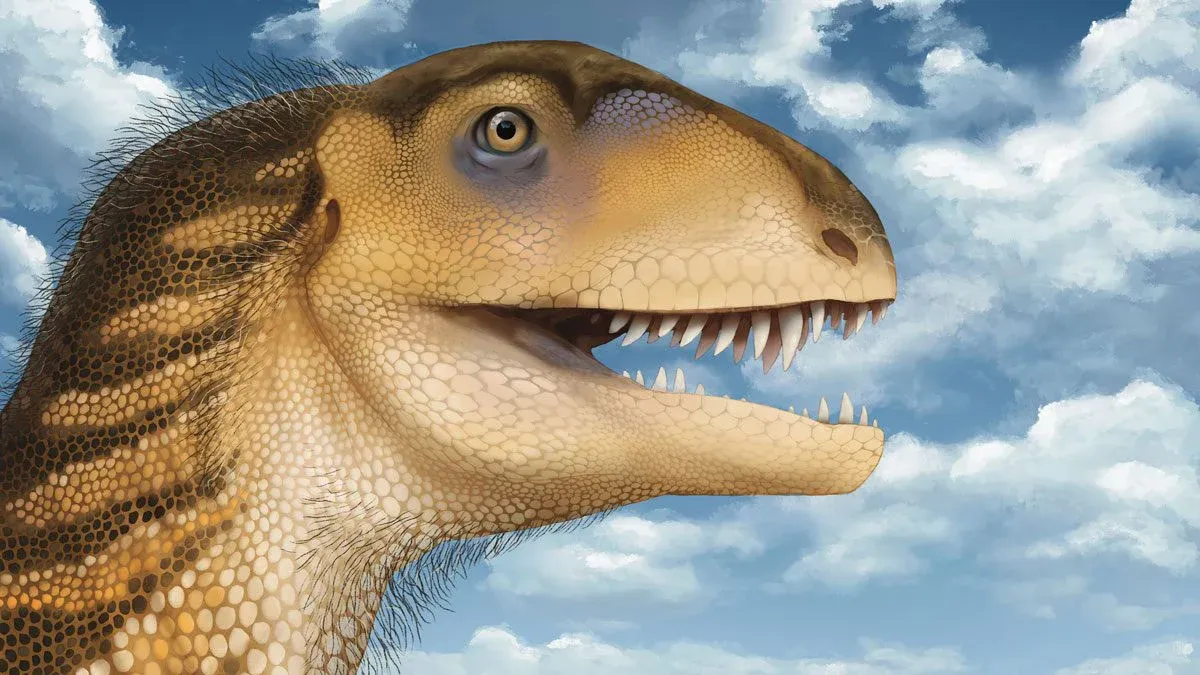
Imagine spending two years staring at a broken skull, only to realize you've just unearthed a brand new, terrifyingly ancient dinosaur. That's precisely what Simba Srivastava, a geosciences senior at Virginia Tech, managed to pull off.
His discovery? A carnivorous dino that roamed the Earth a jaw-dropping three times longer ago than your average T. rex. Because apparently, some things are just too cool to stay buried.
The "Murder Muppet" Takes Center Stage
The skull itself was a bit of a fixer-upper. Found in New Mexico in 1982, it was deemed too damaged to really bother with. Until, that is, Srivastava got his hands on it. He used CT scans to digitally piece the thing back together, even 3D printing a model. Which, if you think about it, is both impressive and slightly terrifying.
We're a new kind of news feed.
Regular news is designed to drain you. We're a non-profit built to restore you. Every story we publish is scored for impact, progress, and hope.
Start Your News DetoxThis ancient beast, now officially named Ptychotherates bucculentus (or "folded hunter with full cheeks" for those of us who skipped Latin), lived during the late Triassic period. We're talking 252 to 201 million years ago. Back then, dinosaurs weren't exactly running the show. They were more like supporting actors, sharing the stage with proto-crocodiles and early mammals.
Then, a mass extinction event cleared out the competition, and as Srivastava wryly put it, dinosaurs went "from being co-stars to the headliner." This particular headliner, with its wide braincase, large cheekbones, and likely a short, deep snout, was apparently quite the looker. So much so, one artist dubbed it a "murder muppet." And honestly, we get it.
Ptychotherates bucculentus turns out to be one of the last known members of the Herrerasauria family, an incredibly early group of carnivorous dinosaurs. The rocks where it was found suggest it might have been clinging on just before the end-Triassic extinction — a sort of last stand in the American Southwest. No other Herrerasaurians have ever been found after that event, implying this mass extinction didn't just clear the deck for dinosaurs, it also wiped out some of their older, weirder relatives.
So, thanks to a college student and a skull everyone else overlooked, we now know that the Triassic extinction was even more brutal than we thought. And that sometimes, the most important discoveries are just waiting for someone patient enough to put them back together.