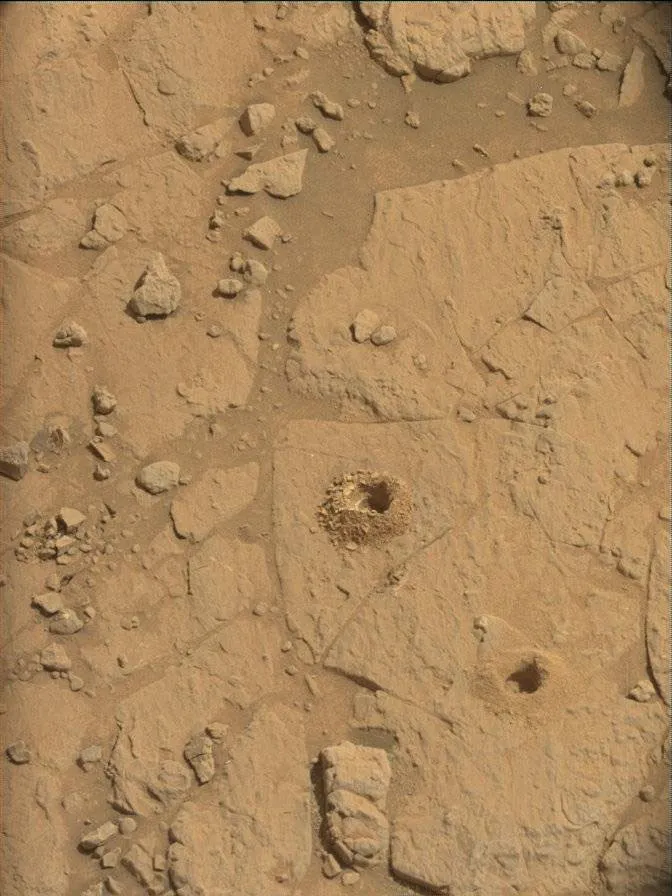
Curiosity found something worth a second look. After its initial drilling at a rock formation called Nevado Sajama, the rover's team decided the mineral story locked inside was too intriguing to leave half-told. This week, they sent the rover back to dig deeper—literally and chemically.
The mission required precision. The team applied tetramethylammonium hydroxide (TMAH), a chemical reagent, to the powdered rock sample and fed it into Curiosity's Sample Analysis at Mars instrument suite, or SAM. Think of SAM as the rover's mobile laboratory: it's designed to break down and identify the organic compounds and minerals that tell the story of Mars' past. The drilling succeeded. The sample was delivered. Now the team waits for results from the first round of analysis, with more data coming through the weekend.
But Curiosity doesn't sit idle between major discoveries. While SAM ran its tests, the rover's other instruments seized the spare power to gather additional clues about the Martian environment. ChemCam, a laser-based spectrometer mounted on the rover's mast, targeted a nearby drill hole called Nevado Sajama2 and analyzed a rock called Tiquipaya—notable because the rover's wheels had broken it open, exposing bright white material that suggested something chemically different from the surrounding terrain. The same instrument also measured atmospheric composition through passive sky observations and prepared detailed imaging of layered rock formations near a butte called Mishe Mokwa.
We're a new kind of news feed.
Regular news is designed to drain you. We're a non-profit built to restore you. Every story we publish is scored for impact, progress, and hope.
Start Your News DetoxMeanwhile, MAHLI (the rover's close-up camera) and APXS (an X-ray spectrometer) documented and analyzed the fine tailings scattered around the drill hole—the ground-up dust and fragments that give direct insight into what SAM is examining. Mastcam captured a full 360-degree panorama of the landscape, then shifted focus to measure atmospheric dust levels. Navcam made complementary dust measurements and prepared to track clouds and dust devils across the Martian horizon.
Even Curiosity's quieter instruments—RAD (measuring radiation), REMS (monitoring environmental conditions), and DAN (sensing subsurface water)—continued their steady work, building a continuous record of what it's actually like on Mars.
This kind of layered investigation is how planetary science works. A single drill hole becomes a conversation between multiple instruments, each asking different questions about the same patch of ground. Curiosity has been doing this for over a decade, and it's still finding reasons to come back.