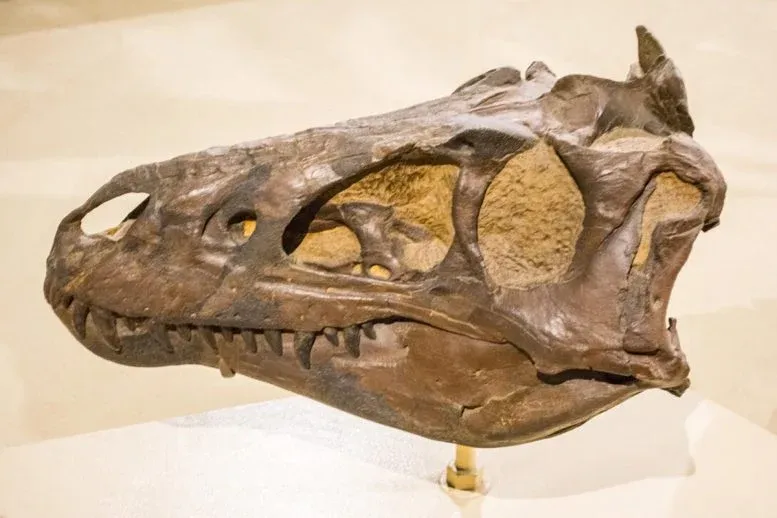
For decades, paleontologists argued about a small dinosaur skull sitting in the Cleveland Museum of Natural History. Was it a young Tyrannosaurus rex still growing into its full size, or something else entirely? A new study has finally settled the question: Nanotyrannus was a fully grown adult — and a completely separate species.
The breakthrough came from an unexpected place: a tiny bone called the hyoid, which sits in the throat. Researchers at Princeton University, led by Christopher Griffin, examined the microscopic structure of this fossilized bone from the original Nanotyrannus specimen. What they found was unmistakable evidence of maturity. This animal had finished growing. It would never become a T. rex.
"At the time, the prevailing consensus was that this skull represented an immature Tyrannosaurus rex," Griffin said. "But once we sampled the hyoid and saw features that strongly indicated maturity, we knew we had to examine that idea more skeptically."
We're a new kind of news feed.
Regular news is designed to drain you. We're a non-profit built to restore you. Every story we publish is scored for impact, progress, and hope.
Start Your News Detox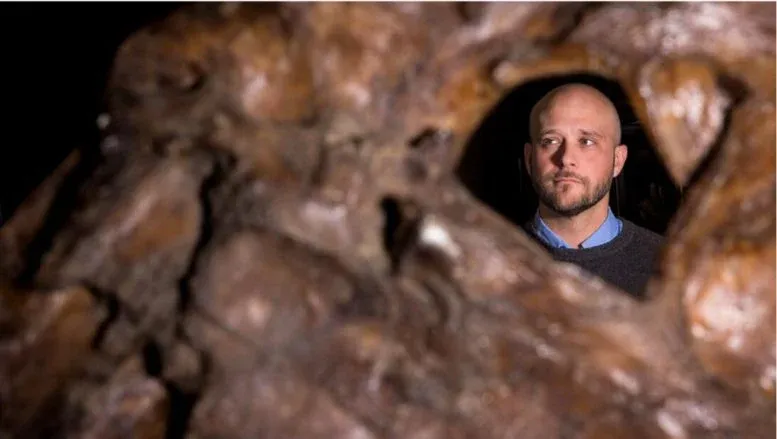
The discovery matters because it rewrites what we thought we knew about an entire ecosystem. Nanotyrannus topped out at about 18 feet long — less than half the length of a fully grown T. rex. For millions of years, these two predators hunted in the same forests, occupying different ecological niches. One was a heavyweight ambush hunter. The other was a smaller, faster carnivore.
"You're left with at least two different-sized meat eaters in the same environment," said Ashley Poust, curator of vertebrate paleontology at the museum. "That has some big implications for how ecosystems worked and how dinosaurs eventually went extinct."
A fossil gets a second look
The Nanotyrannus skull was first discovered in 1942 and initially misidentified as a Gorgosaurus. By 1988, it was reclassified as a new species. But the "young T. rex" theory stuck around — partly because it was the simpler explanation, and partly because nobody had a way to test it.
That changed when Poust developed a new method for aging dinosaurs by studying bone histology — essentially, the microscopic growth rings inside fossilized bones. He tested the technique on modern animals first: ostriches, alligators, lizards. The growth patterns were consistent enough that he could apply them to Nanotyrannus.
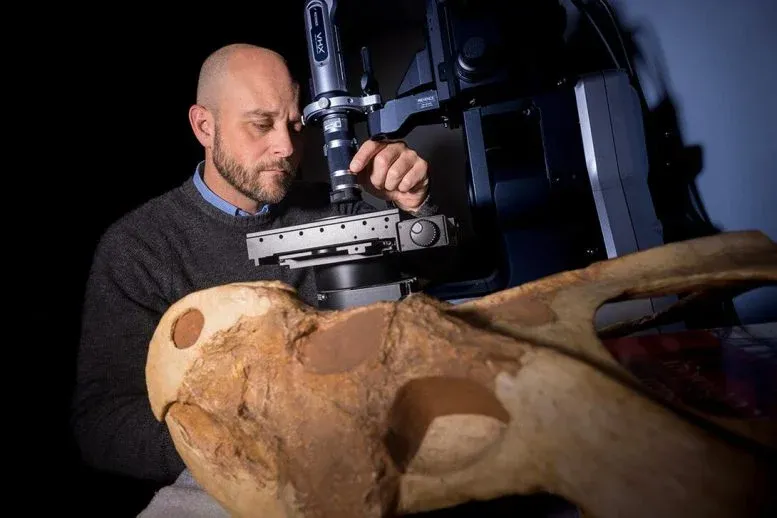
"It's expanding the ability to learn about animals' past lives," Poust said. "The growth signal is so conserved across the body. Maybe this is a tiny wedge to start investigating that in different ways."
The timing of the discovery underscores how science actually works. Just weeks before this study was published, researchers examining a separate Nanotyrannus fossil found in Montana reached the same conclusion using different evidence. Independent confirmation from multiple teams doesn't just strengthen one finding — it closes the debate.
Now the real questions begin. With Nanotyrannus confirmed as a distinct species, paleontologists can start asking harder questions about predator diversity, hunting strategies, and how the Late Cretaceous ecosystem balanced multiple apex carnivores. A fossil that sat in a museum for 80 years just handed researchers a new lens for understanding a lost world.