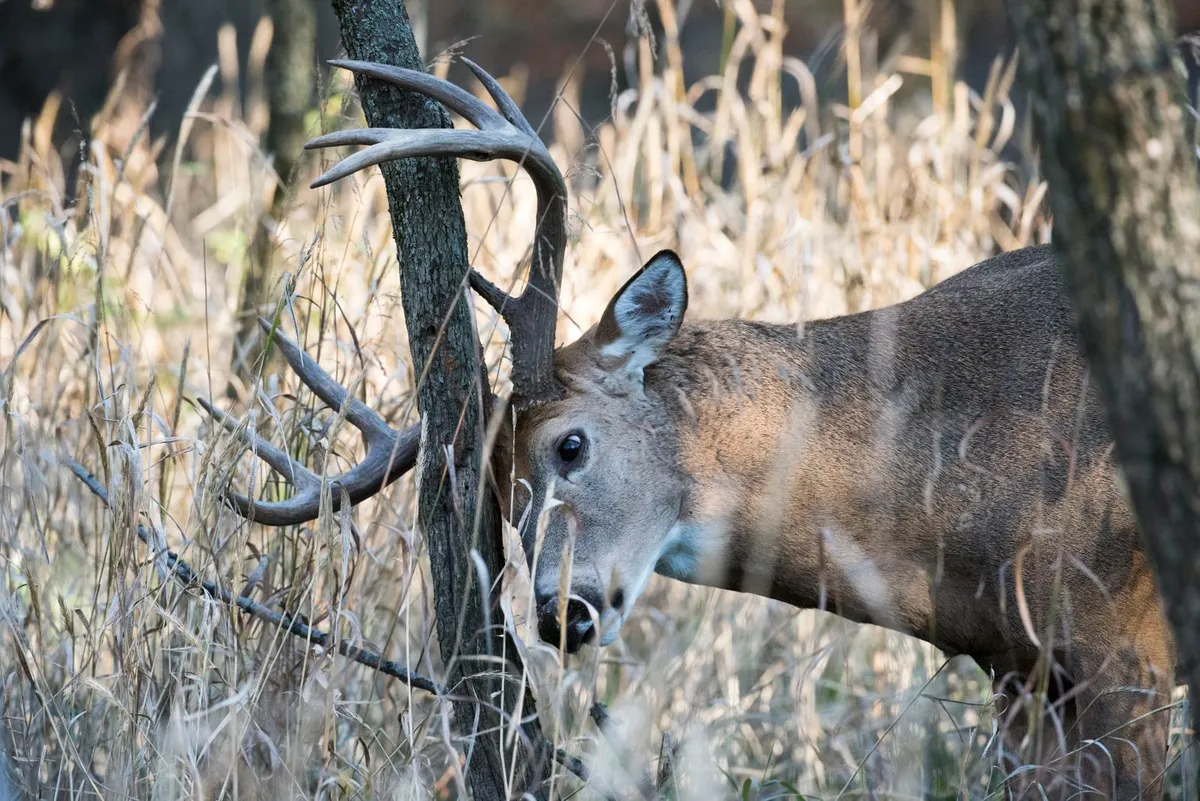
When a male white-tailed deer wants to claim his patch of forest, he rubs his face on a tree and scrapes the ground with his hooves, leaving behind urine and scent glands. Researchers at the University of Georgia just discovered something unexpected about these territorial signposts: they glow.
Under ultraviolet light, the markings fluoresce bright blue-green — the kind of neon shimmer you'd expect in a nightclub, not a forest at dawn. "The urine definitely glows, it looks like spilled white paint," said study co-author Daniel DeRose-Broeckert. "It's pretty striking."
The phenomenon is called photoluminescence — the markings absorb UV light and re-emit it at wavelengths visible to deer eyes. Researchers exposed rubs and scrapes to UV light in Whitehall Forest and measured what came back. The signposts stood out dramatically from their surroundings, suggesting they'd be unmissable to other deer during the hours they're most active: dusk and dawn.
We're a new kind of news feed.
Regular news is designed to drain you. We're a non-profit built to restore you. Every story we publish is scored for impact, progress, and hope.
Start Your News DetoxWhy would evolution wire deer to glow. The answer likely involves multiple layers of communication. A glowing rub could intimidate rival bucks by broadcasting "dominant male was here." It could attract females during breeding season. It might even help deer navigate their territory — imagine following a trail of neon breadcrumbs through the forest.
There's a catch: the research was conducted under artificial UV light in a lab. Whether natural light levels at dawn and dusk produce the same glowing effect remains unclear. And whether deer can actually perceive these markings the way the study suggests is still a hypothesis waiting for confirmation.
But the core finding — published in Ecology and Evolution — opens a door. For decades, scientists have focused on how deer use scent to communicate. This research suggests they're also tuned into visual signals we've been missing. The next phase will likely involve testing whether deer actually use this glow in the wild, and what it means for how they see their world at the edges of day.