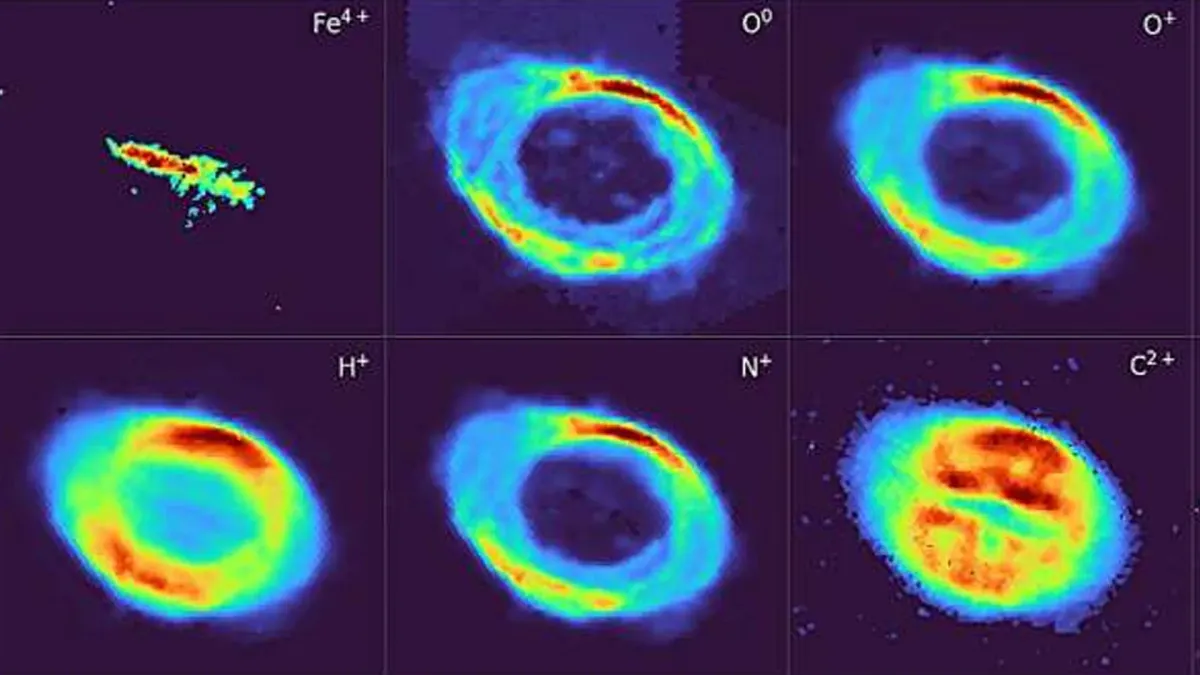
Astronomers studying the Ring Nebula—that iconic cosmic ring visible through amateur telescopes—have spotted something that shouldn't be there: a massive bar of iron stretching across a space 500 times wider than Pluto's orbit. And they think it might be the remains of a planet that got too close to a dying star.
The discovery came thanks to WEAVE, a new instrument installed on Spain's William Herschel Telescope, which can capture light from an entire nebula and break it into component colors simultaneously. Previous observations had focused on narrow slices of the spectrum or specific regions, which meant this iron structure had been hiding in plain sight for centuries.
What makes the finding genuinely puzzling is the sheer amount of iron concentrated in such a precise shape. The bar contains roughly as much iron as the entire planet Mars. According to Roger Wesson, the Cardiff University researcher leading the study, existing models of how planetary nebulae form don't easily explain how so much iron ends up arranged this way.
We're a new kind of news feed.
Regular news is designed to drain you. We're a non-profit built to restore you. Every story we publish is scored for impact, progress, and hope.
Start Your News DetoxTwo theories have emerged. The first is that the iron bar represents a previously unknown stage in how dying stars shed their outer layers—essentially a new chapter in our understanding of stellar death. The second is more dramatic: a rocky planet wandered too close to the expanding star and was vaporized into a curved arc of superheated plasma, with the iron core left behind as evidence.
Neither explanation is certain yet. The researchers plan to observe the Ring Nebula again using WEAVE at higher resolution to pin down the iron bar's composition and age. They're also betting this won't be the only discovery of its kind. Over the next five years, they plan to scan dozens more ionized nebulae across the Milky Way, looking for similar structures.
What's striking about this isn't just the mystery itself, but what it reveals about how much we're still learning from our own cosmic backyard. The Ring Nebula has been sketched by amateur astronomers for generations. It took a new way of looking—not a new telescope, but a new way of seeing—to reveal what was always there.