Physicists have figured out how to use quantum entanglement across space to measure multiple things at once — more accurately than any classical method allows.
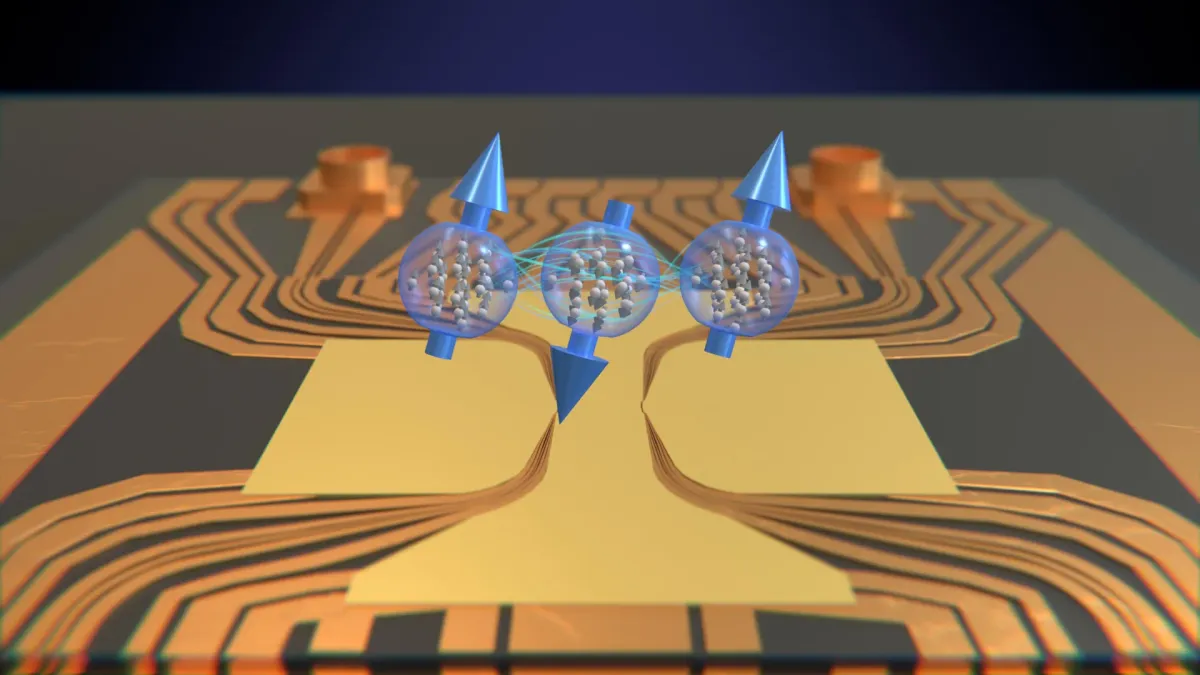
The breakthrough comes from researchers at the University of Basel and Laboratoire Kastler Brossel in Paris, who took a group of entangled atoms and split them into three separate clouds. The atoms remained quantum-linked despite the distance between them, and this connection let the team measure variations in electromagnetic fields with significantly higher accuracy than traditional sensors could achieve.
"Quantum metrology, which exploits quantum effects to improve measurements, is by now an established field," says Prof. Philipp Treutlein, who led the work at Basel. What's new here is distributing the entangled atoms across multiple locations — essentially turning distant, disconnected atoms into a single, coordinated sensor.
We're a new kind of news feed.
Regular news is designed to drain you. We're a non-profit built to restore you. Every story we publish is scored for impact, progress, and hope.
Start Your News DetoxThis matters because precision measurement underpins some of the most important instruments we have. Optical lattice clocks, which keep time to within a few seconds per billion years, could become even more accurate. Right now, small variations in how atoms are positioned within the clock's lattice introduce tiny errors. Entanglement can cancel those errors out.
The same approach works for atom interferometers, instruments that measure Earth's gravitational field with extraordinary sensitivity. Geophysicists use these to map underground resources, detect water movement, and monitor geological hazards. Better precision means better maps.
"So far, no one has performed such a quantum measurement with spatially separated entangled atomic clouds, and the theoretical framework was still unclear," notes Yifan Li, a postdoc in Treutlein's group. The team's work, published in Science, fills that gap. They've shown not just that it works, but how to think about it theoretically — which means others can now build on it.
The practical applications are still ahead. These are laboratory demonstrations, not yet deployed in the field. But the path is clear: entanglement, once a theoretical curiosity, is becoming a tool for measuring the physical world with precision that classical physics simply cannot match.