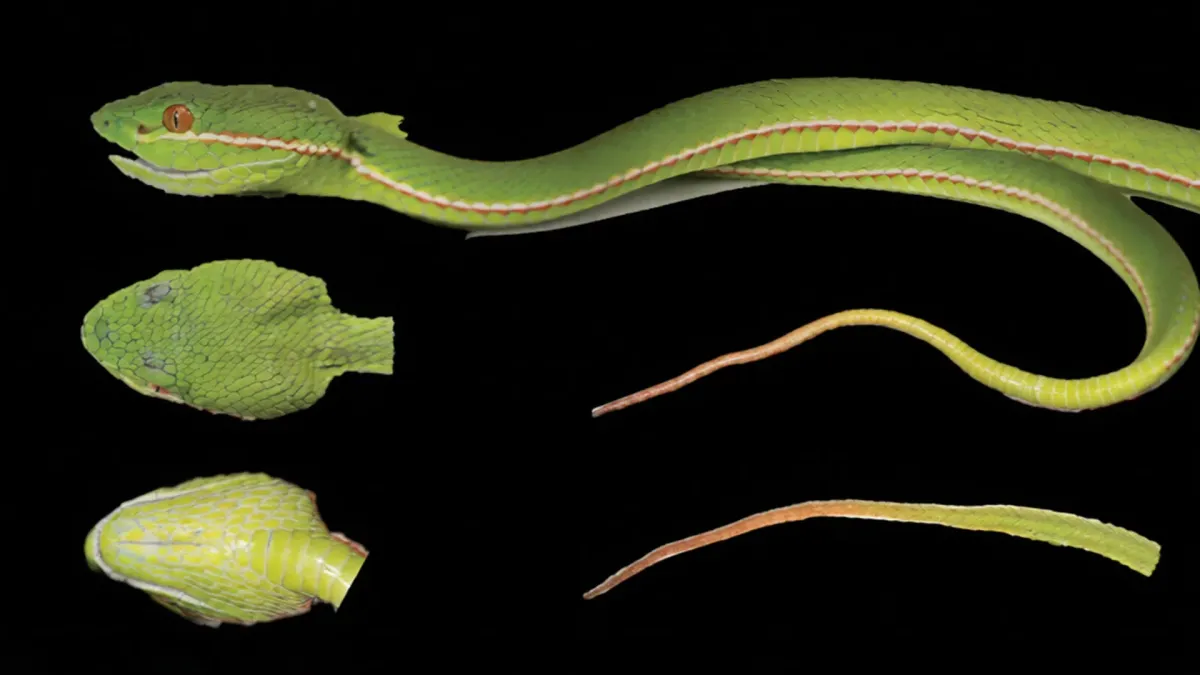
Turns out, some secrets are kept by snakes. Scientists in the misty mountains of western Sichuan, China, just uncovered a brand-new pitviper species that had been chilling in the background, completely unnoticed.
For years, researchers from the Chengdu Institute of Biology and the Giant Panda National Park thought they were looking at a common snake. You know, just another day, another bamboo pitviper. Except, it wasn't. It was an imposter, a bright green chameleon with amber eyes, blending into its lush surroundings so perfectly it fooled everyone.
They've named this stealthy serpent Trimeresurus lii, or the Huaxi Green Pitviper. The name is a nod to Li Er, an ancient Chinese philosopher whose teachings about humans and nature living in harmony feel particularly relevant when you're discovering a new venomous species in a national park. Because apparently, that's where we are now.
We're a new kind of news feed.
Regular news is designed to drain you. We're a non-profit built to restore you. Every story we publish is scored for impact, progress, and hope.
Start Your News DetoxDNA Doesn't Lie, Even for Snakes
This isn't just a slightly different shade of green; genetic tests confirmed this snake is its own evolutionary branch. It's the 58th species in the Trimeresurus genus and only the second from its subgenus found in Sichuan Province. For decades, it was mistaken for the bamboo pitviper (T. stejnegeri) because, let's be honest, they look almost identical to the untrained eye. Or even the trained one, apparently.
But a closer look, combined with DNA analysis, revealed consistent physical differences, like unique smooth head scales. It’s the kind of detail that makes you wonder how many other things are hiding in plain sight, just waiting for a DNA test to blow their cover.
Both males and females are a vibrant green, but the males sport a snazzy red and white stripe along their sides and those distinctive amber eyes. Females, opting for a slightly more understated look, have a yellow stripe and orange-yellow eyes. Which, if you think about it, is both impressive and slightly terrifying.
Like its pitviper cousins, the Huaxi Green Pitviper is venomous. It lives in mountainous areas that people also inhabit, meaning a chance encounter could lead to a less-than-pleasant envenoming. It’s a vivid reminder that even in places we think we know, nature still holds some very sharp surprises.
These snakes can grow to about 32 inches long and thrive in the humid forests of Mt. Emei and Xiling Snow Mountain. This region, part of the West China Rain Zone, is a global biodiversity hotspot — a place so rich in life that we're still discovering new things, even after years of study.
This discovery, published in the journal Zoosystematics and Evolution, is a fantastic reminder that the world still holds plenty of secrets. And some of them are bright green, have amber eyes, and are probably looking right at you.