Astronomers have assembled the sharpest low-frequency radio image of our galaxy yet, and it's changing how we see stellar nurseries and the remnants of dead stars. The image, captured from the Southern Hemisphere, covers our entire galactic plane in radio wavelengths invisible to human eyes—revealing patterns that have been hidden until now.
Silvia Mantovanini, a PhD student at Curtin University's node of the International Center of Radio Astronomy Research, spent 18 months stitching together this portrait. It took a million CPU hours of processing power at the Pawsey Supercomputing Research Centre, crunching data from the Murchison Widefield Array telescope collected across 141 nights between 2013 and 2020. The result is twice as sharp and ten times more sensitive than the previous best version from 2019.

What the colors reveal
When you look at the image, the red circles are supernova remnants—the expanding shells of gas and energy left behind when massive stars explode. The smaller blue regions mark stellar nurseries, places where new stars are actively being born. "You can clearly identify remnants of exploded stars, represented by large red circles. The smaller blue regions indicate stellar nurseries where new stars are actively forming," Mantovanini explained.
We're a new kind of news feed.
Regular news is designed to drain you. We're a non-profit built to restore you. Every story we publish is scored for impact, progress, and hope.
Start Your News Detox
This clarity matters because it lets astronomers trace the full lifecycle of stars—from the moment they ignite in gas clouds to their violent or gradual deaths. For Mantovanini's own research on supernova remnants, the image is a major step forward. It also opens new doors for understanding pulsars, those mysterious spinning neutron stars that beam radio waves across space. By measuring how bright pulsars appear at different radio frequencies, researchers hope to map where they live in the galaxy and how they actually emit their signals.

A catalog of 98,000 objects
The team catalogued nearly 98,000 distinct radio sources scattered across the galactic plane visible from the southern hemisphere. These aren't just supernova remnants and stellar nurseries—the list includes pulsars, planetary nebulae, compact star-forming regions, and galaxies so distant they're billions of light-years away. It's the first time anyone has published a complete low-frequency radio portrait of the entire southern galactic plane.
"This low-frequency image allows us to unveil large astrophysical structures in our Galaxy that are difficult to image at higher frequencies," said Associate Professor Natasha Hurley-Walker, who led the GLEAM-X survey. "No low-frequency radio image of the entire Southern Galactic Plane has been published before, making this an exciting milestone in astronomy."
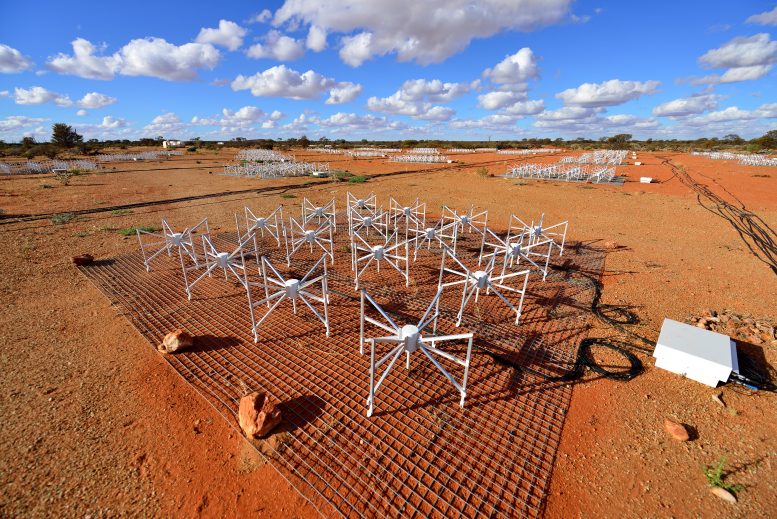

This milestone arrives just as the next generation of radio telescopes are coming online. The Square Kilometre Array, which will eventually span three continents, will be able to see even deeper and clearer. For now, this image stands as a complete reference—a detailed snapshot of our galactic neighborhood that researchers will be mining for discoveries for years to come.