Physicists have figured out how to use quantum entanglement—one of the strangest phenomena in physics—to measure multiple things at once with unprecedented accuracy. The breakthrough could make atomic clocks even more precise and help scientists map gravitational fields with sharper detail.
Entanglement is what happens when two quantum objects become linked in such a way that measuring one instantly affects the other, even across vast distances. Einstein called it "spooky action at a distance" because it seemed to violate the rules of classical physics. For decades, it remained mostly a theoretical curiosity. Then, in 2022, the Nobel Prize in Physics went to researchers who experimentally proved it was real.
Now a team led by Philipp Treutlein at the University of Basel and Alice Sinatra at the Laboratoire Kastler Brossel in Paris has taken entanglement from the realm of puzzles into the world of practical tools. Their work, published in Science, shows that entangled particles separated across space can measure physical quantities—like electromagnetic fields—far more precisely than particles measured independently.
We're a new kind of news feed.
Regular news is designed to drain you. We're a non-profit built to restore you. Every story we publish is scored for impact, progress, and hope.
Start Your News DetoxFrom Single Location to Distributed Networks
About fifteen years ago, Treutlein's group was among the first to entangle the spins of extremely cold atoms—think of them as tiny compass needles pointing in coordinated directions. This allowed them to determine the atoms' orientation more accurately than classical physics would permit. But those atoms were all clustered in one place.
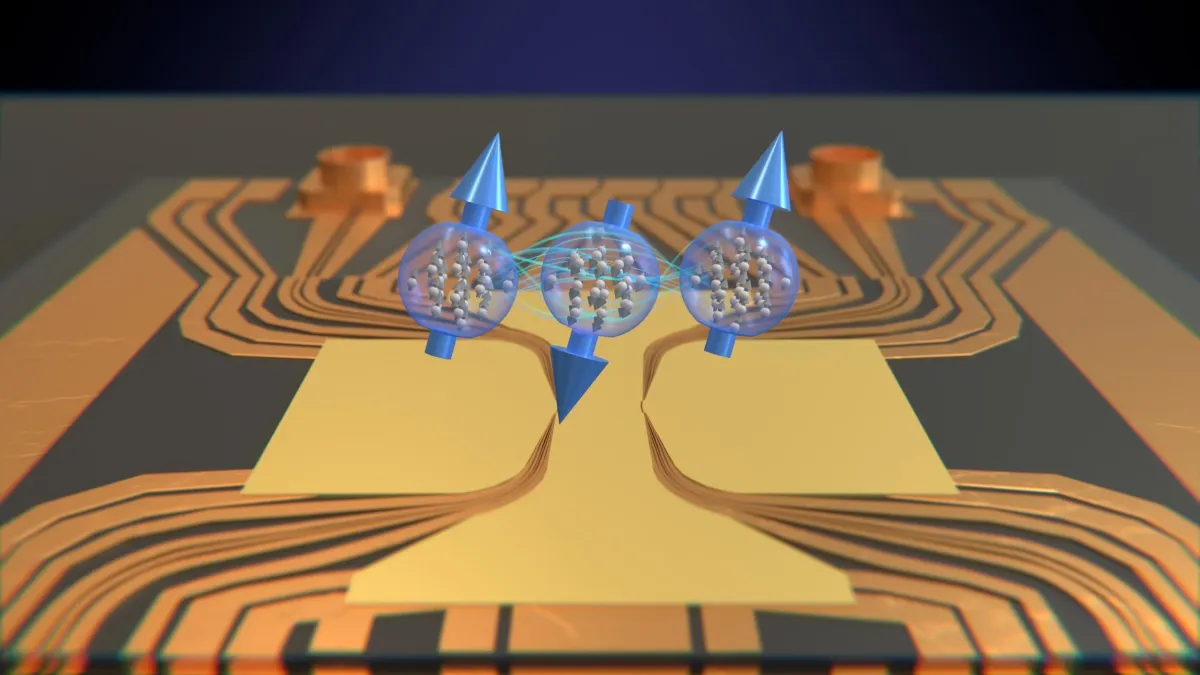
The new experiment spreads the entangled atoms across three separate clouds. This matters because it lets researchers measure how physical quantities vary from location to location. To map an electromagnetic field, for instance, you need sensors in different places. Entanglement between distant clouds reduces the uncertainty that usually creeps in from quantum effects, and it also cancels out external disturbances that affect all atoms equally.
Yifan Li, a postdoc in Treutlein's group, explains the significance: "No one had performed such a quantum measurement with spatially separated entangled atomic clouds before." The team had to develop the theoretical framework from scratch, then prove it worked in the lab. Using just a small number of measurements, they determined field distributions with precision that would be impossible without entanglement linking the distant sensors.
Real-World Applications Already in Sight
The implications are concrete. Optical lattice clocks—instruments that hold atoms in place using laser light and serve as the world's most stable timekeepers—could become even more accurate. The new methods could reduce errors caused by how atoms are distributed across the lattice. Atom interferometers, used to measure Earth's gravitational acceleration, could also benefit. Gravimeters in particular stand to gain sharper measurements of how gravity varies across space, which matters for everything from detecting underground resources to monitoring environmental changes.
What makes this significant is the shift from theoretical to practical. Entanglement is no longer just a phenomenon that makes physicists scratch their heads. It's becoming infrastructure for the next generation of precision instruments.