Imagine a cloud. Now imagine a cloud the size of a galaxy, but with no stars. Just… poof. Nothing. That's essentially what astronomers just found near the famous Whirlpool galaxy, thanks to China's Five-hundred-meter Aperture Spherical Telescope (FAST). It’s like finding a giant, empty parking lot in the middle of Times Square.
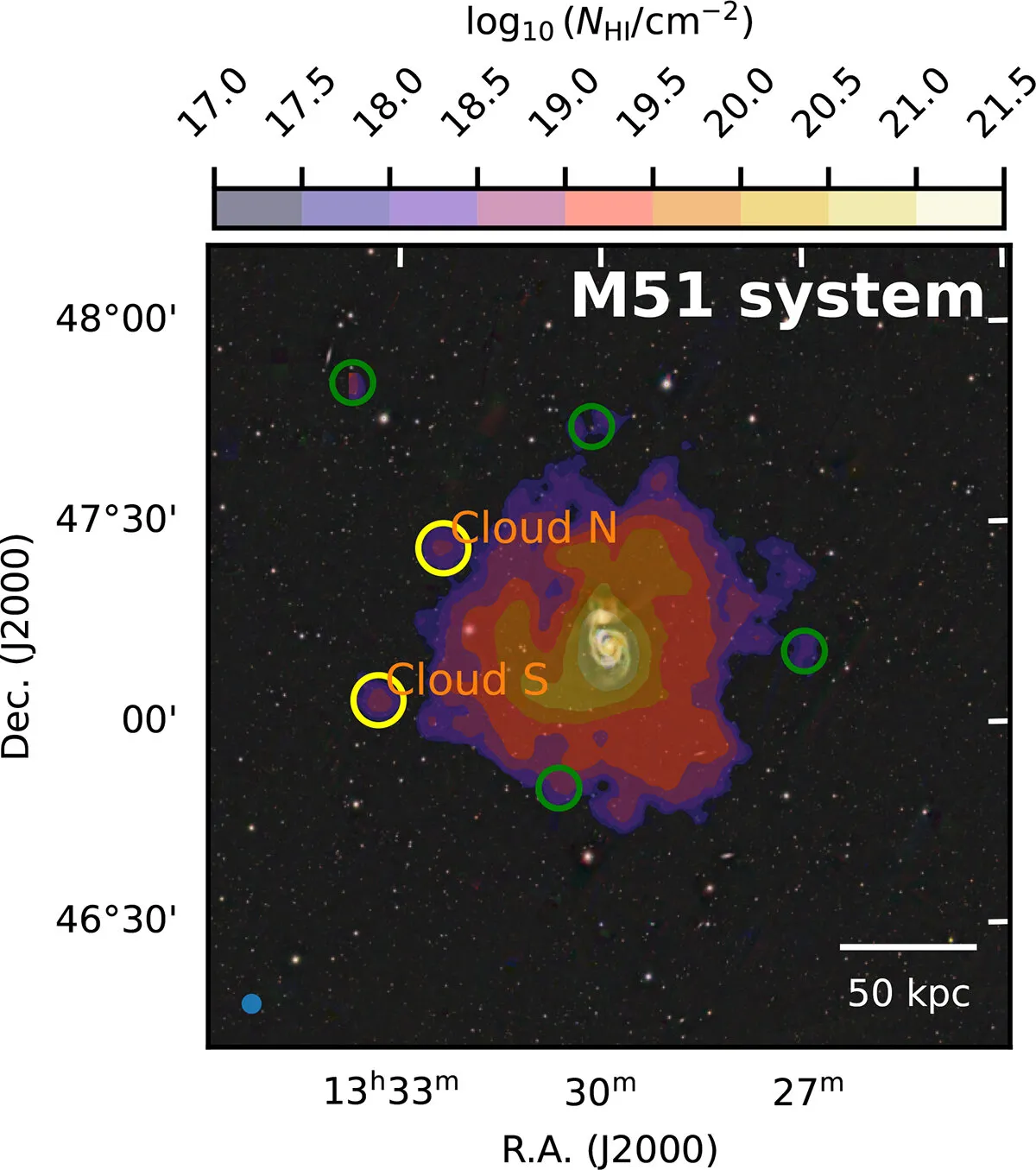
These two mysterious hydrogen clouds, dubbed Cloud N and Cloud S, each pack about three million times the mass of our sun in hydrogen. Yet, despite all that cosmic raw material, they are stubbornly, bafflingly starless. The findings, published in Astronomy & Astrophysics, have the science world buzzing about what these galactic anomalies could be.
Cosmic Voids or Galactic Ghosts?
The prevailing theory of how the universe builds itself, called Lambda Cold Dark Matter (LCDM), suggests that not every dark-matter halo — the invisible scaffolding of galaxies — gets to host a stellar party. Sometimes, gravity's just not strong enough, or the gas never gets dense and cold enough to collapse into stars. Other times, harsh ultraviolet light from powerful quasars and distant stars can heat things up, preventing star formation.
We're a new kind of news feed.
Regular news is designed to drain you. We're a non-profit built to restore you. Every story we publish is scored for impact, progress, and hope.
Start Your News DetoxEnter the "reionization-limited H I clouds," or RELHICs. These are theoretical compact, spherical hydrogen clouds with narrow spectral lines, no visible stars, and a specific velocity signature. Essentially, they're dark-matter halos that managed to hold onto some gas after the cosmic reionization era, but never quite cooled down enough to light up with stars. The LCDM model predicts a whole bunch of these low-mass, starless halos should be out there. We've just been having trouble finding them.
That is, until now. Qingze Chen and his team went hunting for the 21-cm radio signals that neutral hydrogen emits, using data from FAST's FEASTS survey. Out of 55 galaxies they scrutinized, only Cloud N and Cloud S fit the RELHIC profile perfectly. Each holds about 3 million solar masses of hydrogen within a total halo mass of 3.7 billion solar masses — a ratio that lines up nicely with the theoretical predictions.
But here's the twist: both clouds are located a mere 228,000 to 293,000 light-years from the center of M51, the Whirlpool galaxy. M51 is famously a system where galaxies are actively, dramatically interacting. This proximity immediately begs the question: are these truly pristine, starless dark-matter halos, or are they just cosmic shrapnel, "tidal debris" ripped from a galactic collision? Because apparently that's where we are now: finding things so weird we can't tell if they're fundamental new structures or just galactic fender benders.
The researchers can't definitively rule out the debris theory just yet. More detailed radio observations will be needed to confirm if these objects are the universe's elusive starless voids, or simply the ghostly remnants of a celestial crash. Either way, it's a pretty good reason to keep looking up.