Deep beneath South Dakota's Black Hills, in an old gold mine, scientists have been patiently waiting. And recently, a tank of super-chilled liquid xenon delivered a moment that made 250 researchers collectively lean in: a single, unexplained particle interaction.
It looks like a dark matter particle. Let that delicious, tentative phrasing sink in. While no one is shouting "Eureka!" from the mountaintops just yet, this is the closest humanity has come to peering into the cosmic void that makes up most of our universe.
What Exactly Is Dark Matter?
Imagine the universe as a pie. Everything we can see, touch, and argue about — stars, planets, you, me, actual pie — makes up a measly 5% of that pie. The other 95%? Utterly invisible. Dark energy, a mysterious force pushing galaxies apart, accounts for about 68%. The remaining 27% is dark matter.
We're a new kind of news feed.
Regular news is designed to drain you. We're a non-profit built to restore you. Every story we publish is scored for impact, progress, and hope.
Start Your News DetoxWe know it's there because of its gravitational pull. Galaxies spin faster than they should, and light bends in ways that only make sense if there's a whole lot of unseen stuff holding everything together. It's the universe's invisible scaffolding, and we've been trying to figure out what it's made of since the 1930s when astronomer Fritz Zwicky first noticed galaxies in the Coma Cluster were moving far too fast for their visible mass.
NASA even launched the $4 billion Nancy Grace Roman Space Telescope to help us out, because apparently, that's where we are now: building multi-billion dollar observatories to find something we can't see.
The Xenon and the WIMP
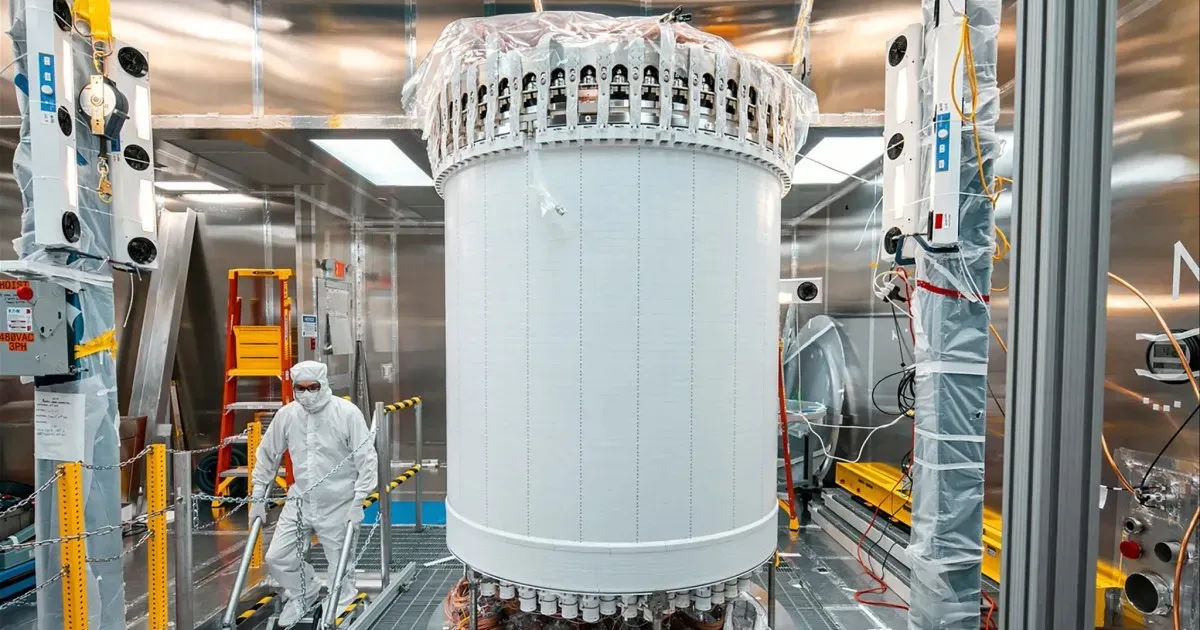
The LUX-ZEPLIN (LZ) experiment, a colossal underground tank filled with ultra-pure liquid xenon and surrounded by light sensors, was designed to catch a glimpse of a particular type of hypothetical dark matter particle: a WIMP (Weakly Interacting Massive Particle). The theory? If a WIMP smacks into a xenon atom's nucleus, it should create two specific flashes of light. Like a cosmic doorbell ringing.
And on June 16, 2023, after 220 days of data collection, the doorbell rang. Once. Just one event. But according to Sam Eriksen, the study's lead, the detectors are so well-understood that even a single unusual event is a big deal.
Physicist Theresa Fruth told ABC News that this solitary signal is so robust, it's been re-tested "many, many times and it still holds up." She added, with a hint of exasperated awe, "This event just won't go away even after many, many checks."
So, while Rick Gaitskell, the LZ spokesperson, is understandably cautious – "We are not claiming to have seen dark matter," he stressed – the scientific community is buzzing. This single, stubborn particle interaction might just be the universe winking back. Or, you know, the first real evidence of a particle that current physics can't quite explain. Which, if you think about it, is both impressive and slightly terrifying.