
A new method allows scientists to study molecules on a surface with extreme precision. This technique helps molecules keep their quantum properties, reaching a fundamental limit for coherence. This breakthrough could lead to new ways to study how molecules interact with surfaces and advance quantum technologies.
Achieving Quantum Coherence on a Surface
Normally, molecules on a surface are hard to study because dirt and other particles create a noisy environment. This noise quickly ruins the molecules' delicate quantum properties. Scientists at the Max Planck Institute for the Science of Light (MPL) found a way around this problem.
Their new method lets them examine molecules on a surface with great accuracy. It consistently helps the molecules maintain their quantum coherence at the ultimate Fourier limit. This level of stability was not possible on a surface before.
We're a new kind of news feed.
Regular news is designed to drain you. We're a non-profit built to restore you. Every story we publish is scored for impact, progress, and hope.
Start Your News DetoxMany quantum technologies rely on tiny objects like atoms and molecules that react strongly to light. These "quantum emitters" can create single particles of light, store quantum information, and share entanglement. These abilities are key for quantum communication and computing.
To study these emitters, they usually need to be held still for a long time. This is often done by trapping them in a vacuum or embedding them inside a solid material.
Surfaces offer another option because individual atoms or molecules could be directly controlled with a sharp tip, like those used in scanning tunneling microscopy (STM) and atomic force microscopy (AFM). However, keeping the quantum properties of surface-bound emitters intact has been challenging due to surface contamination.
A New Cleaning Method
Professor Vahid Sandoghdar's team at MPL solved the contamination issue by using a special property of an organic crystal: it slowly evaporates at room temperature.
The researchers placed a small crystal in a vacuum inside a cryostat. As the top layers of the crystal naturally evaporated, they took surface contaminants with them. Then, the crystal was cooled to just a few degrees above absolute zero, stopping further evaporation. At these very low temperatures, the scientists used a tiny oven to deposit molecules onto the freshly cleaned surface.
This process created an incredibly stable environment for the quantum emitters.
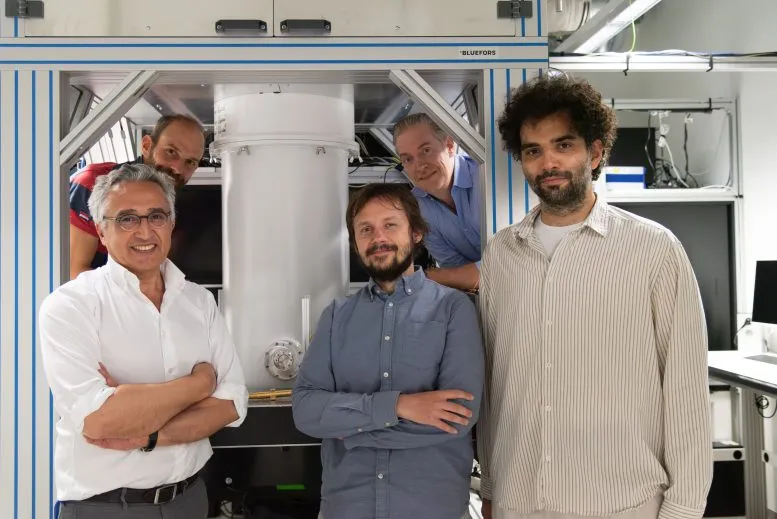
Dr. Alexey Shkarin, a researcher at MPL, explained that the quality of quantum emitters is measured by their "coherence times." This indicates how long they can maintain their quantum state.
Coherence time cannot go beyond the Fourier limit, which is set by how long an emitter takes to transfer its energy to its surroundings. In a noisy environment, this coherence can be hundreds or thousands of times shorter. By placing molecules on a clean crystal surface with the right structure, the researchers found that the molecules consistently reached this Fourier limit.
This marks the first time this fundamental limit has been achieved on a surface. It shows that the molecules were in an extremely quiet and stable environment.
Impact on Molecular Behavior
The experiments also revealed that the surface does more than just hold the molecules. It caused the adsorbed molecules to align in a specific way and changed their energy levels. It might also alter their shape or how they vibrate.
Vahid Sandoghdar noted that future work will combine this method with AFM and STM. This will allow for precise control over individual quantum emitters at the nanometer scale.
Combining the clean surface technique with these microscopy tools could help researchers study individual quantum emitters with tiny control. This could offer deeper insights into surface properties and new ways to engineer the quantum states of matter.
Deep Dive & References
Nano–electron volt Fourier-limited transition of a single surface-adsorbed molecule - Science, 2026